

Key Takeaways
No equipment or gym membership required
Bodyweight training removes the cost and logistical barriers that prevent many people from exercising consistently. The floor of any room is enough to get started.
Builds real functional strength and coordination
Multi-joint bodyweight movements like squats, push-ups, and lunges train muscles to work together - improving the kind of strength that supports everyday activities and reduces injury risk.
Highly adaptable to all fitness levels
Most bodyweight exercises have beginner and advanced variations, making them scalable whether you're exercising for the first time or maintaining a high fitness level.
Supports mobility and joint health
Bodyweight movement patterns build range of motion, stability, and body awareness in ways that machine-based gym training often doesn't, which is why physical therapists frequently use them in rehabilitation.
Easy to stay consistent with
Removing commute time and scheduling friction makes it far easier to exercise regularly - and consistency is one of the strongest predictors of long-term fitness outcomes.
Progressive overload becomes harder over time
Without external load, increasing training stimulus eventually requires complex skill progressions rather than simply adding weight - which can limit long-term strength and muscle development.
Significant muscle hypertrophy has a ceiling
Building substantial muscle mass typically requires progressive loading that bodyweight alone struggles to provide beyond an intermediate level of fitness.
Pulling movements require something to pull against
Exercises like rows and pull-ups are essential for balanced upper-body development but need a bar or anchor point that many home setups don't include by default.
Posterior chain can be systematically undertrained
Hamstrings, glutes, and upper back muscles are harder to load effectively through floor-based bodyweight exercises alone, potentially creating muscular imbalances over time.
Lacks structured programming cues for beginners
Without a coach or trainer present, beginners may develop poor movement patterns that go uncorrected, increasing injury risk - a consideration less present in supervised gym environments.
Our Verdict
Bodyweight training at home is genuinely effective for building foundational fitness, improving mobility, and maintaining consistency - and for many people, it's more than enough. However, it has real ceilings, particularly for building significant muscle mass, developing maximal strength, or training certain muscle groups thoroughly. Used strategically, it fits most everyday fitness goals well.
Ideal for beginners, people returning to exercise after a break, those with busy schedules, or anyone looking for a low-barrier way to stay consistently active.
What Bodyweight Training Actually Delivers
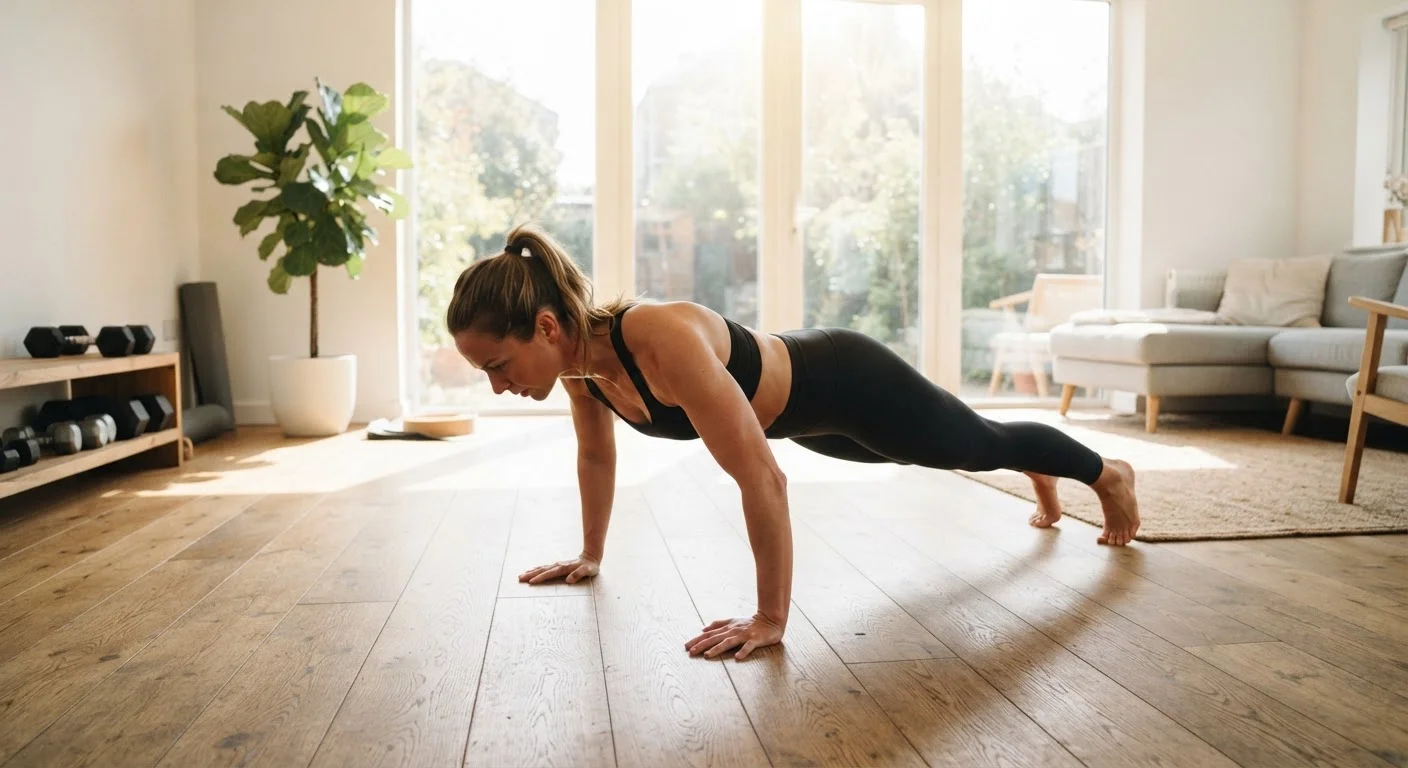
Done consistently and with intention, bodyweight exercise can accomplish a great deal. Push-ups, squats, lunges, planks, and their progressions engage multiple muscle groups simultaneously, improve neuromuscular coordination, and build real, functional strength - the kind that translates to everyday movement.
For cardiovascular conditioning, bodyweight circuits and high-intensity interval formats can raise heart rate meaningfully and improve aerobic capacity. Research consistently supports that even moderate increases in physical activity - regardless of equipment - reduce risk factors associated with cardiovascular disease, type 2 diabetes, and all-cause mortality.
Mobility and joint health are perhaps where bodyweight training shines most clearly. Movement patterns like deep squats, hip hinges, and controlled single-leg work build stability and range of motion in ways that seated gym machines simply don't replicate. For that reason, many physical therapists and coaches integrate bodyweight work throughout rehabilitation and athletic programming.
No equipment or gym membership required
Bodyweight training removes the cost and logistical barriers that prevent many people from exercising consistently. The floor of any room is enough to get started.
Builds real functional strength and coordination
Multi-joint bodyweight movements like squats, push-ups, and lunges train muscles to work together - improving the kind of strength that supports everyday activities and reduces injury risk.
Highly adaptable to all fitness levels
Most bodyweight exercises have beginner and advanced variations, making them scalable whether you're exercising for the first time or maintaining a high fitness level.
Supports mobility and joint health
Bodyweight movement patterns build range of motion, stability, and body awareness in ways that machine-based gym training often doesn't, which is why physical therapists frequently use them in rehabilitation.
Easy to stay consistent with
Removing commute time and scheduling friction makes it far easier to exercise regularly - and consistency is one of the strongest predictors of long-term fitness outcomes.
See also: everyday activities that count as exercise - because movement doesn't have to be formal to be valuable.
Where Bodyweight Training Falls Short
The most significant limitation is progressive overload. Muscle and strength development depends on gradually increasing the demand placed on the body over time. With external weights, that progression is straightforward - add load. With bodyweight alone, options narrow considerably once foundational movements become easy.
Advanced variations (archer push-ups, pistol squats, handstand progressions) extend the challenge, but they also require significant skill, coordination, and sometimes mobility prerequisites that not all exercisers can safely or realistically develop. For those with goals around significant muscle hypertrophy or maximal strength, bodyweight training will eventually hit a ceiling.
Certain muscle groups are also harder to isolate or load adequately. The posterior chain - hamstrings, glutes, and upper back - can be undertrained in typical bodyweight routines unless specific movements are deliberately programmed. Pulling exercises like rows and pull-ups require something to pull against, which not every home setup provides.
Progressive overload becomes harder over time
Without external load, increasing training stimulus eventually requires complex skill progressions rather than simply adding weight - which can limit long-term strength and muscle development.
Significant muscle hypertrophy has a ceiling
Building substantial muscle mass typically requires progressive loading that bodyweight alone struggles to provide beyond an intermediate level of fitness.
Pulling movements require something to pull against
Exercises like rows and pull-ups are essential for balanced upper-body development but need a bar or anchor point that many home setups don't include by default.
Posterior chain can be systematically undertrained
Hamstrings, glutes, and upper back muscles are harder to load effectively through floor-based bodyweight exercises alone, potentially creating muscular imbalances over time.
Lacks structured programming cues for beginners
Without a coach or trainer present, beginners may develop poor movement patterns that go uncorrected, increasing injury risk - a consideration less present in supervised gym environments.
Understanding these limits isn't discouraging - it's useful. Fitness plateaus happen to nearly everyone, and recognizing when your training needs to evolve is the first step to moving past them.
Filling the Gaps Without a Full Gym
The good news is that closing most of bodyweight training's gaps doesn't require an expensive gym membership. A few low-cost additions can substantially expand what's possible at home:
- Resistance bands add variable load to squats, rows, presses, and hip work at minimal cost and storage footprint.
- A pull-up bar (doorframe-mounted) restores the pulling dimension that pure bodyweight floor work lacks.
- Adjustable dumbbells or a single kettlebell provide enough load variation to extend progressive overload significantly.
Even without any equipment additions, intelligent programming matters enormously. Slowing the tempo of each repetition, reducing rest periods, and combining movements into supersets can meaningfully increase difficulty and training stimulus from the same exercises.
When to Consider Supervised Training
If you're returning from an injury, managing a chronic condition, or have specific performance goals, working with a qualified fitness professional - even temporarily - can make your home program significantly safer and more effective. A single assessment session can reveal movement issues that are hard to self-detect. This is particularly relevant for older adults or those with joint concerns.
For a broader view of how bodyweight and weighted training compare in what they actually do for your body, see our overview of strength training vs. cardio. And be aware of persistent fitness myths that can distort expectations around home training.
This article provides general health and fitness information for educational purposes only and is not a substitute for advice from a qualified healthcare or fitness professional. Consult a professional before beginning any new exercise program, especially if you have an existing health condition or injury.