

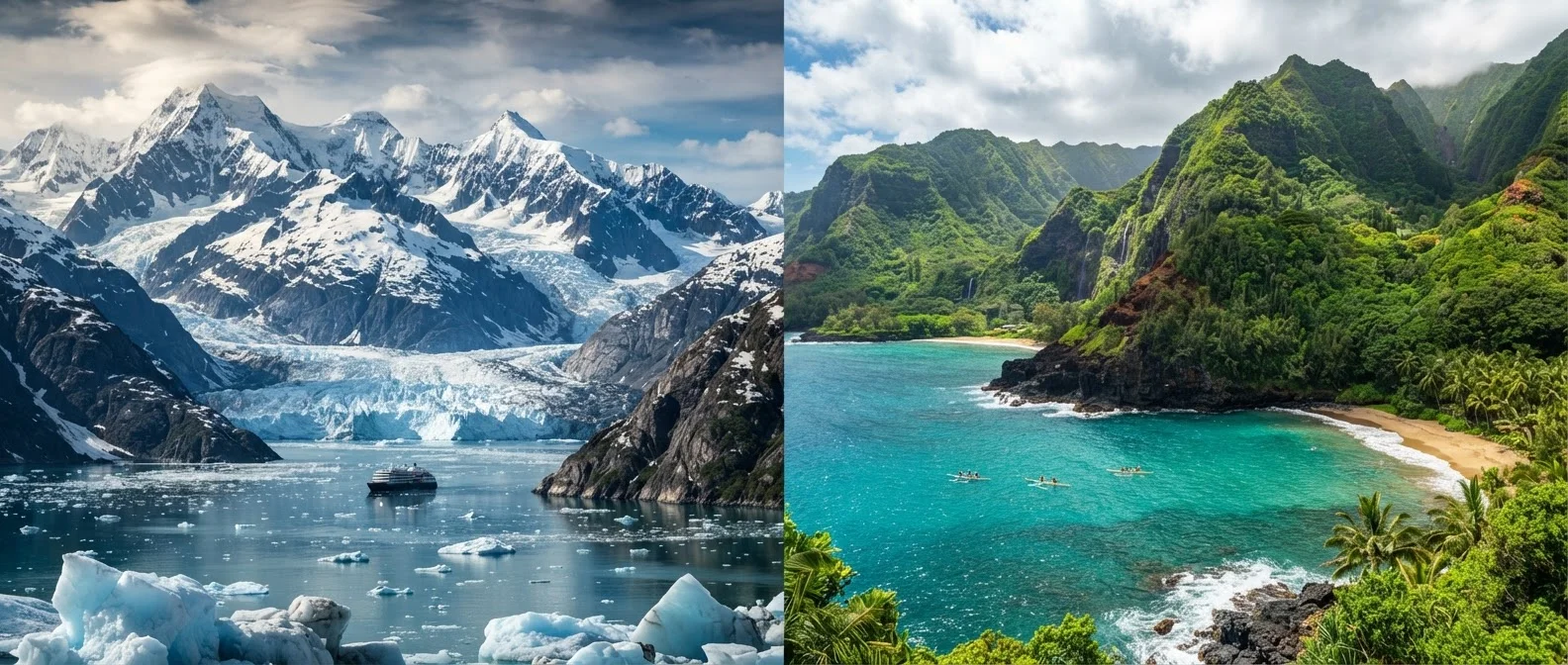
Key Takeaways
Option A
Alaska
The rugged, untamed wilderness frontier.
Best for: Travelers craving remote landscapes, wildlife encounters, and outdoor adventure in a raw, less-crowded setting.
Option B
Hawaii
The tropical, accessible paradise.
Best for: Travelers seeking warm beaches, vibrant culture, diverse activities, and a relatively straightforward trip from the mainland US.
If you want warm weather and a relaxing beach vacation
Hawaii
Hawaii's tropical climate, calm bays, and resort infrastructure make it ideal for travelers who want to unwind without roughing it.
If wildlife and remote wilderness are your top priorities
Alaska
Nowhere else in the US offers grizzly bears, bald eagles, humpback whales, and glaciers in one relatively accessible setting.
If you're traveling with young children or seniors
Hawaii
Hawaii's well-developed tourism infrastructure, accessible beaches, and predictable weather make family logistics far more manageable.
If you're an outdoor enthusiast planning an epic summer trip
Alaska
Alaska's summer months offer extreme daylight, world-class hiking, kayaking, and fishing that genuinely can't be replicated elsewhere.
If you want to visit multiple distinct environments in one trip
Hawaii
Different Hawaiian islands offer dramatically different landscapes - lush rainforests, volcanic fields, arid coastlines - all within one archipelago.
The Core Difference: What Each Destination Actually Offers
Alaska and Hawaii share one obvious trait: they're both non-contiguous US states requiring a flight from the continental 48. Beyond that, they're practically opposites. Alaska is the largest state in the union - over twice the size of Texas - and most of it is untouched wilderness. Hawaii is a compact tropical archipelago defined by beaches, volcanoes, and a rich Pacific Islander and Asian-influenced culture.
Alaska's appeal is primal. Think glacier-carved fjords, active volcanoes, the Northern Lights (visible in fall and winter), and wildlife in astonishing abundance. Hawaii's appeal is sensory and cultural - warm Pacific waters, world-famous surf breaks, luau traditions, and landscapes that shift from black-sand beaches to misty rainforest within a short drive.
Neither destination is objectively "better." They simply answer different questions about what kind of traveler you are. If you want to feel small against a landscape that feels ancient and barely touched, Alaska is calling. If you want to feel enveloped in warmth, color, and culture, Hawaii answers that call instead. For another angle on this tension, see our guide to coastal vs. mountain vacations.
Logistics, Climate, and Getting Around
Getting to Hawaii is generally more straightforward. Major airlines run direct flights from most large US cities, and fares are frequently competitive, particularly to Honolulu or Maui. Once there, rental cars and public transit on some islands make navigation manageable.
Alaska is logistically trickier. Most visitors fly into Anchorage or Fairbanks, but reaching remote areas often means small bush planes, ferries along the Alaska Marine Highway, or cruise ships. Driving the Alaska Highway from the Lower 48 is possible but takes days. Within the state, distances are enormous - Denali National Park is roughly 240 miles north of Anchorage.
| Criterion | Alaska | Hawaii |
|---|---|---|
| Best travel season | June-August (summer) | Year-round |
| Typical climate | Cool to cold; highly variable | Warm tropical; 75-85°F |
| Flight options from continental US | Moderate; mainly Anchorage | Extensive; multiple islands |
| Getting around | Car, bush plane, ferry | Rental car, some transit |
| Crowd levels | Generally lower outside cruise ports | Higher; popular year-round |
| Primary draw | Wildlife, glaciers, wilderness | Beaches, culture, volcanoes |
| Budget flexibility | Limited; often higher spend | Wider range of budgets |
| Family-friendliness | Moderate; requires planning | High; well-suited for families |
Climate is perhaps the starkest contrast. Hawaii enjoys temperatures in the mid-70s to mid-80s Fahrenheit year-round on most islands, with a dry and wet side to each island depending on trade winds. Alaska is overwhelmingly seasonal. Summer (June-August) brings long daylight hours and mild temperatures - often 60s to 70s°F in Anchorage - but winters are harsh, dark, and only suitable for cold-weather enthusiasts or Northern Lights chasers.
Activities, Budget, and Who Each Destination Suits
In Hawaii, activities run the full spectrum: snorkeling with sea turtles, hiking into Haleakalā crater, attending a traditional Hawaiian luau, road-tripping the Road to Hana, or simply reading on a beach. The islands have well-developed tourism ecosystems with options from budget hostels to ultra-luxury resorts. Food costs can be high given island supply chains, but mid-range dining is accessible.
Alaska's activity list leans heavily toward nature and adventure - bear viewing at Katmai, kayaking among icebergs in Kenai Fjords, fly-fishing remote rivers, or riding the Alaska Railroad through boreal forest. Many of these experiences come with meaningful price tags. Guided tours are often necessary for safety and access, and remote lodges can be expensive. That said, Anchorage itself is a functional, affordable city, and budget-conscious travelers can still access Denali, the Kenai Peninsula, and coastal areas without extravagant spending.
If your trip involves multiple national parks, it's worth reading our breakdown of the America the Beautiful Pass before you go - Alaska alone has eight national park units.
8
National park units in Alaska
Alaska contains more national park land than any other state, including Wrangell-St. Elias, the largest national park in the US.
6
Main Hawaiian islands open to visitors
Oahu, Maui, Kauai, the Big Island, Molokai, and Lanai each offer distinct landscapes and experiences within the Hawaiian archipelago.
~20 hrs
Summer daylight in Fairbanks, Alaska
Near the summer solstice, Fairbanks can experience nearly 22 hours of daylight, dramatically extending outdoor activity windows.
Ultimately, the right choice comes down to what energizes you as a traveler. Hawaii rewards those who want ease alongside beauty. Alaska rewards those willing to do a little more work to reach something genuinely extraordinary.