

Key Takeaways
Option A
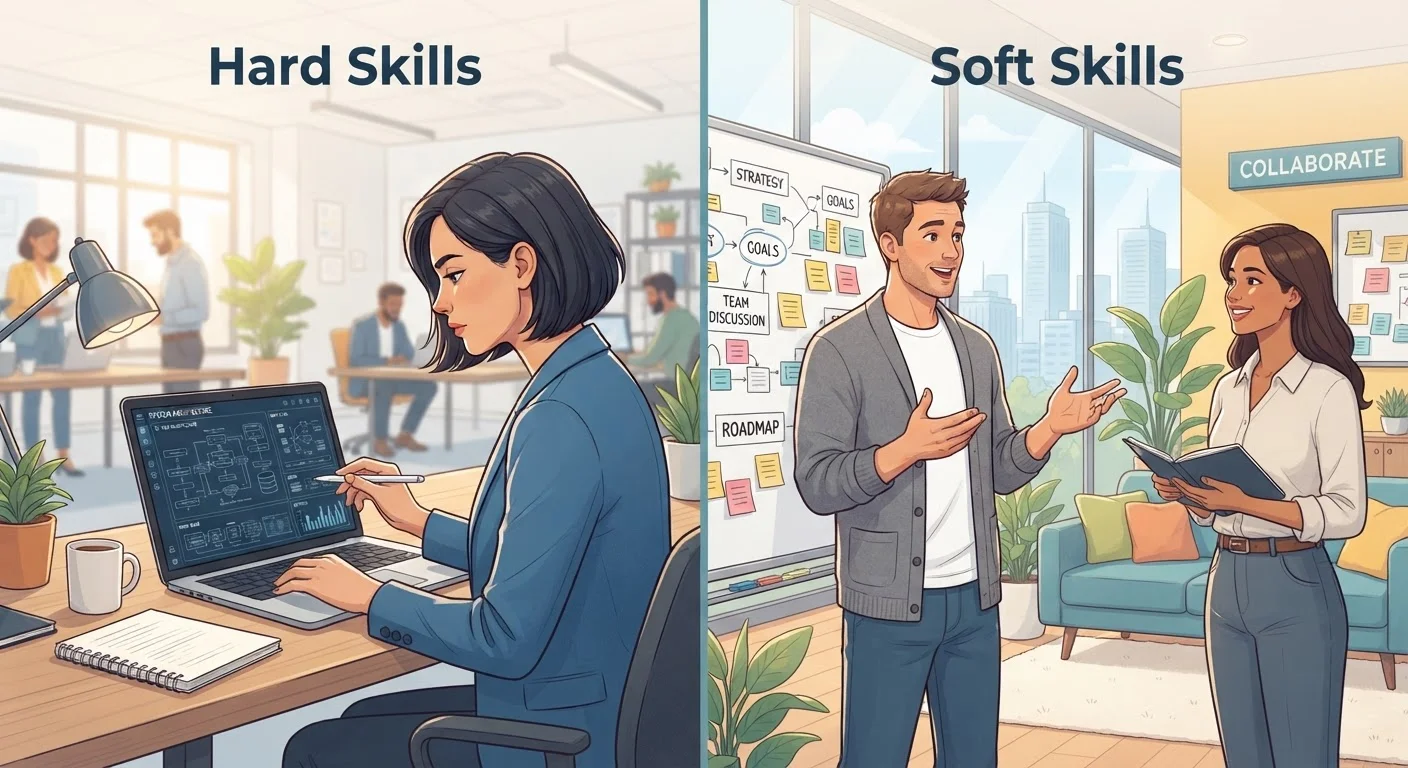
Hard Skills
The measurable, teachable competencies tied to specific tasks.
Best for: Demonstrating role-specific expertise that can be tested, certified, or verified by employers.
Option B
Soft Skills
The interpersonal and behavioral abilities that shape how you work.
Best for: Building effective relationships, adapting to change, and leading teams across any professional context.
If you're entering a technical or specialized field
Hard Skills
Employers in fields like engineering, healthcare, and finance require verifiable, role-specific competencies as a baseline. Building hard skills first establishes your professional credibility.
If you're aiming for leadership or management roles
Soft Skills
Moving into leadership depends heavily on communication, emotional intelligence, and the ability to motivate others - capabilities that technical knowledge alone cannot provide.
If you're changing careers or industries
Soft Skills
Transferable interpersonal skills travel well across industries and can compensate for gaps in domain-specific knowledge during a career transition.
If you want to stand out among equally qualified candidates
Soft Skills
When candidates share similar technical qualifications, soft skills like collaboration, problem-solving, and professional communication often become the deciding factor for hiring managers.
If you're building a long-term professional development plan
Hard Skills
Continuously updating technical competencies ensures you remain relevant as tools, technologies, and industry standards evolve - providing a durable foundation for career growth.
Defining the Two Categories
Hard skills refer to specific, teachable abilities that can be defined, measured, and demonstrated. They're typically acquired through formal education, certification programs, or structured training. Examples include programming in Python, financial modeling, operating medical imaging equipment, or writing in a second language. Because they're concrete, employers can test for them directly - through skills assessments, portfolios, or credential verification.
Soft skills, by contrast, describe the behavioral and interpersonal qualities that govern how someone works rather than what they can do. Active listening, conflict resolution, time management, and adaptability all fall into this category. They're shaped by personality, life experience, and deliberate practice - and while they're harder to measure, they're far from invisible. Hiring managers observe soft skills during interviews, reference checks, and workplace interactions.
See our guide to transferable skills for a closer look at which competencies carry across different industries and job functions.
How They Compare Head to Head
Looking at these two skill types side by side clarifies not just what makes them different, but how they relate and reinforce each other in a professional context.
| Criterion | Hard Skills | Soft Skills |
|---|---|---|
| Definition | Specific, teachable technical competencies | Interpersonal and behavioral traits |
| Measurability | Easily tested and verified | Observed through behavior and feedback |
| How acquired | Courses, certifications, structured training | Experience, reflection, coaching, practice |
| Shelf life | Can become outdated as technology evolves | Compounds and remains relevant over time |
| Examples | Data analysis, coding, accounting | Communication, adaptability, leadership |
| Resume visibility | Listed directly as credentials or tools | Demonstrated through examples and references |
| Role in hiring | Establishes baseline qualification | Often differentiates among qualified candidates |
One important distinction: hard skills tend to have a shelf life. A software tool that was industry-standard five years ago may be obsolete today. Soft skills, meanwhile, tend to compound over time - a professional who has built strong conflict resolution skills doesn't lose them when a new technology emerges.
Why Employers Expect Both - and When Each Matters More
It's tempting to treat this as an either/or question, but most job roles demand a blend. A financial analyst who can build complex models but struggles to explain findings to non-finance stakeholders will hit a ceiling. A project manager with exceptional communication skills but no understanding of the tools their team uses will lose credibility quickly.
That said, the balance does shift depending on career stage and role type. Early in a career, hard skills often carry more weight - they signal that you can perform the core functions of a job. As professionals move into senior or cross-functional roles, soft skills tend to become the primary differentiator. Research from educational and workforce development organizations consistently shows that employers rate communication, critical thinking, and collaboration among their most sought-after qualities in candidates - often above specific technical credentials.
The professional skills required at each career stage shift considerably from entry-level to executive roles, making it valuable to understand what's expected at your current level and what you'll need next.
Building Both Types Deliberately
Hard skills are generally more straightforward to develop through deliberate effort: enroll in a course, earn a certification, work through a structured curriculum, or take on projects that require you to practice a specific technical competency. Online learning platforms, community colleges, and employer-sponsored training programs are all viable pathways. For a detailed comparison of formal and informal learning approaches, see online learning vs. on-the-job training.
Soft skills require a different kind of intentionality. Because they emerge through human interaction, they're best developed in real-world contexts - volunteer leadership roles, collaborative projects, mentoring relationships, or structured feedback loops. Professional coaching can also accelerate growth in areas like executive presence or emotional regulation. If you're evaluating support options, the differences between therapy, coaching, and self-help are worth understanding before committing to a path.
A practical starting point for either skill type: conduct an honest self-assessment. Identify the gap between where your skills are and where your target role requires them to be. From there, build a phased development plan. The career skills development roadmap offers a structured framework for doing exactly that.
It's also worth considering the skills that often go underdeveloped - not because they're unimportant, but because they're easy to overlook. Our guide on undervalued professional skills that carry real weight highlights several worth adding to your development list.