

Key Takeaways
Our Verdict
Cornell Notes, mind maps, and outline notes each have genuine strengths rooted in cognitive science. The most effective choice depends on the nature of the content, your learning preferences, and how you plan to review. Rather than defaulting to one format, consider using different methods strategically across subjects.
| Best for | Recommended |
|---|---|
| Lecture-heavy courses requiring active review | Cornell Notes |
| Visual or conceptual subjects with many connections | Mind Maps |
| Structured reading or step-by-step processes | Outline Notes |
| Learners who want a flexible, hybrid approach | Mix formats by subject or study phase |
Why Format Matters in Note-Taking
Not all notes are created equal. Research in cognitive psychology consistently shows that how you organize information during encoding - the initial capture of new material - affects how reliably you can retrieve it later. The structure of your notes shapes what your brain prioritizes, which connections it forms, and how easily you can review.
Understanding how working memory and long-term storage interact helps explain why format matters: when notes are organized in ways that match the material's underlying structure, the cognitive load of review drops and retention improves.
The three formats compared here - Cornell Notes, mind maps, and outline notes - represent fundamentally different approaches to organizing thought on paper (or screen). Each has strengths and tradeoffs depending on the subject, the source, and your personal processing style.
Cornell Notes: Built for Active Recall
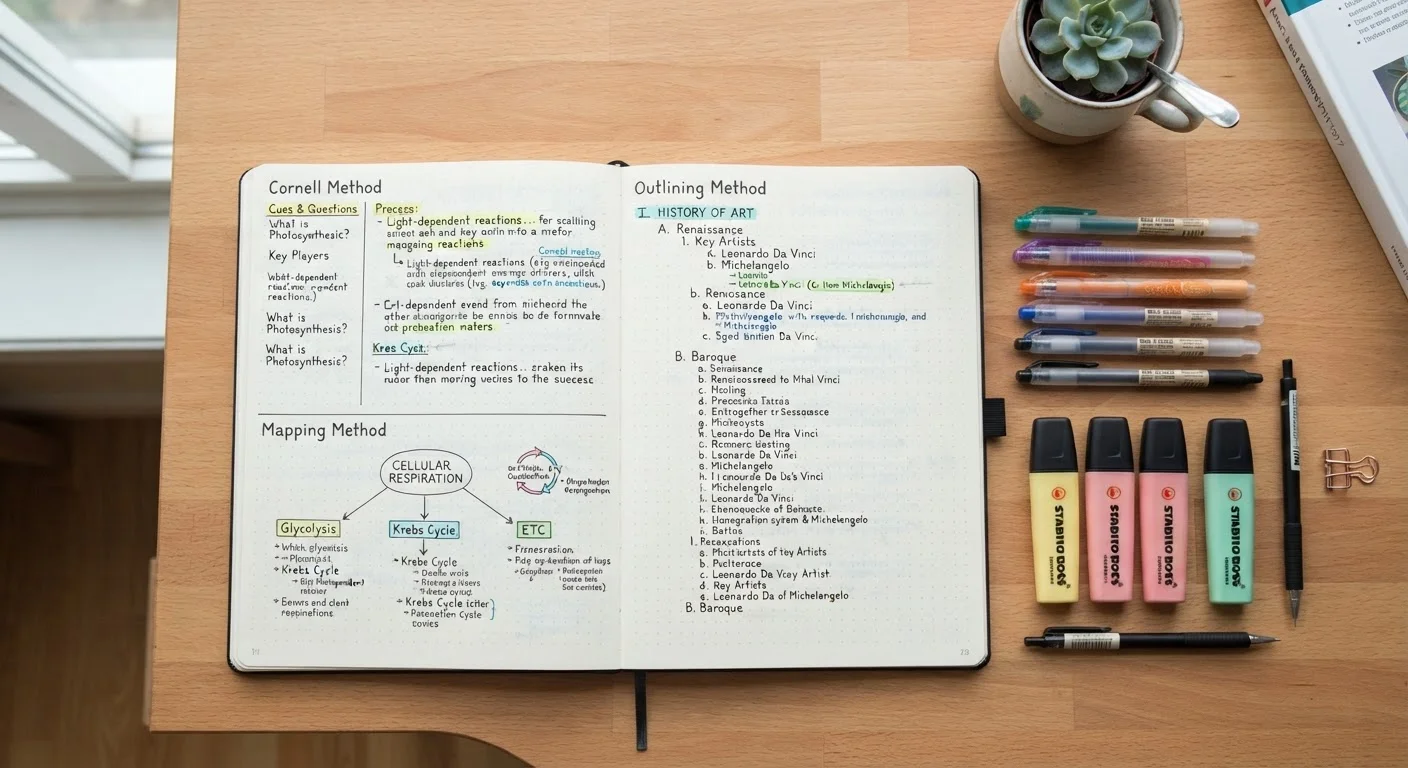
Developed at Cornell University in the 1950s, the Cornell method divides each page into three zones: a narrow left column for cue questions or keywords, a wider right column for main notes, and a summary section at the bottom. After a lecture or reading session, learners cover the right column and use the cues to quiz themselves.
This structure directly supports retrieval practice - one of the most well-documented learning strategies in educational research. By turning your notes into a self-testing tool, the Cornell method encourages you to actively reconstruct knowledge rather than passively re-read it.
Best suited for: fast-paced lectures, sequential content, science and history courses, and any material delivered in a linear format.
Limitations: The structured layout can feel rigid for creative or heavily conceptual subjects. It also requires a degree of discipline during note-taking that may slow newer students down initially. For deeper strategies on weaving this into your full study routine, see how to structure a study session for maximum retention.
| Cornell Notes | Mind Maps | Outline Notes | |
|---|---|---|---|
| Best content type | Linear, lecture-based | Conceptual, interconnected | Structured, hierarchical |
| Supports active recall | Yes - built-in cue system | Moderate - visual review | Low unless adapted |
| Visual organization | Low | High | Moderate |
| Speed during class | Moderate | Fast for big ideas | Fast for structured content |
| Ease of review | High | Moderate | Moderate |
| Works for visual learners | Less suited | Strongly suited | Moderately suited |
| Learning curve | Moderate | Low | Low |
Mind Maps: Visualizing Connections
A mind map starts with a central concept and branches outward into related ideas, sub-topics, and details. The radial, non-linear layout reflects how associative memory actually works - ideas connect to other ideas rather than sitting in fixed hierarchies.
Mind maps are particularly effective for:
- Brainstorming and early-stage planning
- Subjects with overlapping themes (psychology, literature, biology)
- Learners who think visually or struggle to stay engaged with linear formats
- Synthesizing information from multiple sources before writing an essay or report
Limitations: Mind maps can become cluttered and hard to review if a topic is highly detailed. They are generally less effective for capturing precise definitions, formulas, or chronological sequences. Digital tools can help with organization, but they introduce the distraction risks of screen-based study.
Outline Notes: Structure as a Study Tool
The outline method uses indented hierarchies - main headings, sub-points, and supporting details - to mirror the logical structure of content. It is the format most students default to, and for good reason: it maps naturally onto textbooks, slide decks, and spoken explanations that follow a clear main-point-then-detail pattern.
Outline notes work well when:
- The source material already has a clear structure (textbook chapters, formatted lectures)
- You need to capture cause-and-effect or step-by-step processes
- The subject requires distinguishing major concepts from supporting evidence
Limitations: Outlines can encourage passive transcription rather than active engagement, especially when learners feel pressure to capture everything. If used without pausing to paraphrase or summarize, they risk becoming a verbatim copy of the source. For guidance on avoiding this trap, proven principles for capturing information during lectures and reading offers practical techniques.
Choosing and Combining Formats Strategically
The research is clear: matching the format to the content type produces better outcomes than loyally sticking to one system. Consider this approach:
- Use Cornell Notes in live lectures and seminars where content flows quickly and active review matters.
- Use mind maps when reading across multiple sources, preparing for essays, or trying to see the big picture of a complex topic.
- Use outline notes when working through a structured textbook chapter or organizing a defined process.
Some learners find it useful to take outline or Cornell notes first, then translate key ideas into a mind map during review - a process that itself strengthens memory consolidation by requiring re-encoding. This kind of deliberate, multi-phase strategy connects closely to the framework covered in a complete framework for strategic studying.
Finally, format preference is personal. Experimenting across subjects for a few weeks - and honestly evaluating how well you can retrieve the material afterward - is the most reliable way to find what works for you.