

Key Takeaways
Savings Rate
Your savings rate is the percentage of your income that you set aside rather than spend. It is calculated by dividing the amount you save each period by your gross or take-home income. A higher savings rate means more money is being put to work for your future, regardless of what the market is doing.
Savings rate can be calculated on gross income (before taxes) or net income (after taxes); financial planners often use the net figure for practical budgeting purposes.
The Math Behind Why Savings Rate Dominates Early On
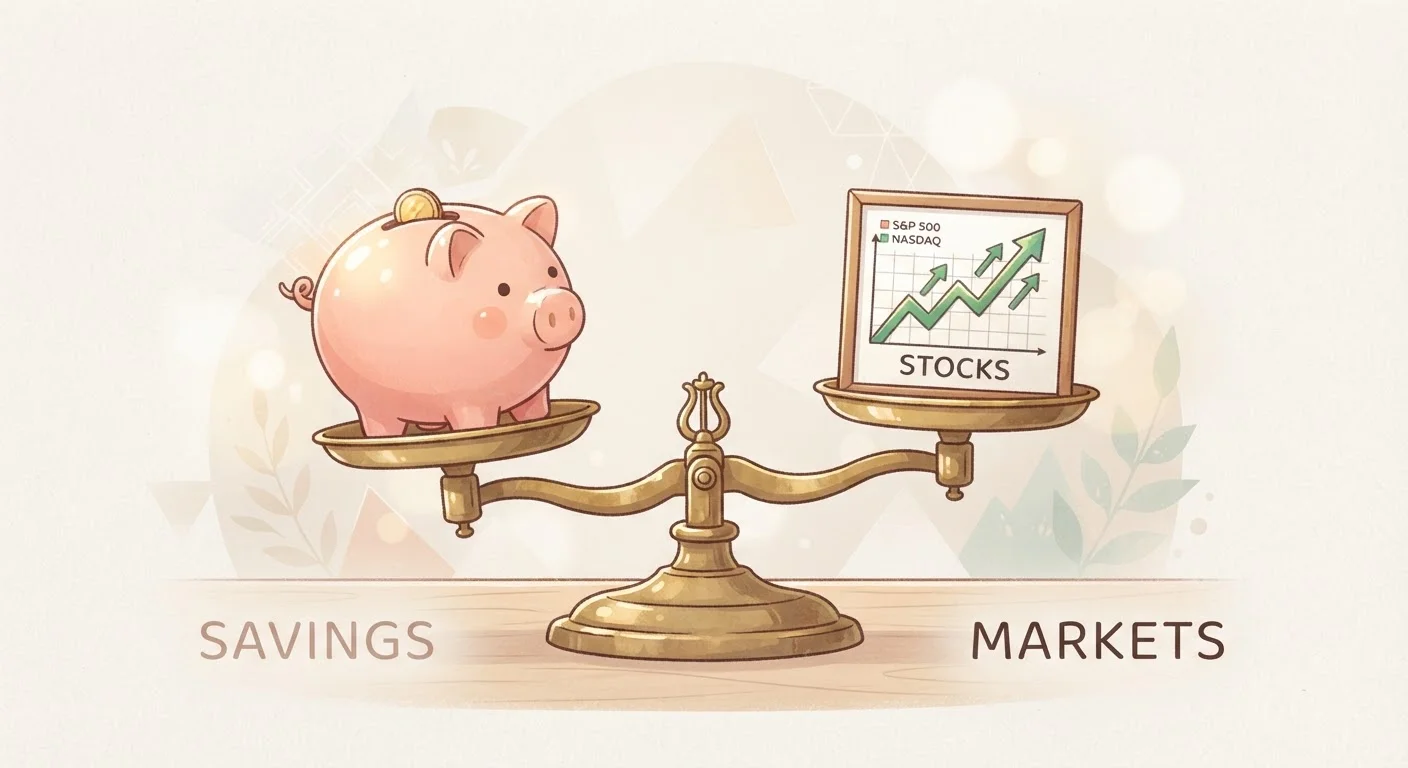
When you are just starting to build wealth, the amount you invest is far smaller than it will be later in life. This simple fact changes the math dramatically. Suppose you have $10,000 invested and earn a strong 10% return in a year - that adds $1,000 to your balance. Now suppose you earn only a 6% return instead - you get $600. The difference is $400.
But if you save an additional $300 per month, you add $3,600 to your portfolio over that same year - dwarfing the impact of a 4-percentage-point swing in returns. This is the core insight: when the portfolio is small, what you contribute matters far more than what the market does with it.
This is not a reason to ignore investment strategy - costs and asset allocation still matter, as explored in this guide to hidden investment costs. But in the early stages, effort spent increasing your savings rate typically yields a bigger payoff than chasing higher returns.
How Your Savings Rate Compounds Over Time
Compound growth rewards contributions made early. Every dollar you save today gets more time in the market, earning returns on returns. A higher savings rate accelerates this process by putting more dollars to work sooner. If you want to understand how this mechanism works in plain terms, compound interest explained without the math jargon is a good starting point.
Think of it this way: two people both earn 7% annually on their investments. One saves 10% of income; the other saves 20%. Over a decade, the second person does not just end up with twice as much - the compounding effect on those extra contributions means the gap widens each year. The savings rate is the fuel; compounding is the engine.
15-20%
Commonly recommended savings rate of income
Many retirement planning frameworks, including guidance from financial planning organizations, suggest saving 15-20% of income to stay on track for a financially secure retirement.
~50%
Americans saving less than recommended
Federal Reserve surveys have consistently found that a significant share of U.S. adults are not saving at rates aligned with long-term financial security goals.
1%
Contribution increase that can add years of income
Research from Vanguard and similar institutions suggests that even a 1-percentage-point increase in retirement savings rate, sustained over a career, can meaningfully extend how long a portfolio lasts in retirement.
This is also why financial educators emphasize starting early. A modest savings rate begun in your twenties often outperforms a higher rate started in your forties, even if the late starter earns better returns. Time is the multiplier that cannot be bought back.
When Returns Start to Take Center Stage
The balance of power eventually shifts. As your portfolio grows - say, into the hundreds of thousands of dollars - annual market returns begin generating gains that rival or exceed what you can realistically save from your paycheck. A 7% return on $300,000 is $21,000; at that point, even a meaningful jump in your savings rate may not move the needle as dramatically.
This transition is one of the most encouraging milestones in wealth-building. It means your money is working hard enough that your portfolio can grow even during periods when life gets expensive and saving is harder. Getting to that inflection point, however, requires prioritizing savings in the years before it arrives.
Understanding common missteps that slow this journey - like skipping employer retirement matches - is covered in wealth-building habits that tend to derail before they start. If you are still in the early stages of setting up savings and investment accounts, this foundational guide walks through every step.
Practical Steps to Raise Your Savings Rate
Raising your savings rate does not require a dramatic lifestyle overhaul. Small, consistent adjustments tend to be more durable than sudden large changes.
- Automate your savings. Set up automatic transfers to a savings or retirement account on payday, before discretionary spending gets a chance to absorb the money.
- Capture windfalls. Tax refunds, bonuses, and raises are opportunities to increase your savings rate without reducing your current standard of living.
- Incrementally increase contributions. Raising your retirement contribution by 1% every year - or every time you receive a raise - is nearly painless and compounds meaningfully over a decade.
- Build your emergency fund first. Stable savings behavior depends on having a financial cushion so that unexpected expenses do not force you to raid investment accounts. Understanding emergency fund guidelines is a logical next step.
Automate to Make Saving Effortless
Set up automatic transfers to your savings or retirement account the day your paycheck arrives. When savings happen before you see the money in your checking account, you adjust your spending to what remains - rather than saving whatever is left over at month's end. This one habit is widely credited with dramatically improving real-world savings rates.
This article provides general financial education and is not personalized financial advice. Consider consulting a licensed financial adviser for guidance tailored to your situation.