

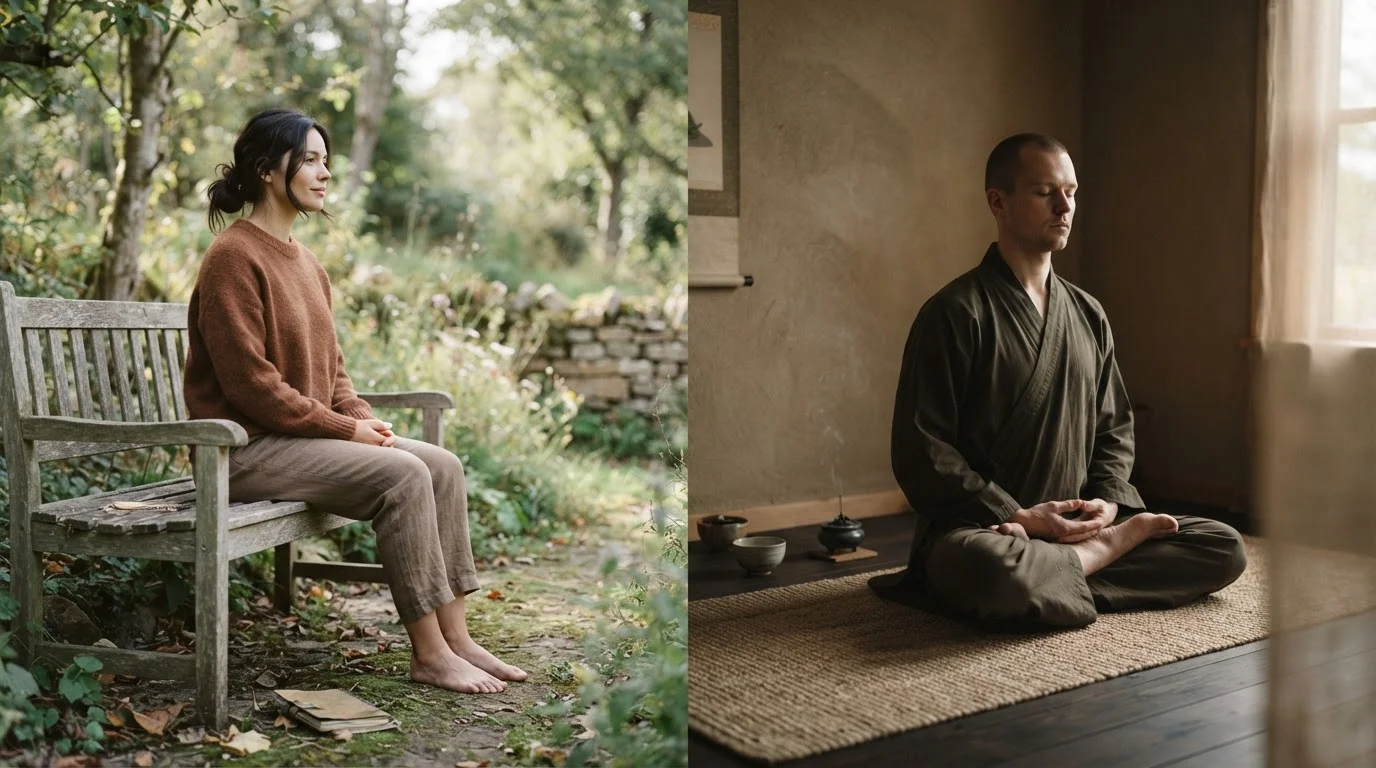
Key Takeaways
Option A
Mindfulness
An ongoing quality of awareness you can bring to any moment.
Best for: People who want to build present-moment awareness throughout daily activities without setting aside dedicated practice time.
Option B
Meditation
A structured, intentional practice with a defined beginning and end.
Best for: People seeking a formal, consistent mental training routine to cultivate focus, calm, or self-awareness over time.
If you want to reduce everyday stress without a formal routine
Mindfulness
Mindfulness can be integrated into activities you already do - eating, commuting, or talking - making it accessible with zero schedule changes.
If you want a structured mental training habit with measurable practice time
Meditation
Meditation's formal structure gives you a clear start and finish, making it easier to build as a consistent, trackable daily habit.
If you want to strengthen focus and cognitive clarity over time
Meditation
Consistent formal meditation practice has been studied for its effects on attention and working memory in ways that informal mindfulness alone has not.
If you find sitting still difficult or struggle with conventional meditation
Mindfulness
Mindfulness-in-motion - applied during a walk, chore, or meal - offers the core benefits of present-moment awareness without requiring stillness.
The Core Distinction: State vs. Practice
The confusion between mindfulness and meditation is understandable - the two are deeply intertwined. But the distinction is both real and useful.
Mindfulness is best understood as a mental quality or state: a deliberate, non-judgmental awareness of what is happening in the present moment - your thoughts, sensations, emotions, and surroundings. It is not something you schedule. It is something you can bring to any activity at any time.
Meditation, by contrast, is a formal practice - a deliberate exercise you engage in for a defined period, using a specific technique. You sit down (or lie down, or walk a set path), set an intention, and follow a method. When the session ends, the practice ends.
A useful analogy: mindfulness is like physical fitness - a capacity you develop and express throughout your day. Meditation is like going to the gym - a structured session that builds that capacity. You can be physically active without ever entering a gym, and you can be mindful without ever formally meditating. But deliberate training often accelerates the development of the underlying quality.
This framing also clarifies why experts sometimes say meditation cultivates mindfulness rather than being mindfulness. The practice is the vehicle; present-moment awareness is the destination.
Types, Techniques, and Overlap
Not all meditation techniques are mindfulness-based, which is another reason the terms shouldn't be treated as synonyms.
Common meditation styles include:
- Mindfulness-based meditation - Attention is directed to breath, body sensations, or sounds, with observations made without judgment. This is the style most commonly referenced in research, including Mindfulness-Based Stress Reduction (MBSR) developed at the University of Massachusetts Medical School.
- Focused-attention meditation - Sustained concentration on a single object, such as a candle flame or a mantra. Mindfulness is involved, but narrowly applied.
- Loving-kindness meditation (Metta) - Deliberately cultivating feelings of compassion toward oneself and others. It uses mindful awareness but has a distinct emotional focus.
- Body scan meditation - Systematically directing attention through regions of the body. Highly mindfulness-adjacent but structured in form.
- Transcendental Meditation (TM) - Uses a specific mantra and aims for a state beyond ordinary wakefulness; this style is less about present-moment observation and more about transcendence.
Mindfulness, meanwhile, can be practiced informally through mindful eating (attending fully to taste and texture), mindful listening (giving a conversation your complete attention), or mindful walking (noticing each step and breath). These practices require no equipment, no timer, and no instruction beyond the intention to pay attention.
| Criterion | Mindfulness | Meditation |
|---|---|---|
| What it is | A mental quality or state of awareness | A structured, time-bound practice or exercise |
| Requires scheduled time | No - can be applied to any activity | Yes - has a defined start and end |
| Requires a technique | No formal technique required | Yes - breath focus, mantra, body scan, etc. |
| Can be done while moving | Yes - walking, eating, working | Mostly no (except walking meditation) |
| Includes non-mindfulness forms | Not applicable | Yes - TM, loving-kindness, visualization |
| Evidence base | Strong in structured programs (MBSR, MBCT) | Varies considerably by technique and study |
| Best entry point for beginners | Mindful breathing during daily tasks | Guided 5-10 minute sessions via app or class |
Understanding these overlaps matters practically. If you try a meditation app and find a body scan unhelpful, that doesn't mean mindfulness itself isn't for you - it may simply mean you need a different format. For a broader view of how mental practices compare to clinical support, see Therapy, Coaching, and Self-Help: Understanding the Differences.
What the Evidence Actually Shows
Both practices have attracted substantial research attention, though the evidence base is uneven and it's important not to overstate findings.
Mindfulness-based programs - particularly MBSR and Mindfulness-Based Cognitive Therapy (MBCT) - have been studied in clinical contexts. The American Psychological Association notes that MBCT has evidence supporting its use for reducing relapse risk in recurrent depression, though it is intended as a complement to, not replacement for, professional treatment.
~14%
U.S. adults who meditate regularly
According to the CDC's National Health Interview Survey, roughly 14% of U.S. adults reported practicing meditation in the prior 12 months as of recent survey data.
3x
Growth in U.S. meditation use since 2012
CDC data indicates meditation use among U.S. adults tripled between 2012 and 2017, reflecting growing mainstream interest in contemplative practices.
8 weeks
Typical MBSR program duration
Mindfulness-Based Stress Reduction, the most researched mindfulness program, is standardly delivered as an 8-week structured course.
More broadly, research suggests regular mindfulness and meditation practice may support emotional regulation, reduce perceived stress, and improve certain markers of attention. Studies published in journals such as JAMA Internal Medicine and Psychological Science have found moderate effects, though researchers note that study quality varies considerably and that placebo effects and expectancy bias are difficult to control for in this type of research.
The relationship between these practices and cognitive function is also worth noting. Attention and working memory - the building blocks of learning - may benefit from consistent practice over time. Our guide to memory, focus, and learning explores how attention systems function and what supports them.
It's equally important to understand what the research does not show: neither mindfulness nor meditation is a substitute for treatment of clinical anxiety, depression, or other mental health conditions. If stress feels unmanageable or persistent, a qualified healthcare provider is the right starting point. Our article on chronic stress vs. everyday stress can help you recognize when stress has moved beyond the ordinary.
This article is for general informational and educational purposes only and does not constitute medical or mental health advice. Always consult a qualified healthcare professional for concerns about your mental or physical health.