

Learning & Education

Pre-Exam Preparation Checklist

Share
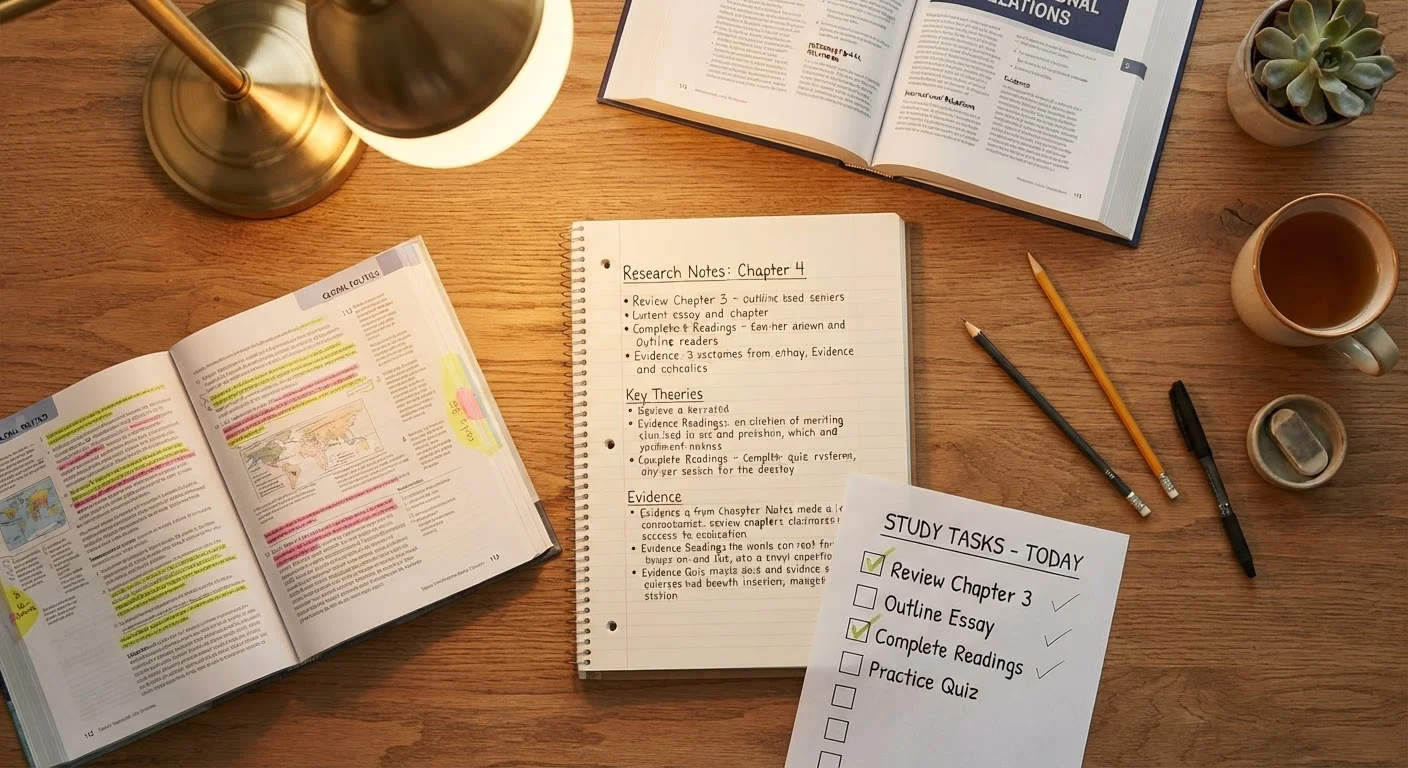
A well-organized study desk with a checklist, textbooks, and highlighted notes for exam preparation

Key Takeaways

Starting your review at least one week out significantly reduces last-minute cramming pressure.
Active recall and spaced repetition are among the most research-supported study strategies available.
Logistics like sleep, nutrition, and materials should be confirmed the night before your exam.
Practice tests reveal knowledge gaps more reliably than re-reading notes alone.
A clear plan — not just effort — is what separates effective exam prep from wasted hours.
30–60 min

Summary

22 items · 30–60 minutes to set up; ongoing through your study period

Why a Structured Checklist Changes How You Prepare

Exam preparation is rarely about working harder — it's about working smarter. Research in cognitive science consistently shows that how students study matters far more than how long they sit with their books. Yet most people approach exams without a deliberate plan, relying on rereading and highlighting that feel productive but yield limited results.

This checklist is built around evidence-backed strategies — including spaced practice, retrieval, and interleaving — to help you build a review process that actually sticks. It applies whether you're facing a standardized test, a college final, a professional certification, or a licensing exam.

Think of it the way you'd think about preparing for any high-stakes event. Just as a pre-trip safety walkthrough ensures nothing critical is overlooked before a long drive, a pre-exam checklist keeps your preparation organized and free of preventable gaps.

Use the groups below in sequence — starting with the big-picture setup, moving through daily study tactics, and finishing with exam-day logistics.

Required

Official Exam Guide or Content Outline

Defines exactly what topics will be tested, ensuring your study plan covers the right material.

Required

Flashcard or Spaced Repetition App

Automates scheduling of review sessions based on your memory performance, supporting evidence-based spaced practice.

Required

Practice Tests or Past Exams

Simulates real exam conditions and reveals knowledge gaps more accurately than passive review.

Required

Study Planner or Calendar

Maps your study sessions across the days before the exam so preparation is systematic rather than reactive.

Optional

Concept Mapping Tool or Blank Paper

Helps you visually organize relationships between ideas, supporting deeper understanding over surface memorization.

Optional

Noise-Canceling Headphones or Earplugs

Reduces auditory distraction during study sessions, particularly useful in shared living environments.

How to Work Through This Checklist

Begin with the Setup & Planning group at least seven to ten days before your exam. This phase is about orienting yourself — knowing what's actually tested, what your weak areas are, and how much time you have to close those gaps.

The Active Study Methods group should run daily through your review period. These items are grounded in strategies like self-testing and spaced repetition, which cognitive researchers have consistently found to outperform passive review. Our related guide on self-testing as a study tool explores when retrieval practice helps most — and where it has real limits.

Finally, the Exam-Day Logistics group should be completed the night before and the morning of your exam. These items are easy to skip when you're focused on content, but neglecting sleep, nutrition, or materials can undercut even the most thorough review.

Setup & Planning

Obtain the official exam outline or syllabus and identify every topic that will be tested. Must
Set a realistic study schedule working backward from your exam date, allocating more sessions to weaker areas. Must
Complete a diagnostic self-assessment or practice test to identify your current knowledge gaps before studying begins. Must
Gather all required materials — textbooks, class notes, official study guides, and any permitted reference sheets. Must
Identify a consistent, low-distraction study environment and block time for it in your calendar. Should
Review any past exams or graded work from this course or subject to spot recurring mistake patterns. Should

Active Study Methods

Use spaced repetition — distribute your review sessions across multiple days rather than massing them into one sitting. Must
Practice active recall by closing your notes and writing or saying what you remember before checking your materials. Must
Complete at least two full-length practice tests under timed, realistic conditions before exam day. Must
Review every practice-test error — understand why you got it wrong, not just what the correct answer is. Must
Use interleaving — mix different topics or problem types within a single session rather than blocking one subject at a time. Should
Create summary sheets, concept maps, or flashcards that force you to reorganize information in your own words. Should
Teach a concept aloud as if explaining it to someone else — this surfaces gaps in understanding that rereading often misses. Nice to have
Join or form a study group for one or two sessions to quiz each other and expose blind spots. Nice to have

Exam-Day Logistics

Confirm the exam location, start time, and required identification documents the night before. Must
Pack all permitted materials — pencils, approved calculators, ID, water, and any authorized aids — the evening before. Must
Get a full night of sleep; research consistently links sleep to memory consolidation and cognitive performance. Must
Eat a balanced meal before the exam; avoid heavy or unfamiliar foods that could cause discomfort. Should
Arrive at the exam location at least 15 minutes early to allow time to settle and reduce anxiety. Should
Do a brief, light review of key formulas or concepts the morning of — avoid cramming new material at this stage. Nice to have
Use a short breathing or grounding routine if test anxiety is a concern, before entering the exam room. Nice to have
Plan your route and transportation in advance so unexpected delays don't start your exam day under stress. Should

This checklist is for general educational guidance only. Results vary based on individual circumstances, exam type, and prior knowledge.

Learning & Education Editorial Team is the collective byline for our editorial team and contributor network. Articles published under this byline or an editorial pen name are researched, written, and reviewed according to our editorial standards for clarity, consistency, and independence before publication.

View all articles by Learning & Education Editorial Team →
Disclaimer: The content provided on our blog site traverses numerous categories, offering readers valuable and practical information. Readers can use the editorial team’s research and data to gain more insights into their topics of interest. However, they are requested not to treat the articles as conclusive. The website team cannot be held responsible for differences in data or inaccuracies found across other platforms. Please also note that the site might also miss out on various schemes and offers available that the readers may find more beneficial than the ones we cover.