

Key Takeaways
What Happens in Your Brain During a Cram Session
When you sit down for a marathon study session the night before a test, your brain isn't storing information the way you might hope. Working memory - the system responsible for holding and manipulating information in the moment - has a limited capacity. Flooding it with hours of new material in a single sitting tends to overwhelm this system rather than transfer content reliably into long-term storage.
Memory consolidation, the process by which new information becomes stable and retrievable, depends heavily on repeated exposure spaced over time and on sleep. A single long session compresses what should be a gradual process into a few hours, producing a fragile form of recall that researchers sometimes call massed practice. You may feel confident walking into the exam room, but that familiarity often reflects surface-level exposure, not durable understanding. For a deeper look at how these systems interact, see this plain-language guide to cognitive science.
Common Cramming Mistakes - and Why They Happen
Most students don't cram out of laziness - they do it because earlier priorities competed for the same time, because the deadline felt distant, or because cramming has occasionally worked well enough to reinforce the habit. Understanding the specific errors made during cram sessions can help break the cycle.
Re-reading notes or textbooks passively for hours without self-testing.
Why it happens: Re-reading feels productive because the material looks familiar, creating an illusion of mastery known as the fluency illusion.
Trying to cover all material at once rather than prioritizing concepts.
Why it happens: With limited time, students often feel compelled to touch every topic, spreading attention so thin that nothing is encoded deeply.
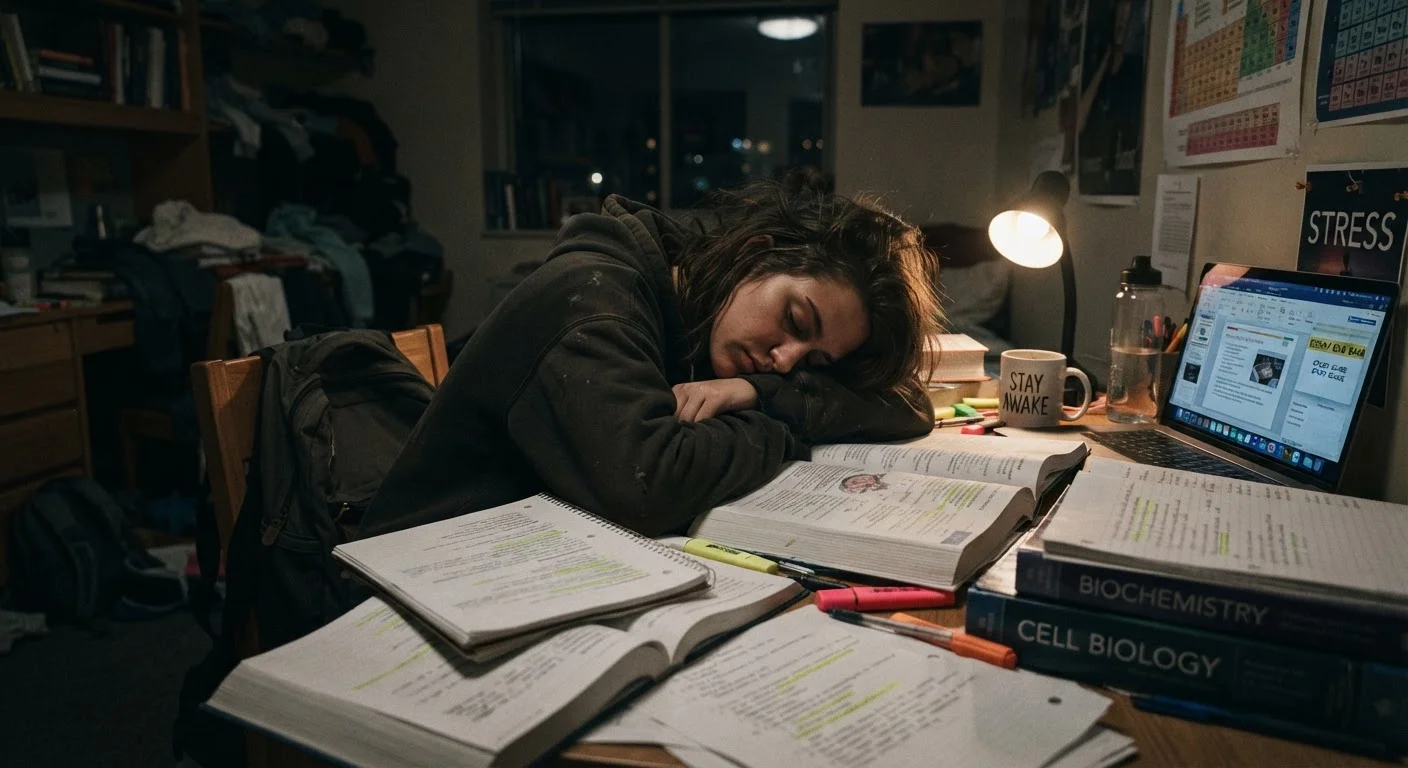
Staying up past 2 a.m. to squeeze in more review time.
Why it happens: The logic seems sound: more hours of study equals more material absorbed. But cognitive performance and memory encoding decline sharply with sleep deprivation.
Studying in a single environment for the entire session without breaks.
Why it happens: Students often equate an unbroken stretch of desk time with productive studying, when mental fatigue actually reduces encoding efficiency after 45-60 minutes.
Mixing up familiarity with actual mastery of the material.
Why it happens: After hours of exposure to the same content, it begins to feel familiar, which students often misinterpret as readiness. This is the fluency illusion at work.
The Sleep Debt Problem
One of the most consequential costs of cramming is sacrificed sleep. Research consistently shows that sleep plays an active role in consolidating newly learned material - the brain replays and reorganizes the day's information during certain sleep stages, reinforcing neural connections. Cutting sleep short to study longer effectively removes the step where learning is cemented.
This means a student who studies for five hours and sleeps for four may retain less than one who studied for three hours and slept a full night. The science of sleep and memory consolidation makes clear that rest is not wasted study time - it is part of the study process itself.
Sacrificing Sleep for Study Time Backfires
Pulling an all-nighter or cutting sleep to under six hours impairs the memory consolidation that occurs during deep sleep stages. Studies in cognitive neuroscience suggest that sleep-deprived learners show measurably reduced recall on tests taken the following day compared with adequately rested peers. Protecting sleep is not a trade-off against studying - it is a core component of effective learning.
What to Do Instead
The most well-supported alternative to cramming is distributing study time across multiple shorter sessions - an approach known as spaced practice. Rather than reviewing all material once for six hours, spacing out three two-hour sessions over several days gives the brain multiple retrieval opportunities, each of which strengthens the memory trace. Learn why spaced repetition works at the cognitive level.
Pairing spaced sessions with active recall - testing yourself rather than rereading notes - adds further gains. Active recall consistently outperforms passive review in studies measuring long-term retention. For a practical framework that incorporates these strategies, building a study session that actually sticks offers a step-by-step structure covering warm-up, deep work, and review phases.
If an exam is already tomorrow and there's no avoiding a compressed session, prioritize high-yield review: focus on core concepts, use active recall over re-reading, and protect at least seven hours of sleep. An imperfect distributed plan made tonight still beats an all-nighter.