

Key Takeaways
Spaced Repetition
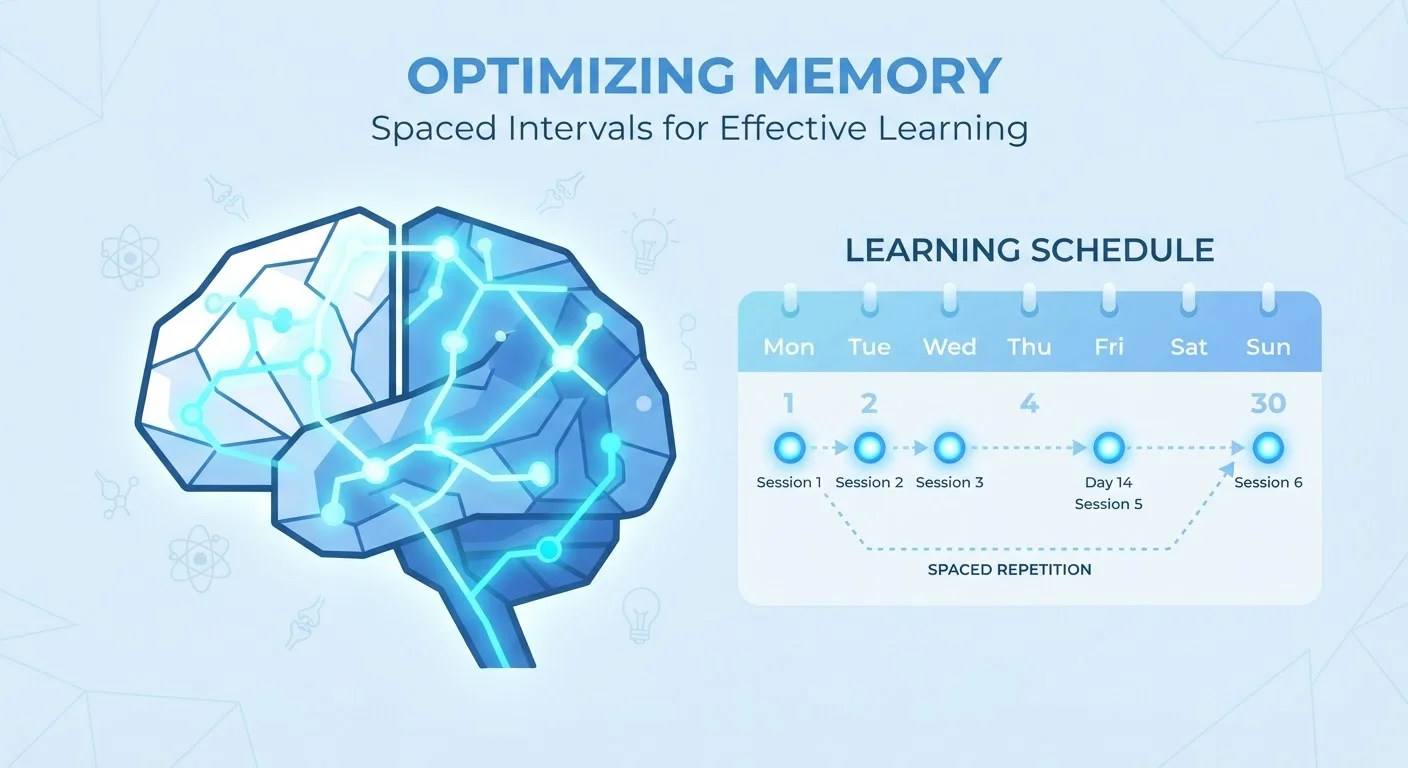
Spaced repetition is a learning technique that schedules review sessions at gradually increasing intervals over time. Instead of studying the same material repeatedly in one sitting, you revisit it after a day, then a few days, then a week, and so on. This approach takes advantage of the way the brain consolidates memories between study sessions.
The optimal intervals are often modeled using algorithms derived from the 'forgetting curve,' a concept introduced by German psychologist Hermann Ebbinghaus in the 1880s, which describes the exponential rate at which memory fades without reinforcement.
The Forgetting Curve: Why Memory Naturally Decays
In the 1880s, Hermann Ebbinghaus conducted pioneering self-experiments on memory, systematically measuring how quickly he forgot newly learned nonsense syllables. What he found - now called the forgetting curve - showed that memory decays rapidly at first, then more slowly over time. Without any review, a significant portion of new information can be lost within 24 hours of learning it.
This decay is not a flaw; it reflects the brain's efficiency. Your brain prioritizes information that appears repeatedly relevant, and deprioritizes what it rarely encounters. Spaced repetition exploits this mechanism by making your brain repeatedly signal: this information matters. To understand why this works at a neurological level, it helps to know how working memory and long-term storage interact during the learning process.
The Spacing Effect: What the Research Shows
Decades of cognitive research have confirmed what Ebbinghaus first observed: distributing learning across time produces stronger retention than concentrating it in a single session. Researchers refer to this as the spacing effect, and it is one of the most replicated findings in educational psychology.
The mechanism involves memory reconsolidation. Each time you retrieve a memory just as it's beginning to fade - not immediately after learning - the act of retrieval strengthens the memory trace in your brain. This is sometimes called desirable difficulty: the mental effort required to recall something slightly difficult to remember produces a more durable memory than effortless review of fresh material.
~50%
Information forgotten within one hour without review
Ebbinghaus's original forgetting curve research estimated that roughly half of newly learned material is lost within an hour if not reinforced - a finding that subsequent researchers have broadly replicated in varied learning contexts.
200%+
Improvement in long-term recall with spaced practice
Multiple controlled studies in cognitive psychology have found that spaced practice can more than double long-term retention compared to massed (same-day) practice on the same total study time.
1-2 days
Typical optimal first review interval for new material
Educational researchers generally recommend scheduling the first review of newly learned material within one to two days, before significant forgetting has occurred but after initial consolidation has begun.
This is also why cramming the night before an exam rarely leads to lasting retention - it compresses all retrieval into a window where forgetting hasn't yet created the difficulty that makes practice effective.
How Spaced Repetition Works in Practice
Applying spaced repetition doesn't require sophisticated technology. At its core, the approach works like this: after first learning a piece of information, schedule a review session after a short delay - typically one to two days. If you recall it successfully, push the next review out further. If you struggle, bring the review interval back in. Over time, well-learned material gets reviewed less frequently, while difficult material gets more attention.
This dynamic scheduling is what makes spaced repetition more efficient than uniform daily review. You focus effort where memory is weakest. Combined with active recall rather than passive re-reading, each spaced session becomes a genuine memory-strengthening event rather than a familiarity exercise.
For a practical framework on structuring each review session effectively, see how to build a study session that actually sticks.
The Role of Sleep and Consolidation Between Sessions
One often-overlooked reason spaced repetition works is what happens between sessions. Sleep is a critical phase of memory consolidation - the process by which newly encoded information is stabilized and integrated into long-term storage. Spacing your reviews across days ensures that sleep is built into your learning schedule by default.
Research in cognitive neuroscience suggests that the hippocampus replays recently learned material during sleep, helping transfer it to the neocortex for longer-term storage. This means spacing isn't just about the timing of review - it's about giving the brain the rest it needs to do its consolidation work. Understanding what sleep does to memory can help you design a study schedule that works with your brain's natural rhythms rather than against them.
Applying Spaced Repetition Across Different Subjects
Spaced repetition is not limited to vocabulary flashcards. Its principles apply broadly:
- Language learning: Vocabulary and grammar rules benefit enormously from spaced review, since forgetting is rapid for new words.
- STEM subjects: Mathematical formulas and scientific concepts can be practiced with problem sets distributed across a study schedule rather than solved all in one sitting.
- Professional certifications: Medical students, law students, and licensing candidates often use spaced repetition to manage large volumes of fact-dense material over weeks or months.
- History and humanities: Dates, events, and analytical frameworks can be reviewed and connected over spaced intervals to build a richer mental map.
Spaced repetition pairs especially well with interleaving - mixing different topics within a session - another scheduling strategy with strong research support. Together, they form a core part of what evidence-supported study habits look like in practice.