

Key Takeaways
Option A
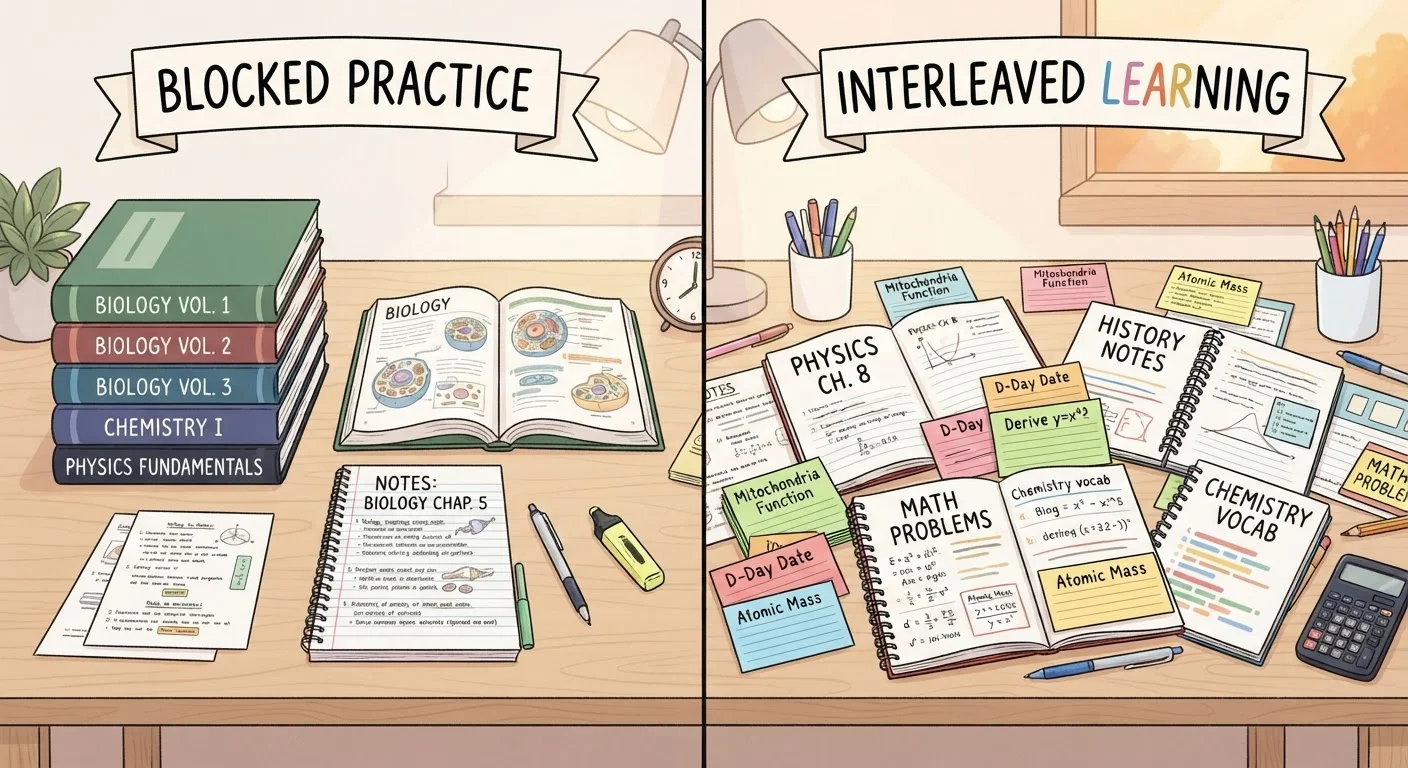
Blocked Practice
The familiar, comfortable way most people already study.
Best for: Learners who are brand new to a topic and need initial fluency before adding complexity.
Option B
Interleaving
The research-backed challenger that makes studying feel harder but stick longer.
Best for: Learners preparing for real-world application or assessments that mix multiple concepts.
If you are learning a completely new concept for the first time
Blocked Practice
Initial exposure to unfamiliar material benefits from repetitive, focused drilling so core patterns can form before complexity is added.
If you are preparing for a test or real-world task mixing multiple concepts
Interleaving
Mixed-topic practice mirrors actual exam and job conditions, training your brain to identify which strategy applies to which problem.
If you want the strongest possible long-term retention
Interleaving
Decades of cognitive science research show interleaved schedules produce significantly better recall on delayed assessments.
If you are a teacher designing a unit for students with no prior exposure
Blocked Practice
Short blocked sequences reduce initial cognitive overload, helping students build a foundation before switching to interleaved review.
If you want to build flexible problem-solving skills across a subject area
Interleaving
Switching between topic types forces repeated discrimination practice, developing the judgment needed to tackle novel problems.
What These Two Scheduling Methods Actually Mean
Most learners default to blocked practice without realizing it has a name. In blocked practice, you work through all problems or examples of one type before moving to the next - finishing every multiplication drill before touching division, or studying Chapter 4 completely before opening Chapter 5. It feels logical and efficient.
Interleaving flips that structure. Instead of grouping by type, you shuffle different topics or problem categories within the same session. A math student might do a geometry problem, then an algebra problem, then return to geometry - cycling through categories rather than exhausting one at a time.
Both approaches are forms of practice scheduling - deliberate decisions about the sequence of learning episodes. The difference lies in what happens cognitively during each approach, and that difference has meaningful consequences for how well information is retained. As related research on why cramming rarely pays off shows, the feeling of studying well and the reality of learning well are often two different things.
What the Research Shows
Cognitive psychologists refer to interleaving as a form of desirable difficulty - a study condition that slows apparent progress but accelerates durable learning. The term was popularized by researchers including Robert Bjork at UCLA, whose lab has produced extensive evidence that conditions making learning feel harder often produce superior long-term retention.
Landmark studies on interleaving - including work on math problem-solving and motor skills - have repeatedly found the same pattern: learners who practice in interleaved sequences score lower on immediate post-session quizzes than blocked learners, but substantially higher on tests given days or weeks later. One widely cited study in the field of mathematics education found that students who switched to interleaved homework performed notably better on final exams than peers who used conventional blocked assignments.
~25%
Interleaving advantage on delayed tests
Multiple laboratory studies in cognitive psychology have found interleaved learners outperform blocked learners on delayed recall tests by roughly 20-30%, though exact figures vary by subject and study design.
~69%
Higher final exam scores with interleaved homework
A study published in Psychological Science found students using interleaved math practice scored approximately 69% on a final exam versus 54% for those using blocked practice.
2-4 topics
Recommended topics per interleaved session
Educational researchers generally suggest mixing two to four distinct concept types per study session to achieve discrimination-learning benefits without overwhelming working memory.
The likely mechanism is discrimination learning. When problems are blocked, your brain only has to execute a known strategy. When they are interleaved, your brain must first identify which strategy applies - a cognitively demanding step that, when practiced repeatedly, builds flexible, transferable understanding. This pairs naturally with the principles behind spaced repetition, which also leverages retrieval difficulty to consolidate memory.
Head-to-Head: Blocked vs. Interleaved Practice
The table below summarizes the core trade-offs between the two scheduling approaches across dimensions that matter most to learners and educators.
| Criterion | Blocked Practice | Interleaving |
|---|---|---|
| Session structure | One topic at a time, fully completed | Multiple topics shuffled together |
| Immediate performance | Higher - feels productive | Lower - feels difficult |
| Long-term retention | Weaker on delayed tests | Stronger on delayed tests |
| Transfer to new problems | Limited - strategy is cued by context | Stronger - requires active strategy selection |
| Best learning stage | Initial acquisition of new concepts | Review and consolidation phases |
| Cognitive demand | Lower - predictable problem type | Higher - must identify correct approach |
| Learner motivation risk | Low - progress feels visible | Moderate - slower apparent progress |
One nuance worth noting: the advantage of interleaving is most pronounced for procedural and concept-discrimination learning - situations where you need to distinguish between similar-but-different problem types. For purely factual recall (memorizing vocabulary in a foreign language, for instance), the picture is more mixed, and some researchers argue that blocked repetition remains useful in early acquisition stages.
How to Build Interleaving Into Your Study Routine
Transitioning from blocked to interleaved practice does not require a complete overhaul of your schedule. A few structural adjustments can make a significant difference.
- Identify your topic clusters. List the distinct concepts or problem types in your subject. These become the ingredients you will shuffle.
- Create mixed practice sets. Rather than completing one chapter's exercises, draw problems from at least two or three recent topics in each session. Randomizing the order amplifies the benefit.
- Resist the urge to re-block when it feels hard. The discomfort of interleaving is evidence it is working. Learners who switch back to blocked practice when performance dips lose most of the benefit.
- Use blocked practice strategically for brand-new material. When encountering a concept for the first time, a short blocked session to build initial fluency is reasonable - then shift to interleaving for review.
- Pair with spaced sessions. Interleaving within a session and spacing across days is a powerful combination. See how to structure a full study session for a practical framework that accommodates both strategies.
Interleaving is also relevant beyond solo study. Instructors designing course curricula, tutors building lesson sequences, and workplace trainers developing skill programs can all apply this principle to produce better transfer of learning - the ability to apply knowledge in new situations. For a broader look at how learning format affects skill-building, the comparison of online learning vs. on-the-job training explores related trade-offs in professional development contexts.