

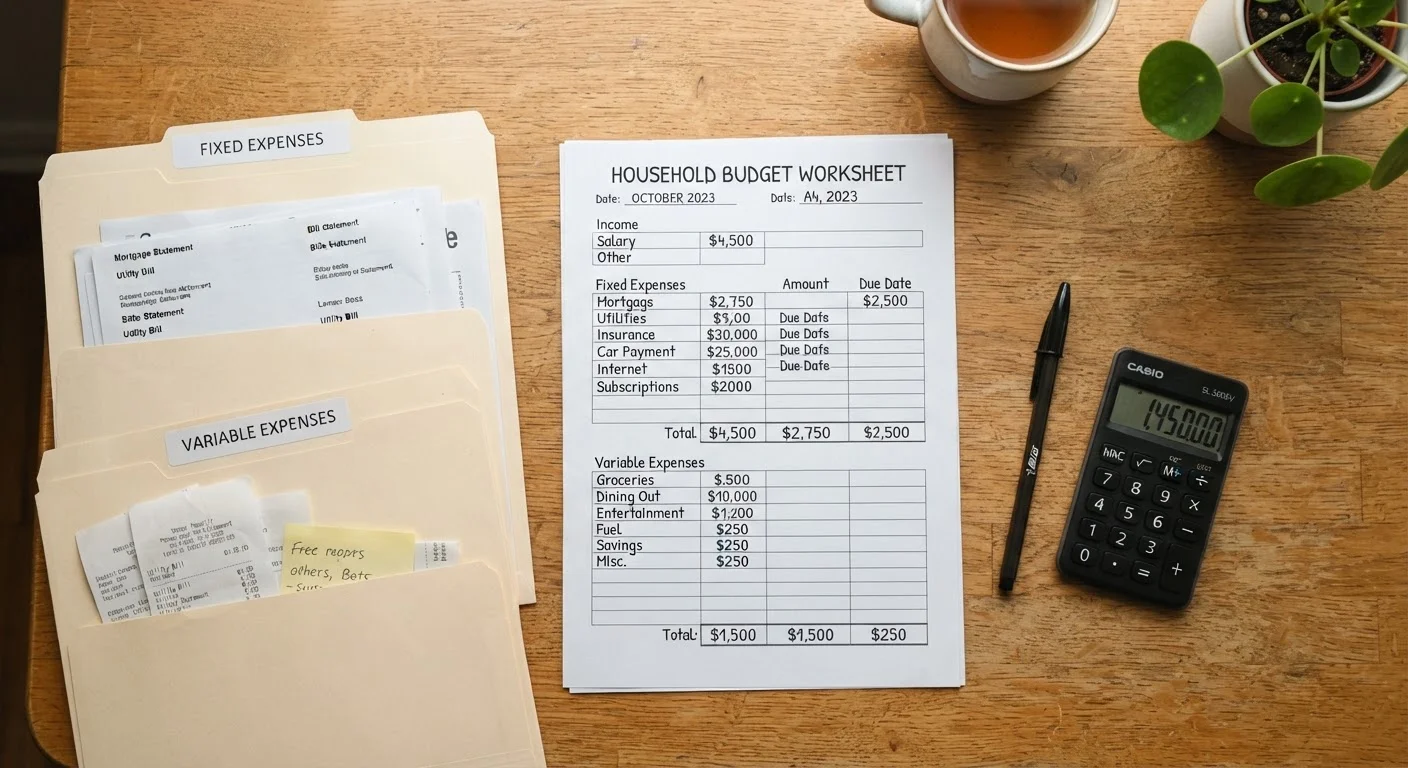
Key Takeaways
Option A
Fixed Expenses
The predictable, non-negotiable costs in your budget.
Best for: Households that want a stable spending baseline they can plan around month after month.
Option B
Variable Expenses
The flexible costs that shift based on choices and circumstances.
Best for: Budget areas where conscious spending decisions can directly reduce monthly outflows.
If you want to reduce monthly spending quickly
Variable Expenses
Variable costs like dining out, subscriptions, and entertainment respond immediately to conscious choices, making them the fastest lever for cutting your monthly outflows.
If you need a reliable spending baseline to plan savings
Fixed Expenses
Because fixed costs don't change month to month, they let you calculate exactly how much income is already committed and how much remains for discretionary use and saving.
If you have an irregular or freelance income
Fixed Expenses
Understanding your fixed floor - the minimum you must cover - is essential when income varies. See our guide for irregular income budgeting for specific strategies.
If you consistently overspend despite having a budget
Variable Expenses
Untracked variable spending is one of the most common reasons budgets fail. Reviewing these categories often reveals the gaps causing the problem.
What Makes an Expense Fixed or Variable
The difference comes down to one question: does this cost change from month to month?
Fixed expenses are charges that stay the same regardless of your behavior. Your rent or mortgage payment, car loan installment, and insurance premiums are textbook examples. You agreed to those amounts when you signed a contract, and they won't fluctuate based on how much you drove, cooked, or watched television. Because they're predictable, they're relatively simple to account for - you know exactly what's coming out each month.
Variable expenses, by contrast, shift based on usage, choices, or circumstances. Groceries, gas, restaurant meals, clothing, and utility bills (which change with consumption) all fall here. The category also includes irregular but recurring costs - car registration fees, medical copays, or holiday gifts - that don't hit every month but must be anticipated.
Understanding which bucket each expense falls into is the prerequisite for building a budget that actually holds. Without this distinction, you're treating all spending as if it responds equally to the same strategies - and it doesn't.
| Criterion | Fixed Expenses | Variable Expenses |
|---|---|---|
| Amount each month | Stays the same | Changes month to month |
| Examples | Rent, car loan, insurance | Groceries, gas, dining out |
| Short-term control | Limited - set by contract | High - driven by daily choices |
| Best management approach | Periodic review and renegotiation | Active tracking and habit adjustment |
| Planning ease | Easy - amount is known in advance | Harder - requires estimation or averaging |
| Impact on savings rate | Determines income floor required | Primary lever for increasing savings |
Why the Distinction Changes Your Budgeting Approach
Fixed and variable expenses require fundamentally different management tactics.
With fixed expenses, the primary opportunity isn't monthly adjustment - it's negotiation or restructuring. You can't decide to pay half your rent this month because money is tight. But you can periodically review whether you're in the right insurance plan, whether refinancing a loan makes sense, or whether a subscription you locked in still serves your needs. These are periodic, deliberate decisions rather than month-to-month management calls.
Variable expenses, on the other hand, are your active spending territory. This is where habits, choices, and attention have immediate financial impact. Meal planning reduces grocery overspend. Carpooling cuts fuel costs. Auditing your streaming services can free up $30 to $100 per month almost instantly. If you're wondering why your budget keeps slipping, uncontrolled variable spending is often the culprit.
Some expenses straddle both categories. Utilities are a good example: your electricity bill isn't a fixed contract amount, but it also isn't purely discretionary. These semi-variable expenses benefit from averaging - look at 12 months of past bills, calculate a monthly average, and budget to that figure.
What About Semi-Variable Expenses?
Some costs don't fit neatly into either category. Utilities, for example, follow a contract structure but vary based on usage. Medical expenses may be predictable in category but not in amount. For these, budgeting experts commonly recommend calculating a 12-month average and treating that figure as your monthly budget target, then adjusting the estimate annually based on actual experience.
This distinction also shapes which budgeting method will suit you. Systems like envelope budgeting and digital tracking apps are built primarily to manage variable spending. See our comparison of envelope budgeting and digital trackers to find the right fit for your habits.
Building Your Expense Inventory
Before any budgeting method can work, you need a complete picture of where your money currently goes. Here's a practical way to build that inventory:
- Pull three months of bank and credit card statements. Three months smooths out one-off anomalies and captures expenses that don't hit every month.
- List every charge and categorize it as fixed, variable, or semi-variable. When in doubt, ask: would this amount change if I made different daily choices? If yes, it's variable or semi-variable.
- Total each category separately. Your fixed total tells you your non-negotiable monthly floor - the minimum income needed to keep the lights on and contracts honored. Your variable total shows you how much discretionary room you actually have.
- Identify any irregular expenses that only appear once or twice per year. Divide the annual cost by 12 and add that monthly fraction to your budget as a sinking fund contribution.
Once you have this inventory, you'll likely find that your fixed costs consume a larger share of income than expected. That's common, and it reinforces why periodically reviewing and renegotiating fixed commitments - not just monitoring daily spending - is part of sound financial management. For more on maintaining your budget through life changes, see strategies for keeping a budget on track when life gets unpredictable.
This article is for general informational and educational purposes only. It does not constitute personalized financial advice. Consider speaking with a licensed financial professional about decisions specific to your situation.