

Key Takeaways
Option A
Envelope Budgeting
The tactile, cash-first approach to spending discipline.
Best for: People who overspend with cards and want a physical, hard-stop mechanism for each spending category.
Option B
Digital Spending Trackers
The automated, data-rich approach to budget awareness.
Best for: People who primarily use cards and accounts and want real-time visibility without handling physical cash.
If you regularly overspend on groceries, dining, or entertainment
Envelope Budgeting
Running out of cash in an envelope creates an immediate, undeniable stop - no rationalizations or overdraft risk from a card swipe.
If you manage multiple accounts, subscriptions, or irregular income
Digital Spending Trackers
Apps automatically categorize transactions across all your accounts, giving you a unified picture that cash envelopes simply cannot provide.
If you're new to budgeting and want to build spending awareness quickly
Digital Spending Trackers
Automatic syncing reduces friction, and visual dashboards make it easy to spot patterns without manual record-keeping.
If you've tried apps before but still overspend
Envelope Budgeting
Seeing and touching money activates a different kind of accountability that digital notifications often fail to replicate.
If you want to address both impulsive spending and long-term planning
Envelope Budgeting
Use cash envelopes for discretionary categories while pairing a digital tracker for bills, savings goals, and overall account monitoring.
How Each Method Actually Works
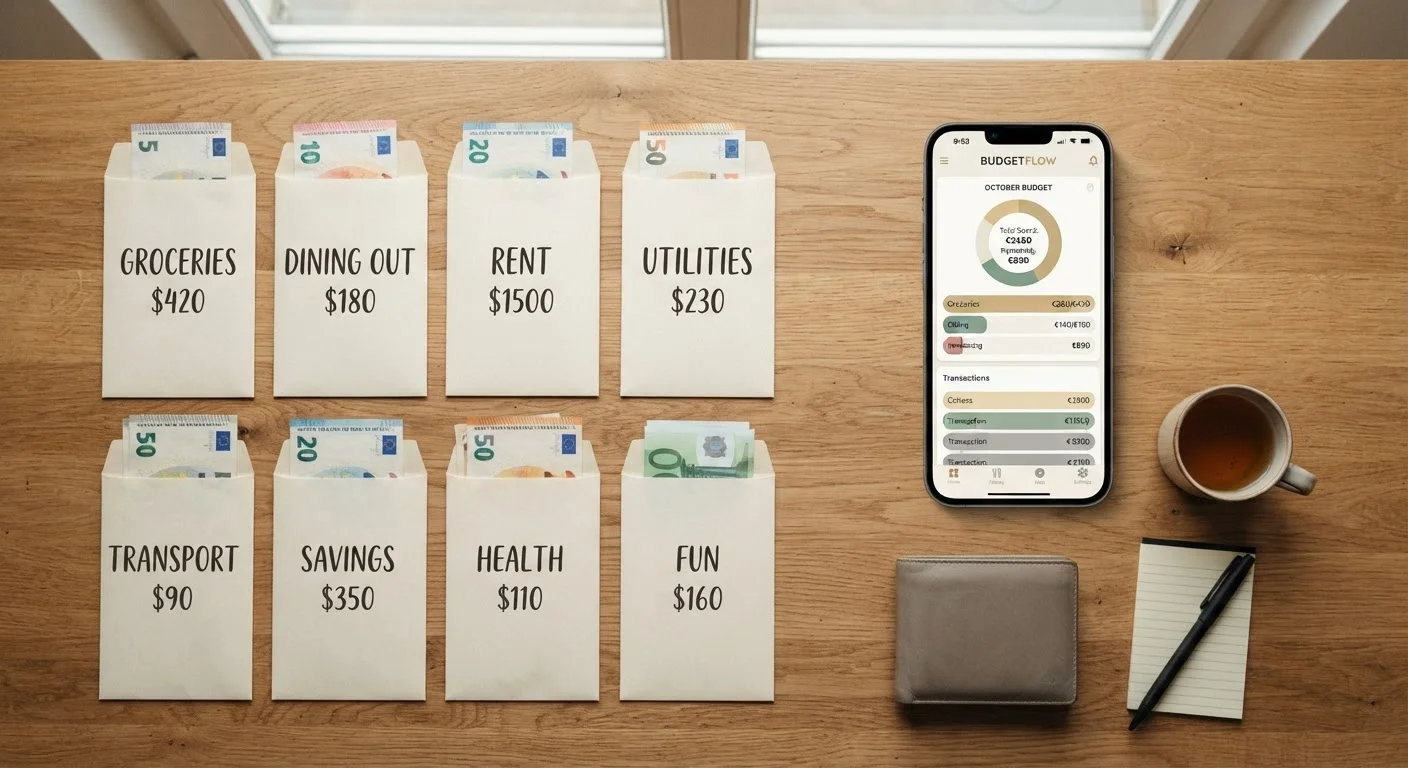
Envelope budgeting is straightforward by design. At the start of each pay period, you withdraw cash and divide it into labeled envelopes - one for groceries, one for gas, one for dining out, and so on. When an envelope is empty, spending in that category stops. No exceptions, no borrowing from next week. The constraint is built into the system.
Digital spending trackers work through connection rather than constraint. You link your bank accounts, credit cards, and loan accounts to an app, which then pulls in transactions automatically and sorts them into categories. Instead of a hard stop, you get a running score: how much you've spent versus how much you planned to spend. The awareness is the mechanism.
Both methods rely on the same underlying logic - assign money to a purpose before you spend it - but they enforce that logic in fundamentally different ways. Envelope budgeting prevents overspending. Digital trackers report it. That distinction shapes which one fits your habits. For a deeper look at assigning every dollar a specific role before the month starts, see our guide to zero-based budgeting.
The Psychology Behind Each Approach
Research on consumer behavior consistently finds that people spend differently depending on payment method. Paying with physical cash tends to feel more "painful" than tapping a card, a phenomenon sometimes called the "pain of paying." That friction isn't a bug in the envelope system - it's the core feature. When you hand over bills, your brain registers the loss more acutely than when a number decreases on a screen.
Digital trackers lean into a different psychological lever: awareness and reflection. Seeing a color-coded chart show that you've spent 90% of your dining budget by the 15th of the month can motivate behavioral change - but it requires you to check the app and act on what you see. The tool provides information; you provide the discipline.
| Criterion | Envelope Budgeting | Digital Spending Trackers |
|---|---|---|
| Spending mechanism | Hard stop - cash runs out | Soft stop - alerts and dashboards |
| Works with cards/digital payments | Limited; best for cash-friendly spending | Yes - links to cards and accounts |
| Setup effort | Withdraw cash, label envelopes | Link accounts, configure categories |
| Ongoing maintenance | Refill envelopes each pay period | Review and correct auto-categorization |
| Visibility into overall finances | Limited to envelope categories | Comprehensive across all accounts |
| Suited for irregular income | Workable but requires manual adjustment | Strong - dashboards show real-time balances |
| Privacy/security risk | Physical loss or theft of cash | Credential sharing; depends on app security |
This gap matters because having a budget doesn't automatically prevent overspending. If you tend to rationalize spending decisions in the moment, a soft alert from an app may not be enough to stop you. If you find cash inconvenient and rarely carry it, envelope budgeting will create real logistical problems.
Practical Tradeoffs to Consider
Envelope budgeting has real limitations in a card-dominant world. Online purchases, automatic bill payments, and subscriptions don't fit neatly into a cash-based system. Many people who use envelopes maintain a separate checking account for fixed bills and only cash-out the discretionary categories where they tend to overspend - an effective hybrid, but one that requires extra management.
Digital trackers have their own friction points. They depend on accurate automatic categorization, which is imperfect - a hardware store purchase might land in "home improvement" one month and "miscellaneous" the next. Many apps also require regular review to be useful; an unreviewed tracker provides data without insight.
Security and privacy are worth noting too. Cash envelopes carry the risk of physical loss or theft. Digital apps require sharing bank credentials or using secure open-banking connections, which some people are uncomfortable with. Neither risk is trivial - both deserve a clear-eyed look before you commit.
Before choosing a method, it helps to know where your money is currently going. A spending audit can surface the categories where you're losing the most ground and point you toward the right tool.
This article is for general informational and educational purposes only and does not constitute personalized financial advice. Consult a qualified financial professional for guidance specific to your situation.