

Key Takeaways
How Credit and Debt Are Connected
Credit and debt are two sides of the same coin. Credit is the ability to borrow money with a promise to repay it; debt is what you owe once you've borrowed. Every time you use a credit card, take out a car loan, or finance a major purchase, you're converting available credit into debt.
The relationship matters because lenders use your history of managing debt to decide how much credit to extend - and at what interest rate. A strong track record of repaying on time signals low risk; a spotty record signals the opposite. Understanding this dynamic puts you in control of both sides of the equation. For a solid foundation on budgeting the money that pays down that debt, see our Budgeting Basics hub.
Understanding Your Credit Score
In the U.S., the most widely used credit scoring model is the FICO® Score, which ranges from 300 to 850. Scores are calculated from five weighted factors:
- Payment history (35%): Whether you pay on time - the single biggest factor.
- Amounts owed / credit utilization (30%): How much of your available credit you're using. Keeping this ratio below 30% is a common guideline; below 10% is even better.
- Length of credit history (15%): How long your accounts have been open.
- Credit mix (10%): A variety of account types (revolving credit, installment loans) can help.
- New credit (10%): Recent applications for new credit can temporarily lower your score.
Scores generally fall into tiers: 800+ is exceptional, 740-799 is very good, 670-739 is good, 580-669 is fair, and below 580 is considered poor by most lenders. For a deeper look at managing the utilization factor - which carries the second-highest weight - see our guide on keeping credit utilization in check.
Request your credit reports from all three bureaus at the same time - not just one - because errors and missing accounts often show up differently across bureaus.
Lenders may report to only one or two bureaus, so a problem invisible on one report can be damaging on another. Checking all three gives you the complete picture.
If you're working toward a major loan application, aim to get your credit utilization below 10% - not just under 30% - in the one to two billing cycles before you apply.
Scores are calculated on the balance reported to bureaus at statement close, so temporarily paying down balances before a hard inquiry can produce a meaningfully higher score at the moment it matters most.
Reading Your Credit Report
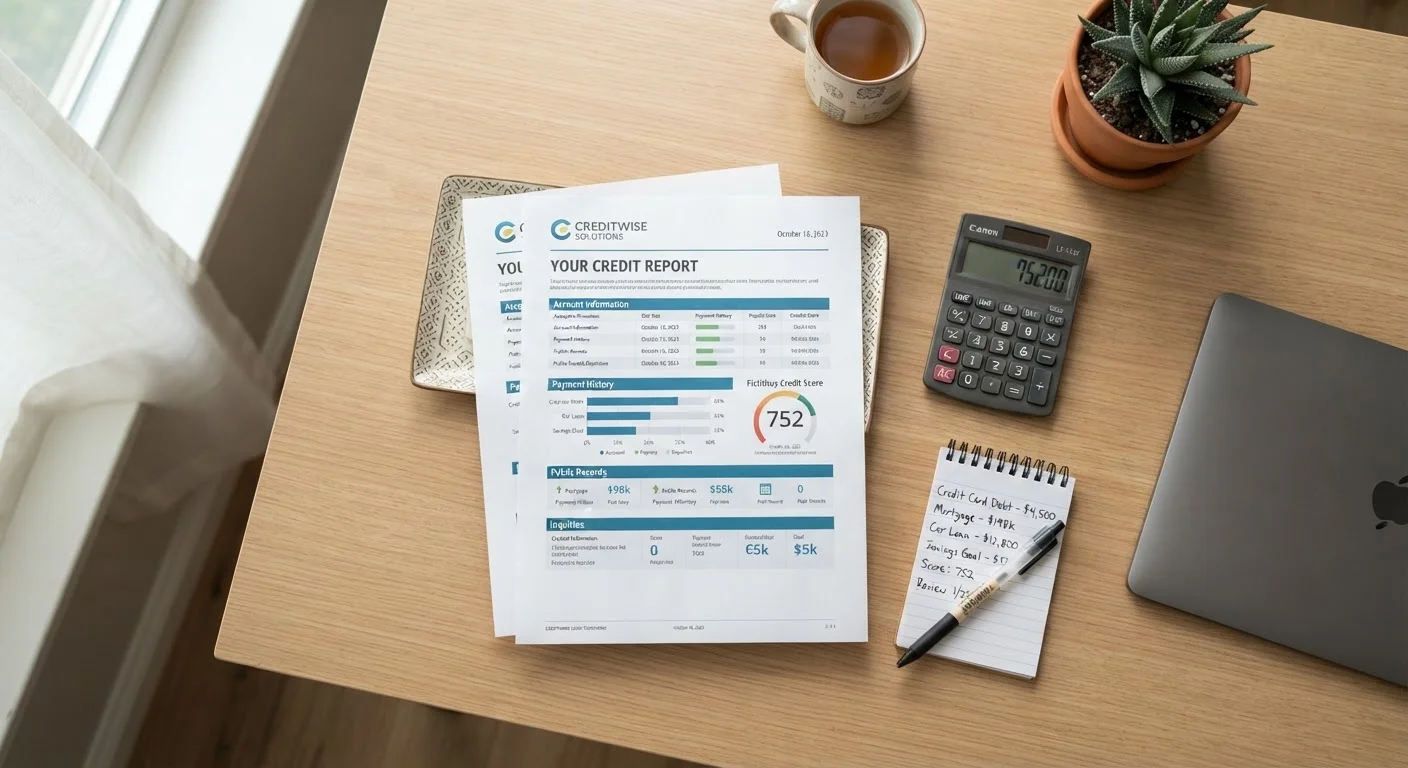
Your credit report is the detailed record that underlies your score. Under the Fair Credit Reporting Act (FCRA), you're entitled to a free report from each of the three major bureaus - Equifax, Experian, and TransUnion - through AnnualCreditReport.com. Reports typically contain four sections:
- Personal information: Name, addresses, date of birth, employer history.
- Account history: Every open and closed credit account, balances, payment history, and dates.
- Public records: Bankruptcies or civil judgments.
- Inquiries: Hard inquiries from credit applications and soft inquiries from checks you initiate.
Errors appear more often than most people expect. Common mistakes include accounts that don't belong to you, incorrect balances, and late payments reported in error. If you spot an error, you can dispute it directly with the bureau - at no cost - and the bureau is generally required to investigate within 30 days. For a plain-language walkthrough of every line, see Your Credit Report, Line by Line.
You're Entitled to Free Credit Reports
Federal law gives every American the right to one free credit report per bureau per year through AnnualCreditReport.com - the only federally authorized source. Avoid third-party sites that charge fees or require a credit card to access your report. Disputing errors is also completely free through each bureau's online dispute process.
Common Types of Consumer Debt
Not all debt carries the same cost or risk. Understanding the differences helps you prioritize where to focus your repayment energy.
- Revolving debt
- Credit cards and lines of credit. Interest accrues on unpaid balances, often at high rates. Carrying a balance month to month is expensive and directly raises your credit utilization ratio.
- Installment debt
- Fixed loans - mortgages, auto loans, student loans, personal loans - repaid in regular payments over a set term. These tend to carry lower interest rates than revolving debt.
- Medical debt
- Increasingly subject to special consumer protections. As of 2023, the three major bureaus removed paid medical collections from credit reports, and there have been additional policy proposals to further limit medical debt's impact on scores.
High-interest revolving debt (particularly credit card balances) is typically the most costly to carry and worth addressing first in most repayment strategies.
Debt Management Strategies That Work
Two evidence-backed payoff methods dominate personal finance guidance:
- Avalanche method: Pay minimums on all debts, then direct any extra money toward the account with the highest interest rate. Mathematically, this minimizes the total interest you pay over time.
- Snowball method: Pay minimums everywhere, then attack the smallest balance first. Each payoff creates momentum and motivation. Research suggests this behavioral benefit helps some people stay on track longer.
Neither is universally superior - the best method is the one you'll actually stick with. If your debts are scattered across multiple accounts with varying rates, you may also want to explore whether consolidation makes sense. Our balanced guide on debt consolidation: when it helps and when it doesn't walks through the real trade-offs. Once debt is under control, redirecting freed-up cash toward savings and investing is the natural next step - see our Saving & Investing hub for practical approaches.
Building or Rebuilding Your Credit
Starting with no credit history - or recovering from a serious setback like bankruptcy or collections - feels daunting, but both are navigable with consistent effort.
Starting from zero: A secured credit card (where you deposit collateral as your credit limit) or a credit-builder loan from a credit union are common first steps. Becoming an authorized user on a responsible person's account can also help. For a full roadmap, see Building Credit from Zero.
Recovering after a setback: Negative marks like late payments or collections can stay on your report for up to seven years; bankruptcies up to ten. But their impact fades over time, especially as you add positive payment history. Consistent on-time payments, low utilization, and patience are the core tools. Our dedicated guide on recovering your credit after a major financial setback covers specific steps in detail.
Beware of Credit Repair Scams
Companies that promise to 'erase' accurate negative information from your credit report for a fee cannot legally do what they claim. Only time and positive behavior remove accurate negative marks. The Federal Trade Commission (FTC) warns consumers that many credit repair outfits charge upfront fees for services you can do yourself - for free - through the bureau dispute process.
Protecting Your Credit Long Term
Once your credit is in good standing, protecting it requires ongoing attention to a few key habits:
- Monitor regularly: Check your credit reports at least once a year - more often if you've been a fraud victim. Many banks and card issuers also offer free score tracking.
- Freeze when not applying: A credit freeze (also called a security freeze) prevents new accounts from being opened in your name without your knowledge. It's free at all three bureaus and can be lifted temporarily when you need to apply for credit.
- Keep old accounts open: Closing a long-standing account shortens your credit history and can raise your utilization ratio. Unless an account carries a fee you can't justify, leaving it open and occasionally used is usually the better move.
- Limit hard inquiries: Each application for new credit triggers a hard inquiry. Rate-shopping for mortgages or auto loans within a short window (typically 14-45 days depending on the scoring model) is usually treated as a single inquiry.
This article is for general informational and educational purposes only and does not constitute personalized financial, legal, or credit advice. Please consult a qualified financial professional for guidance specific to your situation.