

| Free reports per year | 1 per bureau (3 total) (Federal law under FCRA) |
| Late payment reporting window | Up to 7 years (Fair Credit Reporting Act) |
| Chapter 7 bankruptcy on report | Up to 10 years (Fair Credit Reporting Act) |
| Hard inquiry impact period | Up to 2 years (scoring effect ~12 months) (FICO scoring guidelines) |
| Official free report source | AnnualCreditReport.com (FTC-authorized site) |
What Is a Credit Report - and Where Do You Get One?
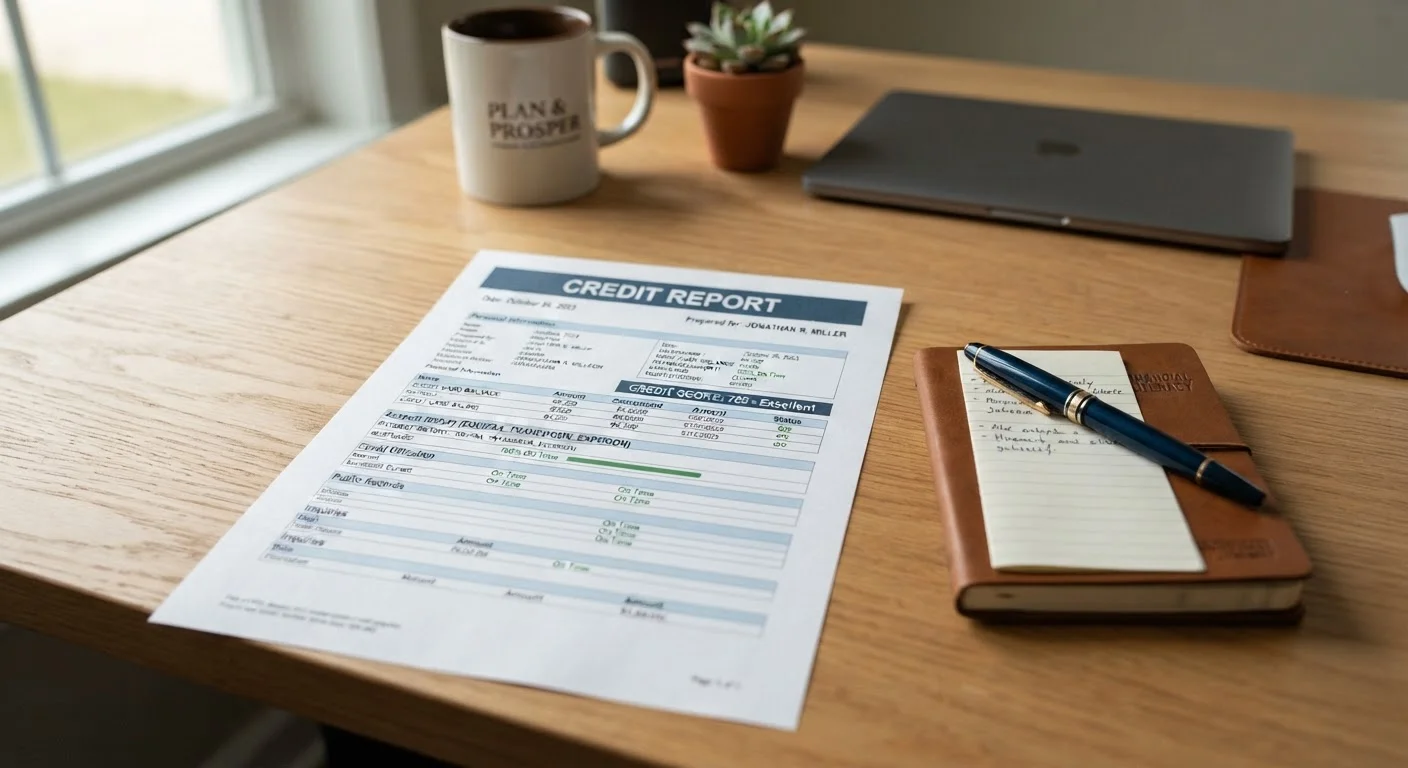
A credit report is a detailed record of your borrowing history compiled by consumer reporting agencies - most commonly Equifax, Experian, and TransUnion. Lenders, landlords, and sometimes employers use it to evaluate your reliability. Under federal law, you're entitled to a free copy from each bureau every 12 months through AnnualCreditReport.com, the official site authorized by the Federal Trade Commission.
Your report is not the same as your credit score. The report is the raw data; the score is a number calculated from that data. See Credit Scores Decoded for how those numbers are built from the information below.
Tradeline
An individual credit account entry on your credit report. Each loan or credit card you hold is listed as a separate tradeline, with details on balance, payment history, and status.
Hard Inquiry
A credit check triggered when you apply for new credit. Hard inquiries are visible to lenders and can temporarily reduce your credit score by a small number of points.
Soft Inquiry
A credit check that does not affect your score, such as when you check your own report or a lender pre-screens you for an offer. Only you can see soft inquiries on your report.
Charge-Off
When a creditor writes off a debt as a loss after extended non-payment - typically after 180 days. A charge-off is a serious negative mark and does not mean the debt is forgiven; it may still be collected.
Consumer Reporting Agency
A company that collects and maintains consumer credit information and sells reports to lenders and others. Equifax, Experian, and TransUnion are the three major U.S. bureaus.
Collections Account
A delinquent debt that a creditor has transferred or sold to a collection agency. It appears on your credit report as a separate negative entry and can remain for up to seven years from the original delinquency date.
Section 1: Personal Information
At the top of any credit report you'll find identifying details the bureaus have collected from lenders and public records. This typically includes:
- Full legal name - including variations and former names
- Current and previous addresses
- Date of birth
- Social Security number (usually partially masked)
- Employer information - as reported by creditors, not always current
This section does not affect your credit score, but errors here - a misspelled name, a wrong address - can sometimes cause accounts to be mixed with someone else's file. Review it carefully. If something looks off, it may warrant a formal dispute. Learn how to file a dispute if you spot inaccuracies.
Section 2: Account History (Tradelines)
This is the largest and most consequential section of your report. Each account - called a tradeline - gets its own entry. Expect to see:
- Account type: credit card, mortgage, auto loan, student loan, etc.
- Creditor name and account number (partially masked)
- Date opened and date of last activity
- Credit limit or original loan amount
- Current balance
- Payment history: usually shown month by month, indicating on-time, late (30/60/90+ days), or missed payments
- Account status: open, closed, transferred, charged off, etc.
Payment history is the single largest factor in most credit scoring models - generally around 35% of a FICO score. A single 30-day late payment can remain on your report for up to seven years, though its impact tends to diminish over time as you build a consistent on-time record.
If you're starting out with no tradelines yet, Building Credit from Zero walks through how to begin establishing this history responsibly.
Section 3: Public Records and Collections
This section captures serious financial events that are a matter of public record or have been referred to a debt collector. Common entries include:
- Collections accounts: unpaid debts sold or assigned to a collection agency
- Bankruptcies: Chapter 7 bankruptcies stay on your report for up to 10 years; Chapter 13 for up to 7 years
Note: Civil judgments and tax liens were historically included but were removed from the three major bureaus' reports following data quality changes implemented around 2017-2018. However, this may vary by bureau and by state, so confirm what appears on your specific report.
Any entry in this section will typically have a significant negative effect on creditworthiness. If a collections account is listed in error - for example, a debt that was paid or doesn't belong to you - disputing it promptly is important.
Section 4: Inquiries
Every time someone accesses your credit file, it's recorded as an inquiry. There are two types, and only one affects your score:
- Hard inquiries
- Generated when you apply for new credit - a loan, card, or mortgage. These can lower your score by a few points and remain visible for two years, though they generally only affect scoring for 12 months. Multiple hard inquiries for the same type of loan (like mortgage shopping) within a short window are often counted as a single inquiry by scoring models.
- Soft inquiries
- Generated by background checks, pre-approval screenings, or when you check your own credit. These do not affect your score and are typically only visible to you, not to lenders.
Before applying for new credit, it's worth reviewing both this section and your overall profile. Run through a self-assessment checklist to make sure your file is in good shape first.
For a fuller picture of how credit and debt interact in your financial life, see Debt & Credit: The Complete Picture.
This article provides general financial education and is not personalized financial or legal advice. For guidance specific to your situation, consider consulting a licensed financial professional.