

Key Takeaways
Why Pet Food Labels Are Harder to Read Than They Look
Pet food packaging is governed by a patchwork of federal and state regulations, with the FDA overseeing safety and the Association of American Feed Control Officials (AAFCO) setting voluntary nutritional standards that most states adopt into law. The result is a label that contains genuinely useful information - but buries it in technical language and surrounds it with marketing copy designed to catch your eye rather than inform your decision.
Understanding which parts of the label are regulated and meaningful versus which are largely unregulated marketing helps you spend your reading time in the right places. This guide walks you through the label section by section so you know exactly what to look for - and what to look past. For a broader overview of the topic, see our companion article on what pet food labels reveal and what they don't.
Don't Let Marketing Claims Drive the Decision
Terms like 'holistic,' 'human-grade,' 'premium,' and 'ancestral diet' are not defined or regulated by the FDA or AAFCO for pet food. They are marketing language, not nutritional certifications. Focus on the guaranteed analysis, the AAFCO statement, and the ingredient list rather than front-of-bag claims.
How to Read a Pet Food Label Step by Step
What you will need
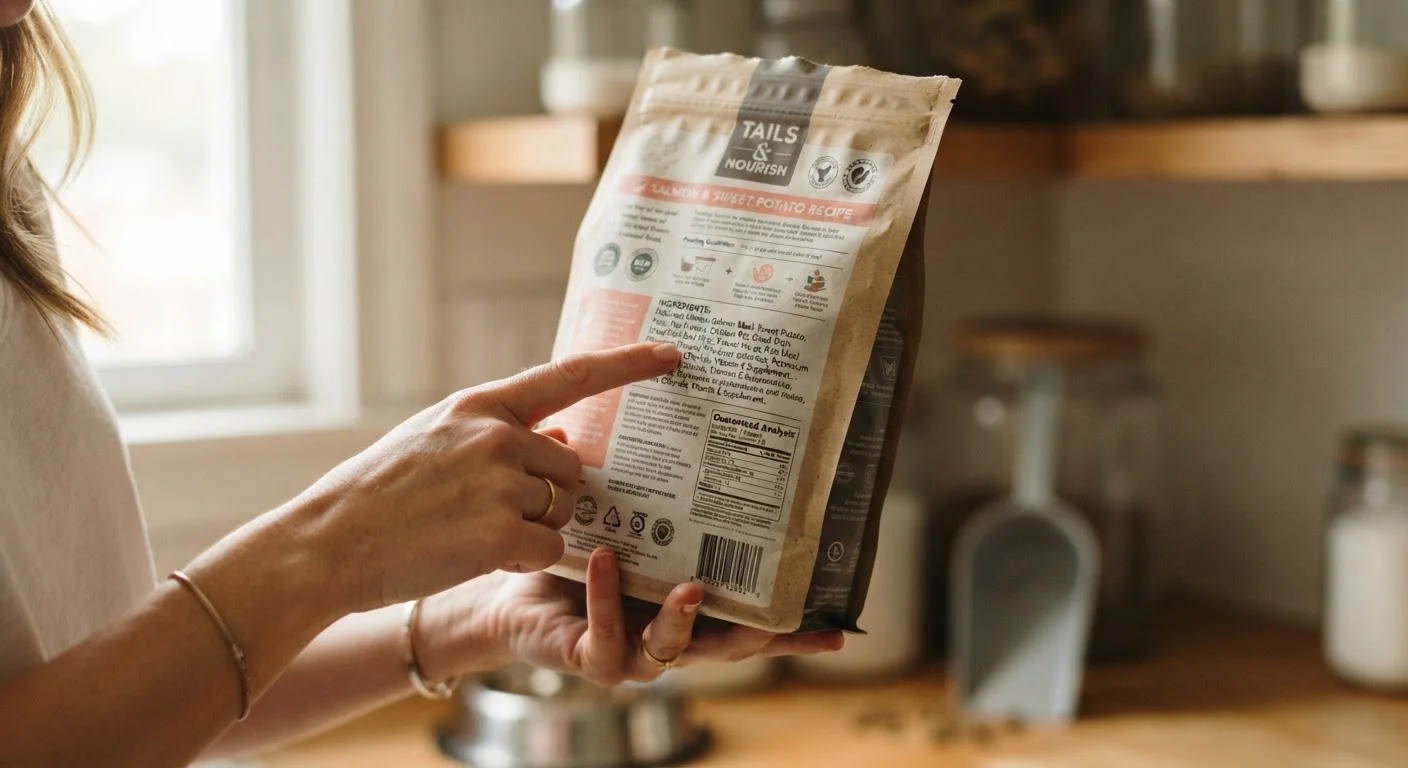
Work through each step below using the label in front of you. Not every label will have every element in the same location, but all commercially sold pet foods in the US are required to include the core components covered here.
Find and Read the AAFCO Nutritional Adequacy Statement
This statement - usually a small paragraph on the back or side panel - is the most meaningful line on the entire label. It tells you whether the food is complete and balanced for a specific life stage (growth, adult maintenance, all life stages, or gestation/lactation) and how that was determined.
Look for one of two phrases:
- "Formulated to meet..." - the recipe was calculated to meet AAFCO nutrient profiles, but was not tested in feeding trials.
- "Animal feeding tests..." - the food was tested on live animals using AAFCO protocols, which is a higher bar.
If the label says "for supplemental or intermittent feeding only," the food is not intended as a sole diet. For a deeper look at what this statement does and doesn't guarantee, see what AAFCO actually means.
Check That the Species and Life Stage Match Your Pet
Dog and cat nutritional requirements differ significantly - cats are obligate carnivores with specific needs (like taurine and arachidonic acid) that dog food is not required to provide. Confirm the label explicitly names the correct species.
Also verify the life stage. Foods labeled "all life stages" must meet the higher nutritional standards for growth, which means they can be fed to puppies and kittens as well as adults. However, very large breed puppies may have specific calcium and phosphorus needs - ask your vet before defaulting to an all-life-stages food for a large breed puppy.
Scan the Ingredient List - But Know Its Limits
Ingredients are listed in descending order by pre-cooking weight, including their natural moisture content. This is why a whole meat (like chicken) may appear first, but after cooking it loses significant water weight - meaning it may contribute less protein by dry weight than it seems.
Watch for these common patterns:
- Ingredient splitting: A single ingredient type (e.g., corn) may appear in multiple forms (corn flour, corn gluten meal, ground corn) lower on the list. Collectively, they may outweigh the first-listed ingredient.
- Named vs. generic proteins: "Chicken meal" names a specific species; "poultry meal" is less specific. Both can be nutritious, but specificity adds transparency.
- Preservatives: Mixed tocopherols (a natural form of vitamin E) are a common preservative. Some artificial preservatives like BHA and BHT are still used and federally permitted, but some owners prefer to avoid them - that's a personal choice rather than a safety absolute.
For a broader look at what labels do and don't reveal, see what pet food labels actually tell you.
Read the Guaranteed Analysis Panel
The guaranteed analysis (GA) lists minimum percentages for crude protein and crude fat, and maximum percentages for crude fiber and moisture. These are not exact amounts - they are legal minimums and maximums the manufacturer guarantees. The actual content of any given batch may be higher or lower within those bounds.
Key points to understand:
- "Crude" refers to the measurement method, not quality. Crude protein measures nitrogen content as a proxy for protein; it does not tell you how digestible that protein is.
- The GA does not typically list individual vitamins or minerals (unless the manufacturer voluntarily includes them), so you cannot read complete micronutrient content from the panel alone.
Note the Manufacturer's Contact Information
Federal regulations require pet food labels to include the name and address of the manufacturer or distributor. This matters because it's how you can contact the company with questions about sourcing, quality control, or recall notices.
Reputable manufacturers typically maintain a customer service line and can answer questions about their testing protocols, sourcing practices, and whether they conduct feeding trials. You don't need to call every brand, but knowing where to look matters.
You can also check the FDA's pet food recall database to see if a product has been subject to any voluntary or mandatory recalls before purchasing.
Cross-Reference the Feeding Guidelines - Then Adjust
Feeding guidelines on pet food packaging are calculated averages based on body weight. They are a useful starting point, not a precise prescription for your individual pet. Factors like activity level, metabolic rate, spay/neuter status, and health conditions all affect how much your specific pet actually needs.
Use the guidelines to establish an initial portion, then monitor your pet's body condition over several weeks. For guidance on adjusting from there, see why feeding guidelines are only a starting point.
Labels Are a Starting Point, Not the Whole Story
No label can fully capture whether a food is right for your individual pet. A product can meet AAFCO standards and still be a poor fit for a pet with a specific health condition, life stage, or sensitivity. Always loop in your veterinarian when making significant diet changes, especially for puppies, kittens, seniors, or pets with diagnosed conditions.
For a side-by-side look at how wet and dry food labels compare in practice, see how wet and dry food differ for your pet's health. If you've noticed physical signs that your current food may not be working well, these signs of dietary gaps are worth reviewing.
This article is for general informational and educational purposes only and does not constitute veterinary or nutritional advice. Always consult a licensed veterinarian for guidance specific to your pet's health and dietary needs.