

Key Takeaways
Why Pet Weight Is Widely Misunderstood
Ask most pet owners whether their cat or dog is a healthy weight, and the majority will say yes. Yet veterinary surveys consistently indicate that overweight and obese pets make up a substantial portion of patients seen in clinical practice. The gap between perception and reality is not a sign of carelessness - it reflects genuine confusion about what healthy actually looks like in an animal.
Part of the problem is that many owners anchor their sense of normal to their own pet's body over time. When weight creeps on gradually - a few ounces here, a half-pound there - the eye adjusts and the new shape feels ordinary. By the time a vet raises a concern, the owner may be genuinely surprised.
This article walks through the most common misconceptions about pet weight, corrects them with vet-aligned information, and gives you practical tools to assess your pet more accurately between appointments. For a broader look at where well-meaning owners often go astray, see where new pet owners go wrong with preventive care.
Myth
If my pet is eating a normal amount, they can't be overweight.
Fact
Caloric needs vary significantly by age, breed, activity level, and neuter status - 'normal' is not a fixed quantity.
A cup of food that maintained a young, active dog at a healthy weight may create a caloric surplus in the same dog at age seven with a slower metabolism and fewer daily miles walked. Neutering also reduces metabolic rate, often by a meaningful margin. Overfeeding can happen gradually and invisibly when portions aren't adjusted to meet the pet's current life stage. For a deeper look at how feeding beliefs can mislead owners, see popular pet feeding myths vets hear every day.
Myth
You can tell a pet's healthy weight just by looking at them.
Fact
Dense or long coats, bloating, and breed variation make visual assessment alone unreliable without hands-on palpation.
A fluffy Persian cat or a thick-coated Labrador can carry significant excess weight that a casual glance simply won't reveal. The body condition score system exists precisely because visual estimation is inadequate. Hands-on rib and spine palpation provides information the eye cannot, which is why even experienced vets touch the animal rather than just observe it. Owners of long-haired breeds especially benefit from learning the palpation technique - and from asking their vet to demonstrate it at the next visit.
Myth
A chubby pet is just a happy, well-loved pet - excess weight isn't really harmful.
Fact
Excess body fat in pets is clinically associated with joint disease, type 2 diabetes, respiratory difficulty, and reduced lifespan.
The health consequences of pet obesity are well-documented in veterinary literature. Carrying extra weight places chronic stress on joints, accelerating the onset and severity of osteoarthritis. In cats, obesity is one of the strongest risk factors for feline diabetes mellitus. Overweight pets also tend to be less active, which compounds the problem. The good news: research suggests that even modest, gradual weight loss in overweight dogs can produce noticeable improvements in mobility and energy. Watch for physical signs that may also signal a dietary issue: signs your pet's diet isn't meeting their needs.
Myth
The weight printed on a breed chart is the right target weight for my pet.
Fact
Breed weight ranges are broad population averages; individual ideal weight depends on frame size and body composition, not breed alone.
A female Labrador Retriever might be perfectly healthy at 55 lbs or at 75 lbs depending on her skeletal frame and muscle mass. Anchoring to a generic breed range can cause owners to either overfeed a small-framed individual or underfeed a large-framed one. Your veterinarian can establish an individualized target weight based on your specific pet's structure - a more reliable guide than any chart. Body condition score, not a number on a chart, should be the primary reference point.
Myth
Putting a pet on a diet means simply switching to 'light' food.
Fact
Weight management in pets typically requires precise caloric reduction, not just a food category switch, and should be supervised by a vet.
'Light' or 'weight management' labeled foods contain fewer calories per cup than standard formulas, but the actual caloric difference varies widely between products. Pouring the same volume of a 'light' food that you previously used of a regular food may result in little to no caloric change, or may inadvertently cut calories too sharply - which carries its own risks, particularly in cats (who can develop a serious liver condition called hepatic lipidosis from rapid caloric restriction). A veterinarian can calculate a safe daily caloric target and recommend a timeline for gradual, healthy weight reduction.
How Vets Actually Assess Body Condition
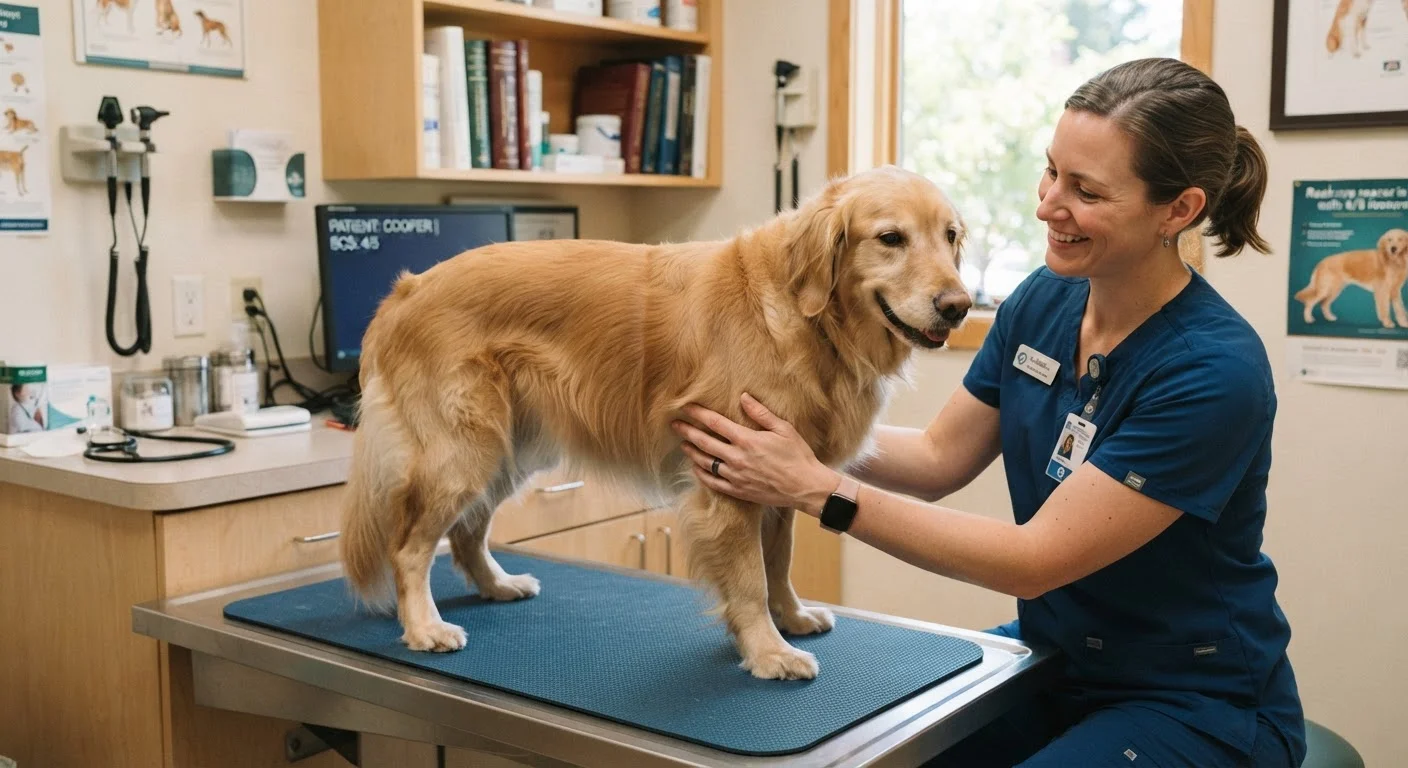
Rather than relying solely on scale weight, veterinarians use a standardized tool called the Body Condition Score (BCS). Most practices use either a 5-point or 9-point scale. On the 9-point version, a score of 4-5 is considered ideal. A score of 6-7 indicates overweight, and 8-9 signals obesity.
The BCS is determined through both visual observation and hands-on assessment. Vets look at whether the waist is visible from above, whether there is an abdominal tuck when viewed from the side, and whether ribs can be felt easily without pressing hard - but are not visible through the fur. You can practice a simplified version of this at home: run your fingers firmly along your pet's ribcage. If you cannot feel individual ribs without applying noticeable pressure, excess fat is likely present.
~59%
Dogs classified as overweight or obese
The Association for Pet Obesity Prevention's clinical surveys have repeatedly found that the majority of dogs assessed in veterinary practice fall above their ideal body condition score.
~61%
Cats classified as overweight or obese
Similar surveys indicate cats are affected at an even higher rate than dogs, with indoor-only and neutered cats at elevated risk.
It's equally important to understand that underweight is also a concern. A pet whose ribs, spine, or hip bones are prominently visible needs evaluation just as much as an overweight one. The goal is that comfortable middle - a slight hourglass shape, palpable but not prominent ribs, and an evident waist.
What you feed your pet is closely tied to weight outcomes. Understanding how to read a pet food label accurately is a practical first step toward making better portion decisions. And because package feeding guides are population averages rather than individual prescriptions, learning how to adjust portions for your specific pet is equally valuable.
This article is for general informational purposes only and does not constitute veterinary medical advice. Always consult a licensed veterinarian for guidance specific to your pet's health and weight management needs.