

Key Takeaways
What Reactivity Actually Means
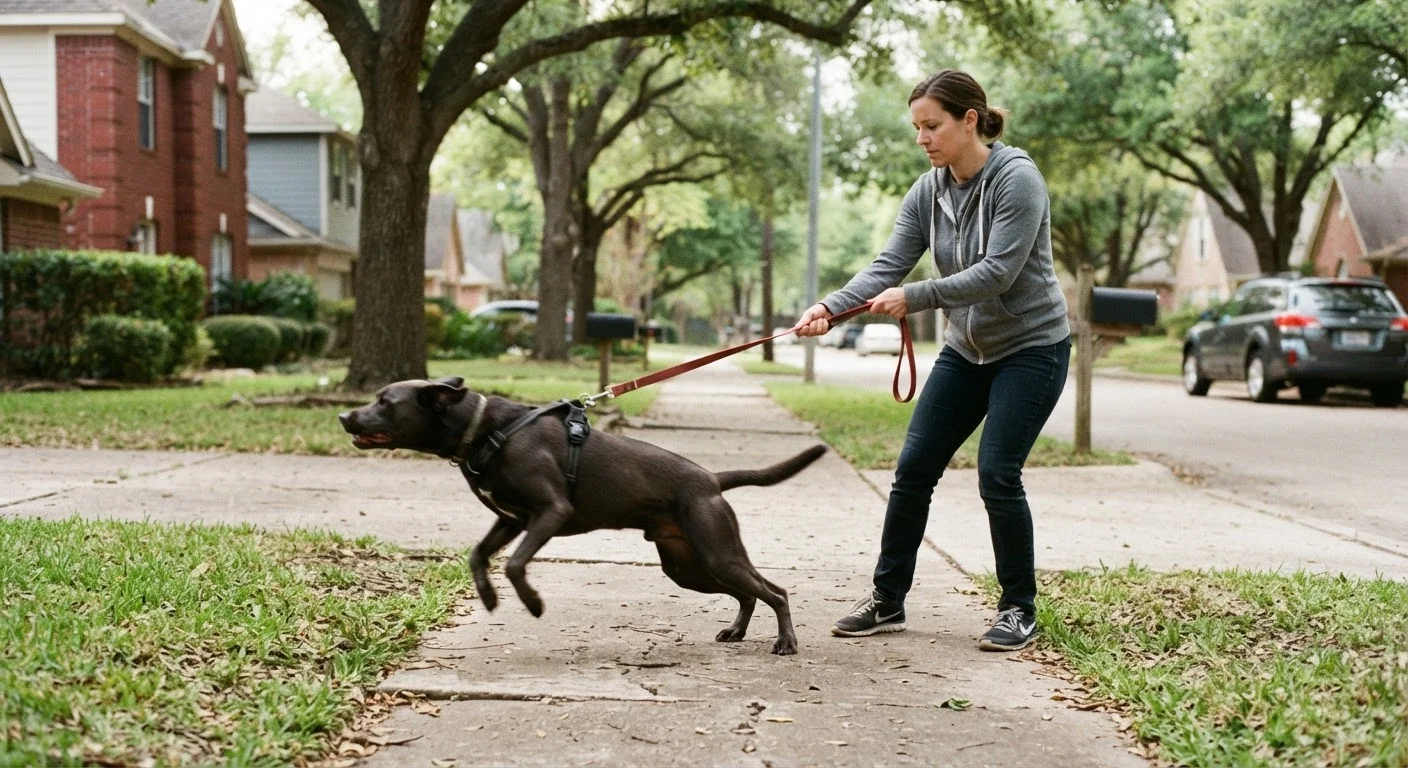
If your dog barks explosively at passing dogs, lunges toward cyclists, or freezes and stiffens at the sight of a stranger, you're likely dealing with leash reactivity - an overreaction to specific triggers that the dog perceives as threatening or overly exciting. It's one of the most common challenges pet owners report on walks, and it's frequently misread as aggression or stubbornness.
Reactivity is better understood as an emotional response. The dog's arousal spikes past a manageable level, and their behavior reflects that internal state: fight, flight, or freeze. The leash compounds things by removing the dog's option to move away, which can intensify the reaction. As the real reasons behind leash behavior article explains, what looks like defiance is almost always something more nuanced happening beneath the surface.
Understanding the signs, common triggers, and management strategies gives owners a clear path forward - and the strategies below are drawn from behavior science and positive reinforcement principles.
Recognize the early warning signs
Reactivity doesn't start with the bark - it begins much earlier. Learning to read your dog's pre-reaction signals lets you intervene before the behavior escalates. Key signs to watch for include:
- Body stiffening - muscles tighten, posture becomes rigid
- Fixed staring - locked gaze on the trigger without looking away
- Ears forward or pinned back depending on the emotional valence
- Tail raised stiffly or tucked low
- Leash tension increasing as the dog orients toward the trigger
Catching these signals early - before full arousal - gives you a window to redirect or increase distance. The further you are in this chain when you act, the harder it is to bring the dog's arousal back down.
The bark is the last warning sign - learn to read what comes well before it.
Identify your dog's specific triggers
Not all reactive dogs respond to the same things. Common triggers include other dogs (especially on-leash), unfamiliar people, joggers, cyclists, skateboards, loud vehicles, and sudden movements. Some dogs react only to certain contexts - for example, a dog may be fine with people approaching from the front but react to those passing from behind.
Keep a simple mental or written log after each reactive episode: What triggered it? How far away was the trigger? Was the dog already tired or aroused from something earlier in the walk? This kind of pattern recognition helps you anticipate situations and manage them proactively rather than reactively.
Pattern recognition across multiple walks is more useful than any single observation.
Understand the concept of 'threshold'
Threshold refers to the distance from a trigger at which your dog can still think, take treats, and respond to cues. Under threshold means the dog is aware of the trigger but still manageable. Over threshold means arousal has peaked and learning is effectively shut down - this is when lunging and barking occur.
Your training goal is to keep your dog under threshold as much as possible during walks, and to gradually, over many repetitions, reduce the distance at which they remain comfortable. Trying to push a dog past their threshold too quickly tends to worsen reactivity rather than improve it.
Once a dog goes over threshold, the learning window closes - management means staying below it.
Apply desensitization and counter-conditioning
These two techniques are the foundation of evidence-based reactivity work. Desensitization means gradually exposing the dog to their trigger at a level below what causes a reaction - starting far away, then incrementally reducing distance across sessions over time. Counter-conditioning means pairing the trigger with something the dog loves (usually high-value food), so the trigger begins to predict good things rather than stress.
In practice: when your dog notices the trigger but hasn't reacted, mark the moment (with a verbal cue like "yes" or a clicker) and immediately deliver a treat. You're teaching the dog: seeing that thing means great things happen for me. The reward timing and technique concepts guide explains why timing precision matters so much here.
Counter-conditioning works by making the trigger predict good things, not by ignoring the trigger.
Use management tools to prevent rehearsal
Every time a reactive dog completes a full reaction, that neural pathway gets reinforced - the behavior becomes more practiced and more automatic. Management means arranging the environment to prevent reactions from happening in the first place, which is just as important as active training.
Practical management strategies include:
- Choosing walk routes and times with lower dog or foot traffic
- Crossing the street or turning around early when you spot a trigger
- Using a well-fitted front-clip harness to reduce pulling force without causing discomfort
- Teaching a reliable emergency U-turn cue so you can redirect quickly
A solid stay cue can also serve as a stabilizing anchor in situations where movement options are limited.
Preventing rehearsal of the reaction is as important as training an alternative behavior.
Know when to seek professional support
Some cases of reactivity are manageable with owner-led training. Others - particularly those involving dogs who have made contact, who react to nearly everything, or whose behavior is worsening despite consistent effort - warrant professional assessment. A certified professional dog trainer (CPDT-KA) with experience in behavior modification, or a board-certified veterinary behaviorist (DACVB), can provide a structured behavior modification plan and, where appropriate, discuss whether a veterinary consultation is warranted to rule out pain or underlying anxiety as contributing factors.
Reactivity that stems from a diagnosable anxiety condition may require a comprehensive approach beyond training alone. Only a licensed veterinarian can evaluate and advise on that component. If you're also navigating other behavior concerns, the guide to separation anxiety offers a useful parallel look at how anxiety-driven behaviors are assessed and addressed.
When reactivity is severe or worsening, professional assessment can prevent dangerous escalation.
Building a Long-Term Management Plan
Reactivity rarely resolves in a single training session. Think of it as a gradual retraining of your dog's emotional response - one repetition at a time. Consistency across all walks matters more than any single technique.
High-Value Treats Make a Real Difference
During counter-conditioning sessions, use treats your dog finds exceptionally motivating - small pieces of cooked chicken, cheese, or similar high-reward foods often work better than standard kibble. The stronger the positive association you can create with the trigger, the more effectively you can shift your dog's emotional response. Save these special treats exclusively for reactivity training so they retain their value.
Before committing to a training plan, review the pre-session readiness checklist to make sure you're setting the right conditions each time you go out. And if your dog's reactions are intense, frequent, or escalating, consulting a certified applied animal behaviorist (CAAB) or a veterinary behaviorist is strongly recommended - these professionals can assess whether an underlying anxiety disorder is contributing to the behavior and advise on the most appropriate plan.
This article is for general informational and educational purposes only and is not a substitute for professional veterinary or behavior advice. If your dog's reactivity poses a safety risk, please consult a qualified professional.