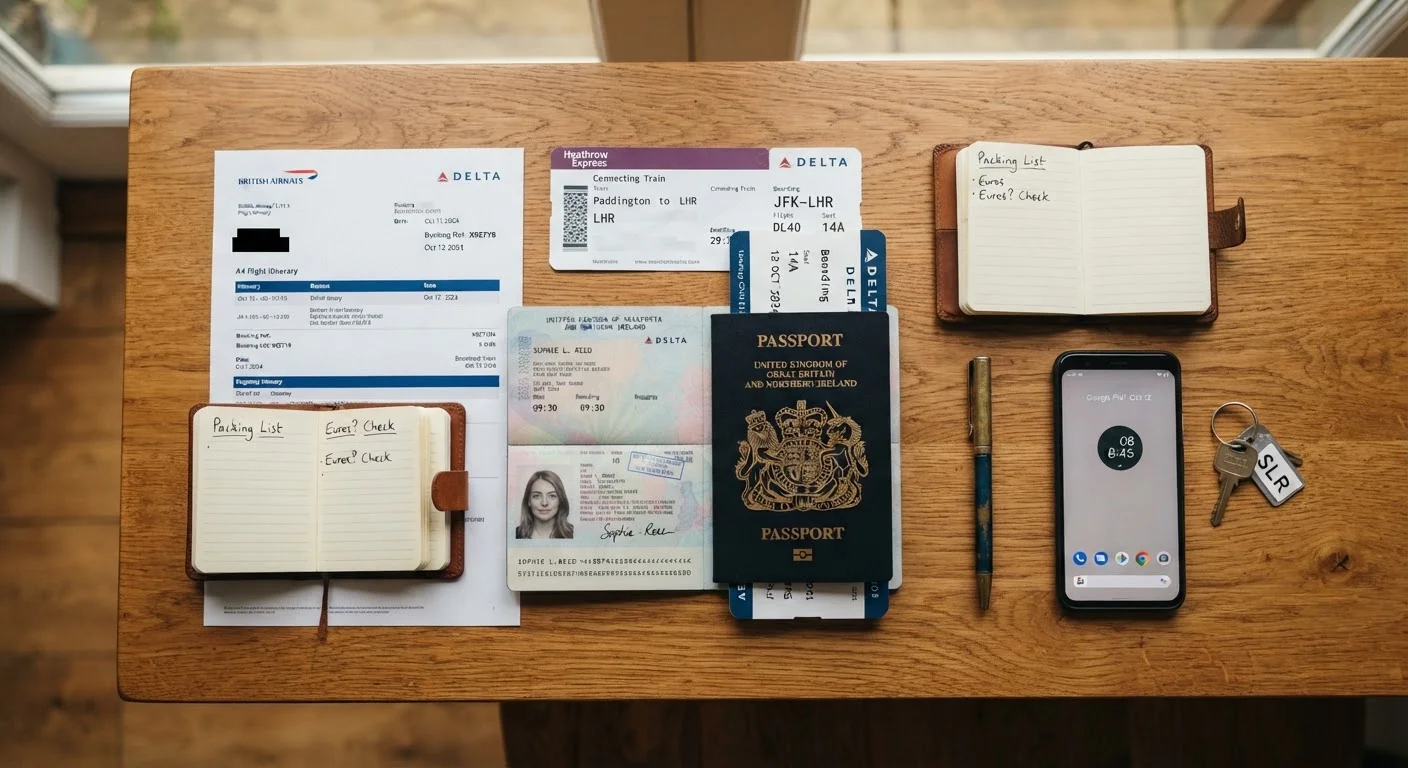
Your passport should have at least six months of validity beyond your return date - many countries require it.
Notify your bank before departure to avoid frozen cards or blocked international transactions.
Travel health prep includes vaccinations, prescriptions, and verifying your insurance covers international care.
Digital and physical copies of critical documents stored separately can be lifesavers if originals are lost.
Registering with the U.S. Smart Traveler Enrollment Program (STEP) helps the embassy reach you in an emergency.
45–90 min
Summary
28 items · 45-90 minutes
Why a Pre-Departure Checklist Matters More for International Travel
Domestic travel has a built-in safety net - if you forget something, you can usually grab it at a local store or call someone to mail it. International travel closes that net. A forgotten vaccine record, a debit card blocked for suspected fraud, or a visa requirement you didn't know existed can each derail a trip before it starts.
This checklist is designed to be worked through methodically, ideally starting several weeks before departure. Some items - like renewing a passport or scheduling a travel medicine consultation - need lead time measured in weeks, not days. If you want a broader pre-trip framework, our pre-trip preparation checklist covers the full planning arc. This guide zeroes in on what's specific to crossing a border.
Documents & Entry Requirements
Confirm your passport is valid for at least six months beyond your return date - many countries enforce this rule at the border. See what passport validity actually means for country-specific context.Must
Research whether your destination requires a visa for U.S. passport holders, and apply well in advance if one is needed.Must
Make two sets of photocopies of your passport, visa, travel insurance policy, and vaccination records - keep one set in your luggage and leave one with someone at home.Must
Save digital scans of all critical documents to a secure cloud folder or encrypted email you can access from any device.Should
Check your destination's entry requirements for any additional documents: proof of onward travel, hotel bookings, or proof of sufficient funds.Must
Review customs rules for your destination - particularly restrictions on food, medications, currency limits, and dual-entry items. Our guide on customs pitfalls explains the most common errors.Should
Health & Vaccinations
Schedule a travel medicine consultation at least 4-6 weeks before departure so any recommended vaccines can take effect in time.Must
Confirm which vaccinations your destination requires or recommends by checking CDC and State Department travel health notices.Must
Pack enough prescription medication for your entire trip plus a few extra days, kept in original labeled containers. Review our guide for travelers managing health conditions for additional documentation tips.Must
Verify that your health insurance covers international care, or purchase a separate travel health or medical evacuation policy before you leave.Must
Carry a brief medical summary (blood type, allergies, conditions, current medications) in both English and the local language if possible.Should
Finances & Banking
Notify your bank and credit card companies of your travel dates and destination countries to prevent fraud-triggered blocks.Must
Research the local currency and identify the most cost-effective way to access cash at your destination (ATMs, bank exchanges, etc.).Should
Carry a small amount of local currency for arrival - airport taxis, tips, and transit often require cash before you find an ATM.Should
Confirm your debit and credit cards don't charge excessive foreign transaction fees; if they do, consider alternatives for the trip.Should
Save your bank's international customer service number separately - the number on the back of your card typically doesn't work overseas.Must
Safety & Registration
Register your trip with the U.S. State Department's Smart Traveler Enrollment Program (STEP) so the nearest embassy or consulate can contact you in an emergency.Must
Save the address and phone number of the nearest U.S. embassy or consulate at your destination.Must
Check the State Department's travel advisory level for your destination and read any safety notes before finalizing plans.Must
Share your full itinerary - flights, accommodation, and key contact info - with a trusted person at home.Should
Technology & Connectivity
Confirm your phone plan's international coverage or purchase a local SIM or international eSIM before you depart.Must
Download offline maps, translation apps, and any essential apps before boarding - don't count on airport Wi-Fi.Should
Pack the correct power adapters and voltage converters for your destination's outlet types.Must
Enable two-factor authentication backup codes for key accounts in case you lose SIM access while abroad.Nice to have
Final Pre-Departure Checks
Reconfirm all flight and accommodation bookings 24-48 hours before departure and check in online if available.Must
Weigh your bags and verify they meet airline size and weight limits to avoid last-minute fees at check-in.Should
Arrange secure storage for important items at home (spare key, valuables) and ensure your home is properly locked and secured.Should
Tools and Resources to Have on Hand
Working through this checklist is faster when you have the right resources open. Below are the key tools worth pulling up before you start.
Required
U.S. State Department Travel Website (travel.state.gov)
Look up visa requirements, current travel advisories, and country-specific entry rules before you finalize plans.
Required
CDC Travelers' Health Portal (wwwnc.cdc.gov/travel)
Find destination-specific vaccine recommendations and health notices to bring to your travel medicine appointment.
Required
Smart Traveler Enrollment Program (STEP)
Register your international trip with the U.S. embassy so you can receive alerts and be contacted in an emergency.
Required
Secure cloud storage or encrypted email
Store digital copies of your passport, insurance documents, and itinerary so they're accessible from any device if originals are lost.
Optional
Offline maps app (e.g., downloaded map data)
Navigate your destination without relying on cellular data or paid roaming - essential in areas with limited connectivity.
Required
International power adapter set
Ensure your devices can charge at your destination's outlet configuration without damage from voltage differences.
On the packing side, international trips reward ruthless editing. Our guide on what experienced travelers leave behind explains why less gear usually means smoother travel. And if part of your journey involves a domestic drive to the airport, the driver's safety walkthrough is worth a quick scan before you hit the road.
After You've Checked Everything Off
Finishing this checklist puts you in a meaningfully stronger position than most travelers who head to the gate on instinct alone. A few final thoughts before you zip the bag:
Share your itinerary. Leave a copy with a trusted contact at home - hotel names, flight numbers, and rough day-by-day plans. If communication goes dark unexpectedly, they'll know where to start.
Know your destination's emergency numbers. The U.S. 911 equivalent varies by country. Look it up and save it on your phone before you land. Our companion guide on staying safe abroad covers the situational habits experienced travelers use to stay secure without anxiety.
Brush up on local customs. Entry logistics aside, knowing basic etiquette - greetings, tipping norms, dress expectations - goes a long way. See our overview of cultural etiquette abroad for a practical starting point.
Visa and Entry Rules Change - Always Verify Officially
Entry requirements, visa policies, and health documentation rules can change with little public notice. Always verify requirements directly through the official government website of your destination country and the U.S. State Department before you travel. Information from third-party travel sites - including this article - may not reflect the most current rules. Do not rely solely on what worked for a friend or colleague on a previous trip.
Travel & Trips Editorial Team is the collective byline for our editorial team and contributor network. Articles published under this byline or an editorial pen name are researched, written, and reviewed according to our editorial standards for clarity, consistency, and independence before publication.
Disclaimer: The content provided on our blog site traverses numerous categories, offering readers valuable and practical information. Readers can use the editorial team’s research and data to gain more insights into their topics of interest. However, they are requested not to treat the articles as conclusive. The website team cannot be held responsible for differences in data or inaccuracies found across other platforms. Please also note that the site might also miss out on various schemes and offers available that the readers may find more beneficial than the ones we cover.