

Key Takeaways
Our Verdict
Dealerships and independent mechanics each occupy a legitimate place in a driver's service strategy. Dealerships shine for warranty work, recalls, and model-specific diagnostics, while independent shops often deliver competitive value for routine maintenance and general repairs. The smartest approach is matching the shop to the job rather than committing to one option for everything.
| Best for | Recommended |
|---|---|
| Vehicles still under manufacturer warranty or subject to an open recall | Dealership Service |
| Routine maintenance such as oil changes, tire rotations, and brake inspections on older vehicles | Independent Mechanic |
| Complex electronic or model-specific diagnostics requiring proprietary tools | Dealership Service |
| Drivers seeking lower labor rates and flexible scheduling | Independent Mechanic |
What Each Option Actually Offers
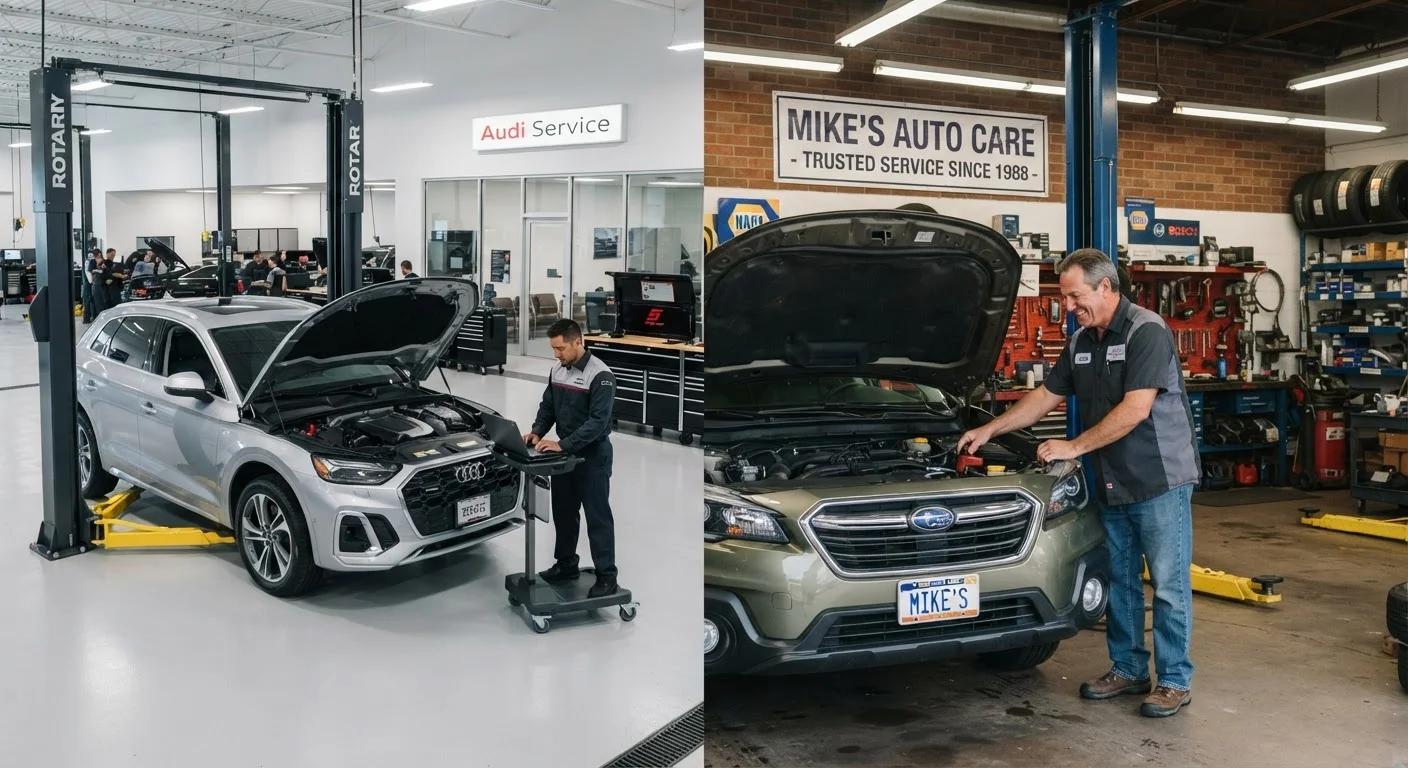
When your vehicle needs attention, two paths are available: the franchised dealership that sells and services your brand, or an independent repair shop staffed by mechanics who work on a range of makes and models. Understanding what each genuinely provides - rather than what marketing suggests - is the first step to a confident decision.
Dealerships employ technicians trained specifically on your vehicle brand and have access to manufacturer-issued diagnostic software, technical service bulletins, and original equipment manufacturer (OEM) parts. They are also the only shops authorized to perform warranty-covered repairs and manufacturer recalls at no cost to you. The trade-off is typically higher labor rates and, at some locations, a more transactional service experience.
Independent mechanics range from one-person operations to multi-bay shops with ASE-certified (Automotive Service Excellence) technicians. Many specialize in particular makes or have decades of experience with a broad range of vehicles. They generally offer more competitive labor pricing and can source quality aftermarket or OEM-equivalent parts. Their limitations tend to surface with newer, heavily computerized vehicles that require proprietary diagnostic access.
For a deeper look at what's actually involved in keeping a car in good shape, see Your Car's Maintenance Schedule, Explained.
Comparing the Key Factors
No single criterion decides this choice. The factors below reflect the practical realities most drivers encounter when weighing where to take their vehicle.
| Dealership Service | Independent Mechanic | |
|---|---|---|
| Labor rates | Generally higher | Often more competitive |
| Warranty repairs | Authorized - required for coverage | Not authorized for manufacturer warranty |
| Recall service | Performed free of charge | Not eligible to perform recalls |
| Brand-specific diagnostics | Proprietary tools available | May lack some OEM-only software |
| Parts sourcing | OEM parts standard | OEM or quality aftermarket options |
| Scheduling flexibility | Variable; can be busy | Often more flexible |
| Technician familiarity | Brand-specific training | Broad multi-make experience |
| Best suited for | New vehicles, warranty, recalls | Out-of-warranty, routine maintenance |
Labor rate differences between dealerships and independent shops can be meaningful over time, especially for high-frequency services. The Real Cost of Skipping Routine Maintenance illustrates how the cumulative effect of service decisions - wherever you get them - adds up more than any single visit.
When a Dealership Makes the Most Sense
There are specific situations where routing your vehicle to a dealership is the straightforwardly correct call:
- Active warranty coverage: Warranty repairs must be performed by an authorized dealership to be covered. Using an independent shop for a failure covered under your manufacturer or powertrain warranty typically voids that specific claim.
- Open recalls: Safety recalls are handled free of charge at dealerships. Check the National Highway Traffic Safety Administration (NHTSA) database using your VIN to confirm whether any recalls apply to your vehicle.
- Complex software or system updates: Modern vehicles increasingly rely on software integration. Some updates and calibrations - particularly for advanced driver-assistance systems (ADAS) - require manufacturer tools that independent shops may not possess.
- New or low-mileage vehicles: Keeping service records at a dealership can simplify warranty claims and, for some buyers, adds reassurance during a future resale.
When an Independent Shop Is a Sound Choice
Independent mechanics are a practical and often sensible option in many everyday scenarios:
- Out-of-warranty vehicles: Once the manufacturer warranty expires, the obligation to use a dealership disappears. At this stage, an established independent shop can offer equivalent - sometimes superior - workmanship at lower labor rates.
- Routine maintenance: Oil changes, air filter replacements, tire rotations, and brake inspections don't typically require brand-specific tools. A reputable independent shop handles these competently and often with shorter wait times.
- Established relationship with a trusted mechanic: A mechanic who knows your vehicle's history can catch developing issues early. That continuity of care has real practical value. For guidance on evaluating a shop's thoroughness, What a Pre-Purchase Inspection Actually Covers explains the standards a skilled mechanic applies.
If you're considering handling some tasks yourself, DIY Car Maintenance: Knowing What's Safe to Tackle lays out a realistic picture of where the line sits between safe home maintenance and work that belongs in a professional shop.
Questions Worth Asking Before You Decide
The quality of any service experience depends heavily on the specific shop, not just its category. Before committing, consider asking:
- Are the technicians ASE-certified? Certification isn't a guarantee of quality, but it signals a baseline of tested competency.
- What parts will be used - OEM, aftermarket, or remanufactured? Each has legitimate uses; understanding the difference helps you evaluate the quote.
- Is there a written estimate before work begins? In most U.S. states, shops are required to provide one. Insist on it.
- What warranty covers the repair? Many independent shops offer a parts-and-labor warranty on their work. Ask for the terms in writing.
- Does the shop have experience with your specific vehicle? This matters more for European imports or hybrid/electric vehicles than for common domestic models.
Keeping organized service records - regardless of where you go - protects your interests if a dispute arises and supports a vehicle's resale value. For broader context on the financial side of car ownership, Car Ownership Basics covers the key considerations every owner should understand.