

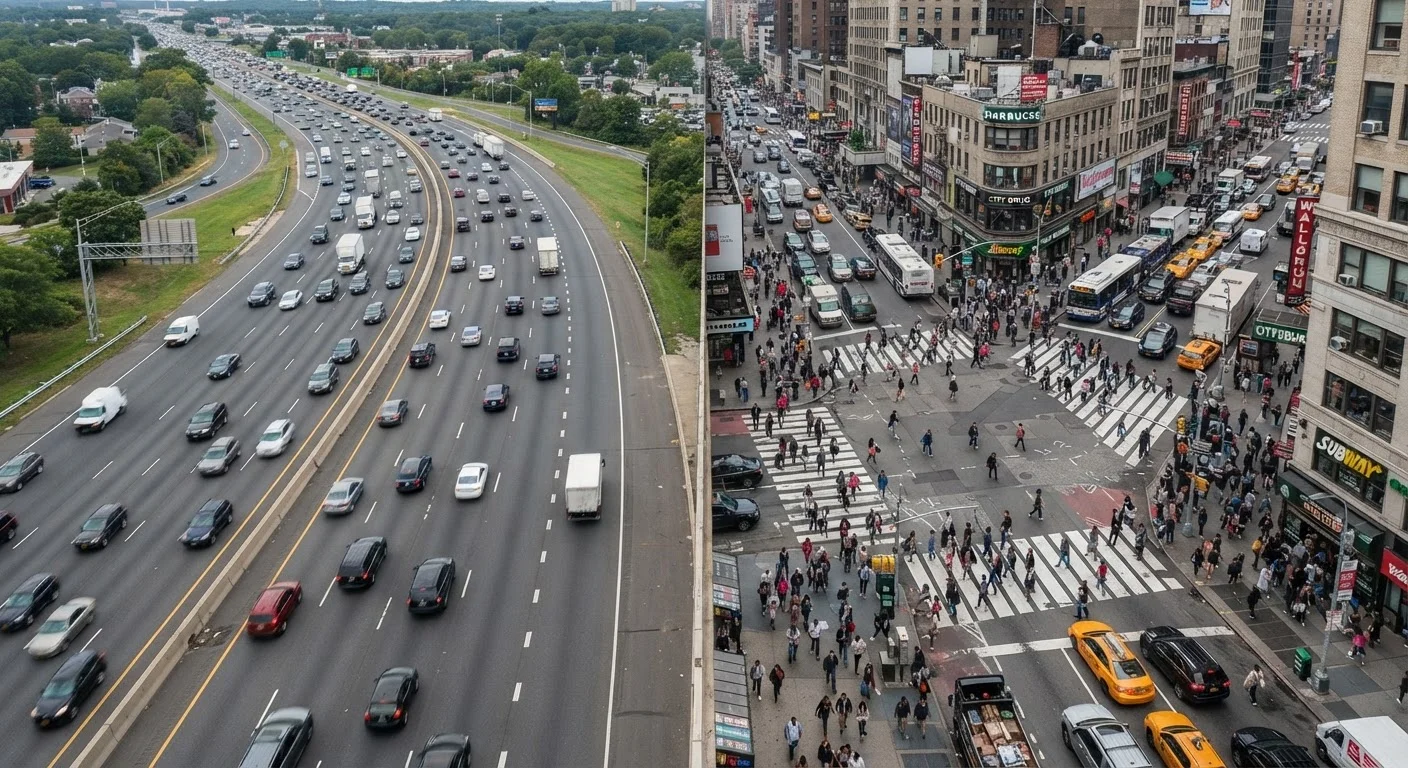
Key Takeaways
Option A
Highway Driving
High-speed, structured, long-distance travel with sustained focus demands.
Best for: Drivers covering long distances who must manage speed, following distance, and fatigue over time.
Option B
City Street Driving
Low-speed but high-complexity navigation through dense, unpredictable environments.
Best for: Drivers navigating frequent stops, pedestrians, cyclists, and tight intersections in urban areas.
If you primarily drive long rural or interstate routes
Highway Driving awareness training
High-speed environments demand mastery of following distance, lane discipline, and fatigue management over extended periods.
If you navigate dense urban areas daily
City Street Driving awareness training
Urban complexity requires constant multi-directional scanning, anticipation of pedestrian behavior, and intersection discipline.
If you regularly transition between both environments on a single trip
Both skill sets equally
Consciously shifting your mental mode - not just your speed - is critical to staying safe as road conditions change dramatically.
Why the Same Driver Faces Different Risks in Each Environment
Most American drivers split time between interstates and city streets without giving much thought to how radically different those environments are from a safety standpoint. The skills and instincts that keep you safe at 70 mph on a freeway are not the same ones that protect you - and the cyclist crossing in front of you - at a downtown intersection.
Understanding how risk is distributed across each environment is a practical step toward becoming a more deliberate, prepared driver. For a broader framework on safe habits, see our complete safe driving resource.
| Criterion | Highway Driving | City Street Driving |
|---|---|---|
| Primary speed range | 55-80+ mph | 15-45 mph |
| Dominant risk type | High-severity crashes from speed | High-frequency crashes from complexity |
| Vulnerable road user exposure | Low (limited pedestrian/cyclist access) | High (pedestrians, cyclists constant) |
| Attention style required | Sustained long-range focus | Rapid multi-directional scanning |
| Fatigue risk | High (monotony triggers microsleep) | Lower (frequent stimulation) |
| Merging/lane change frequency | Moderate, at high speed | Frequent, at low speed |
| Reaction distance at typical speed | 100+ feet per second | 30-65 feet per second |
| Weather impact severity | High (speed amplifies wet/icy risk) | Moderate (lower speeds reduce severity) |
Highway Hazards: Speed, Distance, and Sustained Attention
On the highway, the dominant risk factor is speed. At 70 mph, a vehicle travels roughly 103 feet per second. That means a two-second lapse in attention - a glance at a phone, adjusting the radio - translates to over 200 feet covered without active control. The physics of stopping distance and reaction time makes this particularly unforgiving.
Highway driving also introduces several structural hazards:
- Merging and lane changes: Speed differentials between lanes and oncoming merge traffic create conflict points that require mirror discipline and timing. See our breakdown of merging and blind spot management for detailed technique.
- Fatigue: Monotonous stretches of highway are a well-documented trigger for microsleep - brief, involuntary sleep episodes that last as little as a few seconds but can be fatal at speed.
- High-severity crashes: While freeway crashes occur less frequently per mile than urban crashes, they are statistically more likely to result in serious injury or fatality when they do occur, largely because of the speeds involved.
Weather compounds all of these factors significantly. Rain, snow, and fog extend stopping distances and reduce visibility at the very speeds where drivers have the least margin for error.
City Street Hazards: Complexity, Proximity, and Unpredictability
Urban driving is slower but significantly more chaotic. The hazard density on city streets - pedestrians mid-block, cyclists in and out of lanes, double-parked trucks blocking sightlines, and signalized intersections with multiple conflict points - demands constant, active scanning rather than sustained highway vigilance.
Key city-driving risk factors include:
- Pedestrian and cyclist exposure: Urban environments place vulnerable road users in close, frequent proximity to vehicles. Right-hook collisions (where a turning vehicle strikes a cyclist) and crosswalk conflicts are disproportionately common in cities.
- Intersection complexity: A four-way intersection can generate up to 32 distinct conflict points between vehicles, cyclists, and pedestrians. Driver inattention at even a modest 25 mph can result in a serious collision.
- Door zones and narrow lanes: Parked cars create the risk of sudden door openings. Tight urban lanes reduce the buffer between your vehicle and other road users.
- Distracted and unpredictable behavior: Pedestrians checking phones, cyclists riding against traffic, and aggressive drivers contribute to an environment where the next hazard can appear from multiple directions simultaneously.
Nighttime amplifies urban risks further. Reduced vision and glare make pedestrians harder to detect, especially those not wearing reflective clothing.
Adapting Your Approach When Transitioning Between Environments
One underappreciated risk moment occurs when drivers move from one environment to the other - exiting a freeway into a city, or transitioning from stop-and-go urban traffic onto an open interstate. Speed adaptation is the obvious adjustment, but the mental mode shift matters just as much.
Drivers exiting highways often carry highway-speed habits into lower-speed zones: longer following distances feel unnecessary, and scanning for pedestrians hasn't yet become instinctive. Conversely, drivers moving from congested city streets onto a freeway may underestimate how quickly they need to build speed for a safe merge.
~40%
Of U.S. traffic fatalities occur at intersections
According to the Federal Highway Administration, intersection-related crashes account for a substantial share of all road deaths, underscoring the danger of urban conflict points.
103 ft/sec
Distance traveled per second at 70 mph
Basic physics means a two-second distraction at highway speed covers over 200 feet - longer than most drivers intuitively estimate.
32
Potential conflict points at a standard four-way intersection
Traffic engineering research identifies up to 32 vehicle-vehicle and vehicle-pedestrian conflict points at a typical signalized urban intersection.
Deliberate habits help bridge both environments: always recalibrate your following distance as conditions change, check your scanning rhythm (highway scanning is long-range; city scanning is wide and close-range), and resist the assumption that the rules of one environment carry smoothly into the other.
This article is for general informational purposes only. Driving conditions vary widely, and readers should always follow posted signs, local traffic laws, and current guidance from road safety authorities in their area.