

Key Takeaways
Tailgating
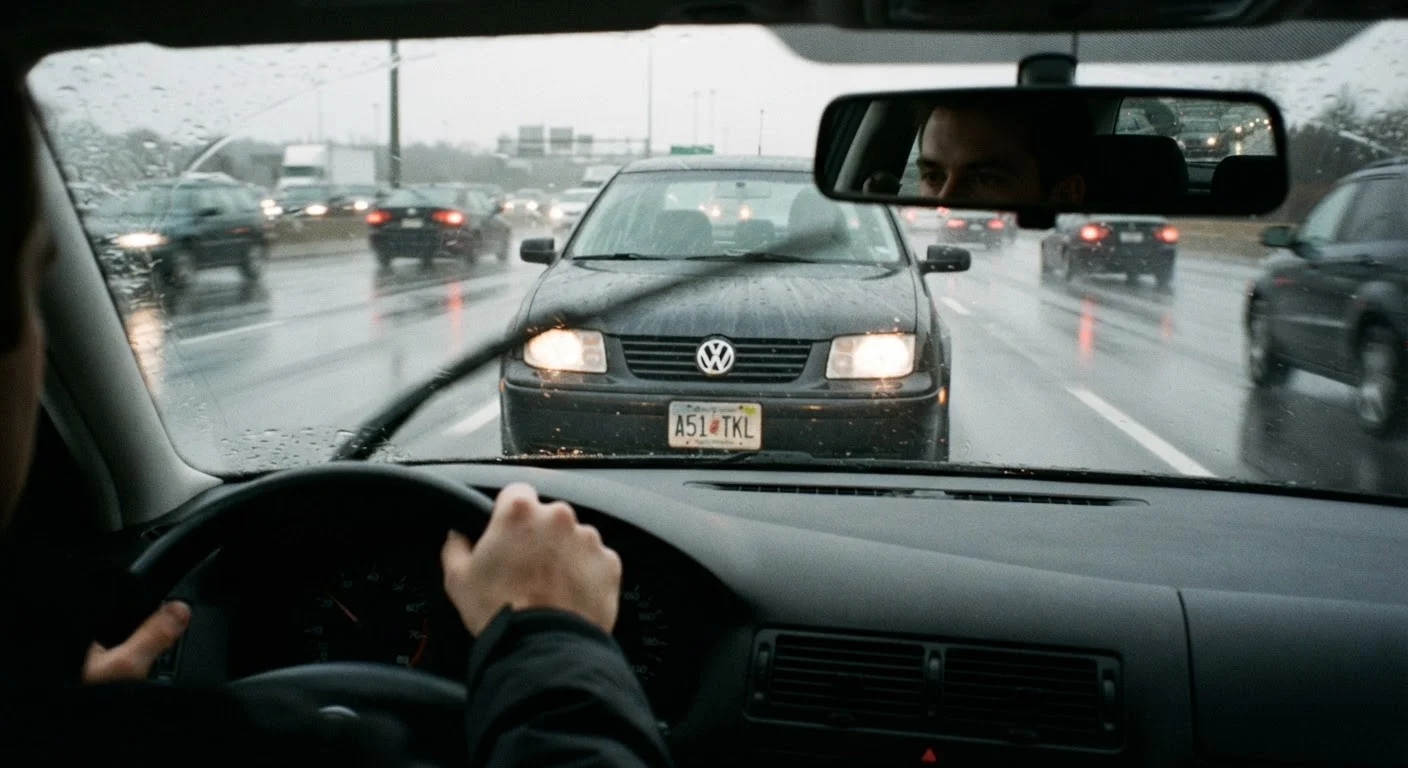
Tailgating means following another vehicle more closely than is safe given your speed, road conditions, and reaction time. When you tailgate, the gap between your front bumper and the vehicle ahead is too small to allow you to stop safely if that driver brakes suddenly. It is one of the most common - and underestimated - causes of rear-end collisions on American roads.
The federally recognized guideline is the three-second following rule: pick a fixed point, and your vehicle should pass it no sooner than three seconds after the vehicle ahead. In adverse conditions, that gap should increase to four or more seconds.
The Physics of Stopping a Moving Vehicle
Understanding why tailgating is dangerous starts with a basic physics reality: cars do not stop instantly. The total stopping distance of any vehicle is made up of two components - reaction distance (the distance traveled while the driver perceives a hazard and moves their foot to the brake) and braking distance (the distance the vehicle travels once the brakes are applied).
Average human reaction time is approximately 1.5 seconds. At 60 mph, that alone means your vehicle travels about 132 feet before the brakes even engage. Add braking distance on a dry road, and a typical passenger car needs roughly 240-270 feet to stop from highway speed. On wet pavement, that number can increase by 50 percent or more.
For a detailed breakdown of how speed and distance interact, see the physics and guidelines behind safe following distances.
~29%
Of all U.S. crashes that are rear-end collisions
According to the National Highway Traffic Safety Administration (NHTSA), rear-end crashes consistently represent nearly one-third of all reported traffic crashes annually.
1.5 sec
Average human reaction time before braking begins
Research in traffic safety literature consistently places average driver perception-reaction time at approximately 1.5 seconds under normal conditions.
132 ft
Distance traveled at 60 mph before brakes engage
At 60 mph, reaction distance alone covers roughly 132 feet - before the vehicle even begins to slow down.
Why Three Seconds Is the Baseline - Not the Maximum
The three-second rule exists because it accounts for an average driver's reaction time plus a reasonable braking margin under normal road conditions. But it is a minimum baseline, not a ceiling. Several conditions demand more space:
- Rain and wet roads: Braking distances increase dramatically on wet asphalt because tire-to-road friction is reduced. A four- to five-second gap is more appropriate.
- Ice and snow: Stopping distances can be four to ten times longer than on dry pavement depending on surface conditions and tire type.
- Towing or carrying heavy loads: Extra weight increases momentum and extends stopping distance. Large SUVs, trucks with trailers, and loaded vehicles all need more room.
- Older vehicles or worn tires: Brake system condition and tire tread depth directly affect how quickly a vehicle can stop.
Drivers often underestimate how much conditions compound stopping distance - what feels like a comfortable gap on a dry summer day is dangerously inadequate after a rainstorm. Night driving introduces similar margin-reducing factors that make adequate following distance even more important after dark.
The Psychology Behind the Habit
Tailgating is not always intentional aggression. Many drivers follow too closely simply because speed distorts their perception of distance. At highway speeds, a three-second gap - which looks enormous on paper - can appear surprisingly tight through a windshield, especially in heavy traffic where closing gaps feels instinctive.
Other contributors include:
- Impatience: Running late or feeling in a hurry causes drivers to unconsciously reduce following distance in an attempt to maintain pressure on slower traffic ahead.
- Normalization: Dense highway traffic sometimes creates a herd effect where nearly every driver is following too closely, making the behavior feel normal and safe when it is neither.
- Cognitive load: Distracted driving - even a brief glance at a phone or navigation screen - eliminates reaction time entirely. Combined with a short following gap, even momentary inattention can be catastrophic. Distracted driving habits are more common than most people acknowledge.
“Following too closely is one of the most preventable crash causes on the road. Drivers consistently overestimate how quickly they can react and how quickly their vehicle can stop - the physics simply don't support the gaps most people are leaving.”
— Traffic Safety Research Community, General consensus reflected in NHTSA and IIHS driver behavior research
Building the Habit of Safe Following Distance
Correcting tailgating is straightforward in concept but takes conscious practice to make automatic. A few strategies that traffic safety educators consistently recommend:
- Use the three-second count every time. Pick a stationary object - a sign, overpass, or lane marker - and count seconds after the vehicle ahead passes it. If you pass it before three seconds, back off.
- Resist mirror pressure. If someone is tailgating you, the instinct is often to speed up or close the gap ahead of you. Instead, gradually increase your own following distance so you have extra cushion to slow down smoothly without provoking a chain reaction.
- Account for conditions proactively. Before entering rain, snow, or heavy traffic, consciously extend your gap - don't wait until you need it.
- Build the habit early if you have new drivers at home. Teen drivers benefit enormously from explicit coaching on following distance, since they lack the experience to intuitively recognize when a gap is too short.
Following distance is one of the simplest, most measurable safety habits a driver can develop. For a broader look at the defensive driving principles that reinforce this habit, see our comprehensive safe driving resource.