

Key Takeaways
Option A
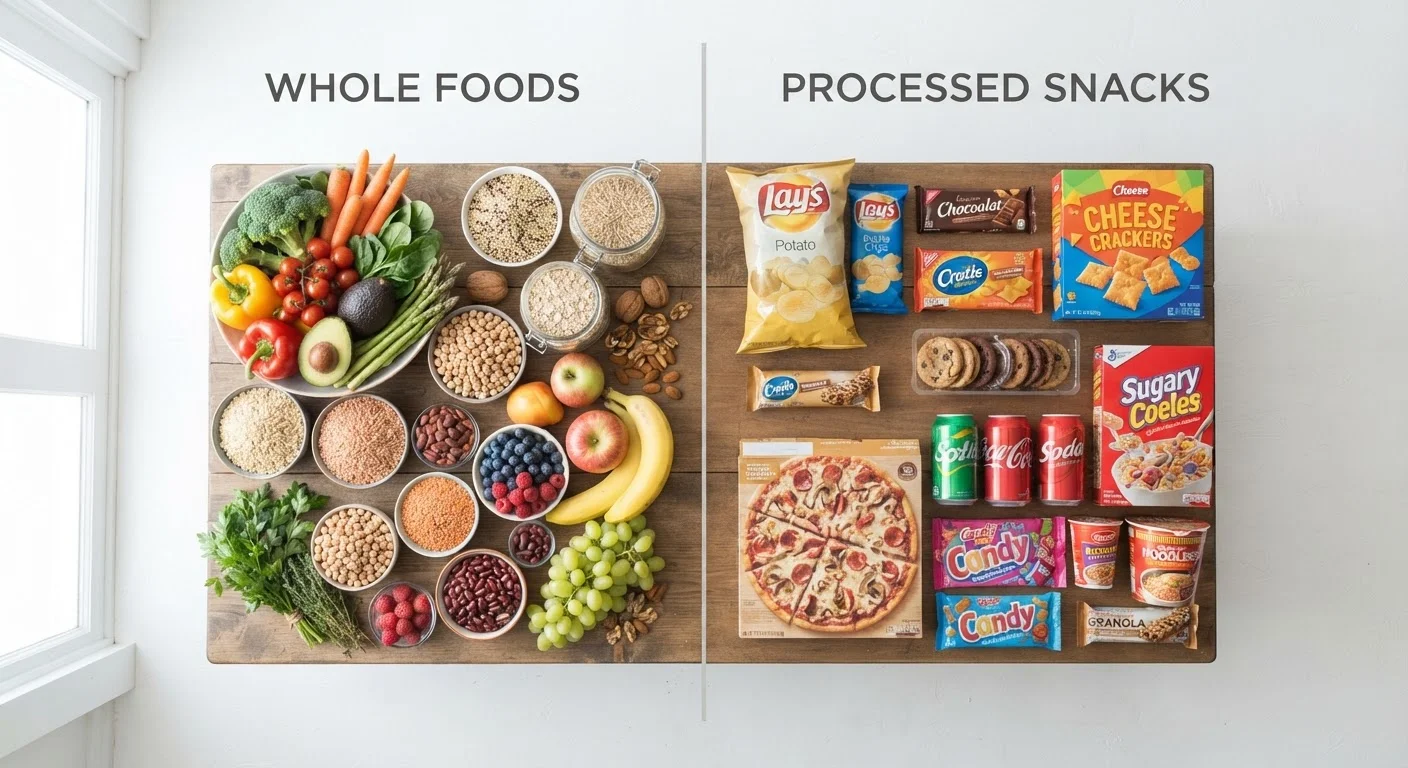
Whole Foods
The minimally altered, nutrient-dense foundation of most dietary guidance.
Best for: People looking to maximize nutrient density and build eating patterns around evidence-based dietary guidelines.
Option B
Processed Foods
A broad spectrum ranging from mildly altered staples to heavily engineered convenience products.
Best for: Understanding how industrial food production affects nutritional quality, and where different foods fall on the processing scale.
If you want to maximize nutrient density in your diet
Whole Foods
Whole foods preserve more fiber, vitamins, minerals, and phytonutrients that are often reduced or lost during industrial processing.
If you need affordable, quick, and shelf-stable options
Processed Foods
Lightly processed staples like canned beans, frozen vegetables, and whole-grain bread offer genuine nutritional value alongside practical convenience.
If you're trying to reduce added sugars, sodium, and refined oils
Whole Foods
Ultra-processed products are a primary source of excess sodium, added sugars, and refined fats in the American diet.
If you're learning to read food labels and evaluate packaged products
Processed Foods
Understanding what's been added, removed, or altered in processed foods is the first step to making more informed choices within that category.
Defining the Terms: What Does 'Processing' Actually Mean?
The phrase "processed food" is widely used but rarely defined with precision. In the broadest sense, any food that has been altered from its original form - washed, cut, cooked, frozen, or packaged - has been processed. By that definition, almost everything humans eat is processed to some degree.
What matters more is the degree and purpose of processing. Researchers and public health bodies have developed frameworks to clarify this. The most widely cited is the NOVA classification system, developed by researchers at the University of São Paulo, which groups foods into four categories based on the extent and intent of industrial processing:
- Group 1 - Unprocessed or minimally processed foods: Foods as found in nature or with only minimal physical alteration - fresh fruit, vegetables, plain meat, eggs, plain milk, legumes, nuts, and whole grains.
- Group 2 - Processed culinary ingredients: Substances extracted from Group 1 foods and used in cooking - oils, butter, flour, sugar, and salt. These are rarely eaten alone.
- Group 3 - Processed foods: Products made by adding Group 2 ingredients to Group 1 foods, primarily to extend shelf life - canned fish, cheeses, cured meats, and bottled vegetables.
- Group 4 - Ultra-processed foods: Industrially formulated products containing additives not used in home cooking - emulsifiers, artificial flavors, colorants, and stabilizers. This includes most packaged snacks, sodas, reconstituted meat products, and instant noodles.
This spectrum matters because lumping all processed foods together obscures meaningful nutritional distinctions. A can of plain chickpeas and a bag of cheese-flavored chips are both "processed," but they are nutritionally very different.
How Processing Affects Nutritional Value
Industrial processing can affect food in both directions - sometimes improving safety and digestibility, often reducing beneficial nutrients.
On the beneficial side, pasteurization eliminates pathogens in milk, fermentation improves the bioavailability of some nutrients in yogurt and kefir, and freezing vegetables shortly after harvest can preserve micronutrient content better than long-transported "fresh" produce.
However, heavier processing commonly involves:
- Fiber loss: Refining whole grains removes the bran and germ - the parts containing fiber, B vitamins, iron, and healthy fats. White flour and white rice are lower in these nutrients than their whole-grain counterparts.
- Micronutrient depletion: High-heat processing and extended storage can degrade heat-sensitive vitamins such as vitamin C and some B vitamins.
- Additive load: Ultra-processed foods typically contain high levels of added sodium, refined sugars, and saturated or trans fats - nutrients the DGA consistently recommends limiting.
- Phytonutrient reduction: Beneficial plant compounds - antioxidants, polyphenols, and flavonoids - are concentrated in the parts of plants often removed during processing.
| Criterion | Whole Foods | Ultra-Processed Foods |
|---|---|---|
| Fiber content | High; naturally intact | Often removed or minimal |
| Added sugars | None added | Frequently high |
| Sodium levels | Naturally low | Often elevated for flavor/preservation |
| Micronutrient density | High and naturally occurring | Reduced; sometimes re-fortified |
| Additive content | None | Emulsifiers, colorants, stabilizers |
| Shelf life | Short to moderate | Extended |
| Cost and convenience | Varies; can require more prep | Often lower cost; ready-to-eat |
For a practical tool to evaluate packaged products, see our guide on reading a Nutrition Facts label without the confusion.
What the Research Actually Shows
Large observational studies have consistently associated higher consumption of ultra-processed foods with increased risk of obesity, type 2 diabetes, cardiovascular disease, and certain cancers. A frequently cited 2019 cohort study published in The BMJ found that a 10% increase in ultra-processed food consumption was associated with a significantly higher risk of cardiovascular events - though, importantly, this type of study establishes association, not causation.
57%
Share of US calories from ultra-processed foods
A 2016 analysis published in BMJ Open estimated that ultra-processed foods account for approximately 57% of total caloric intake in the average American diet.
10%
Increased cardiovascular risk per ultra-processed food serving increase
A large 2019 cohort study in The BMJ found each 10% increment in ultra-processed food consumption was associated with higher cardiovascular disease risk in an observational setting.
~90%
Americans not meeting whole grain intake recommendations
The Dietary Guidelines for Americans reports that the vast majority of US adults consume less than the recommended amount of whole grains daily.
These associations are difficult to fully disentangle from other lifestyle factors - people who eat more ultra-processed foods may also sleep less, exercise less, or have less food access. That said, the consistency of findings across diverse populations lends the evidence meaningful weight.
It is equally important to note that not all processed foods perform poorly in research. Minimally processed whole grains, plain dairy, canned legumes, and frozen vegetables are consistently included in healthy dietary patterns studied in the scientific literature. For a deeper look at how nutrition research reaches its conclusions and why findings sometimes conflict, see our article on what nutrition science can and cannot tell us.
Dietary patterns also matter more than individual foods. Research on Mediterranean, DASH, and other evidence-supported eating patterns shows that a diet built primarily around minimally processed whole foods - regardless of specific food choices - is associated with better long-term health outcomes. How this plays out across different dietary approaches, including plant-based and omnivorous diets, is explored in our piece on plant-based eating vs. omnivorous diets.
This article provides general nutrition information and education only. It is not a substitute for personalized advice from a registered dietitian or qualified healthcare provider. If you have specific health concerns or dietary needs, please consult a licensed professional.