

| Hand tools in core kit | 8 essential items |
| Recommended drill voltage | 18V lithium-ion |
| Tape measure length | 25 feet |
| Level size for household use | 24 inches |
| Hammer head weight | 16 oz (most versatile) |
| Sandpaper grits to stock | 80, 120, and 220 |
Why a Focused Tool Kit Beats a Cluttered Garage
Most homeowners accumulate tools haphazardly - a drawer of mismatched screwdrivers here, a borrowed wrench there. The result is either too little when a real repair comes up, or so much clutter that finding anything takes longer than the fix itself. A deliberately chosen core kit solves both problems.
The tools listed here are selected because they handle the widest range of everyday repairs: hanging shelves, patching drywall, tightening loose fixtures, unclogging drains, replacing switch plates, and more. Before spending on specialised gear, master this foundation. See our complete guide for first-time homeowners for broader context on where tools fit into your overall repair strategy.
| Hand tools in core kit | 8 essential items |
| Recommended drill voltage | 18V lithium-ion |
| Tape measure length | 25 feet |
| Level size for household use | 24 inches |
| Hammer head weight | 16 oz (most versatile) |
| Sandpaper grits to stock | 80, 120, and 220 |
The Essential Hand Tools
Hand tools form the backbone of any repair kit. These should be your first purchases - durable, non-powered, and immediately useful.
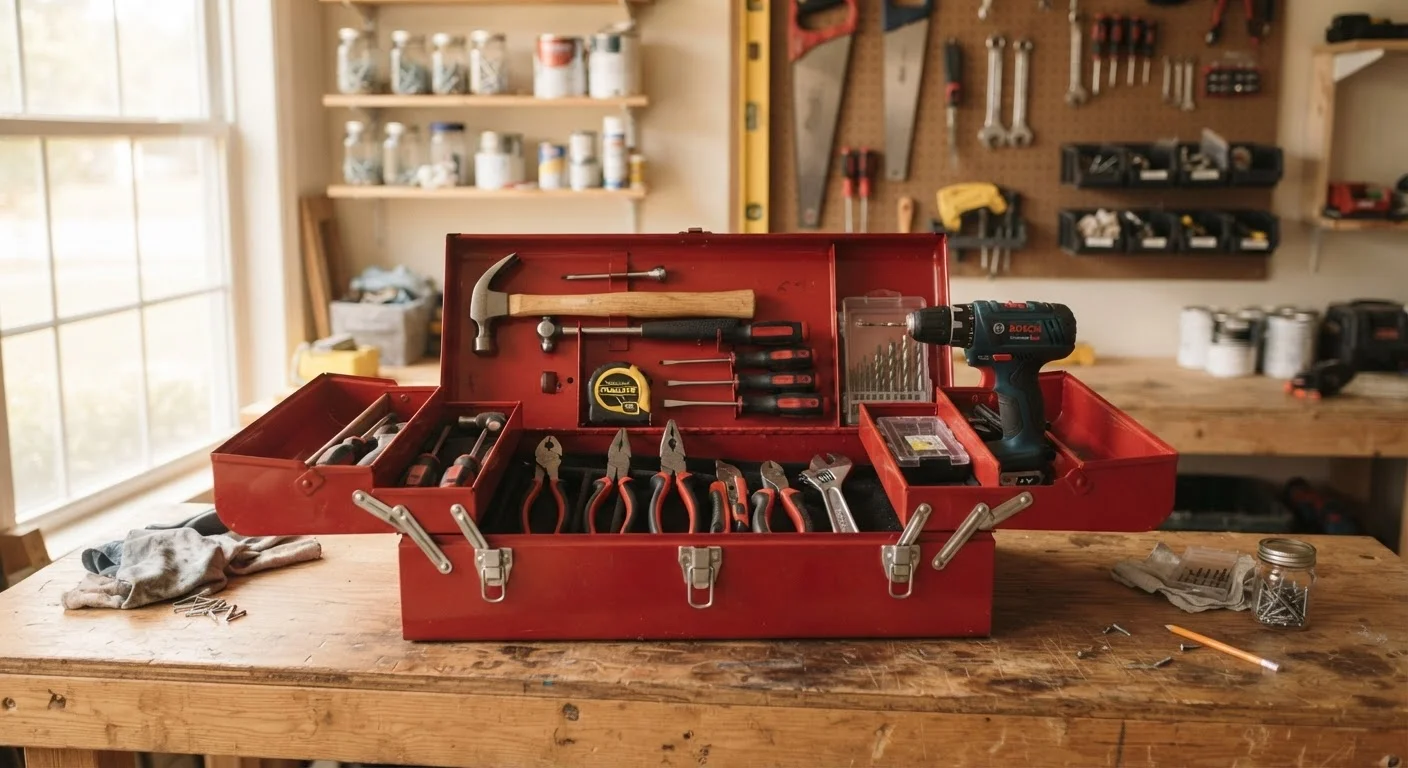
- Claw hammer (16 oz): Drives and pulls nails, sets anchors, and taps stubborn parts into place. A 16-ounce head is the most versatile weight for household tasks.
- Flathead and Phillips screwdrivers (multiple sizes): The majority of screws in your home fall into these two categories. A set with at least three sizes each covers nearly every scenario.
- Adjustable wrench: Replaces the need for an entire socket set for most plumbing fittings and hex-head fasteners. One 10-inch wrench handles most household sizes.
- Needle-nose pliers and slip-joint pliers: Needle-nose reaches tight spaces; slip-joint handles gripping, bending, and turning tasks. Both are worth keeping.
- Tape measure (25 ft): Accurate measurement prevents costly mistakes. A 25-foot, 1-inch-wide blade locks firmly and reads easily.
- Utility knife: Cuts drywall patches, opens caulk tubes, scores materials, and trims weatherstripping.
- Level (24-inch): A bubble or digital level ensures shelves, frames, and fixtures hang straight the first time.
- Putty knife: Essential for applying spackling compound, scraping loose paint, and prying off cover plates without damage.
Common DIY myths often lead homeowners to substitute a kitchen knife for a putty knife or use the wrong screwdriver - small errors that cause bigger damage.
The Power Tools Worth Adding
Two power tools cover the vast majority of tasks that hand tools cannot handle efficiently.
- Cordless drill/driver (18V): Drives screws, bores holes, and - with the right bit - mixes small amounts of compound. An 18-volt lithium-ion model provides enough torque for most home applications without excessive bulk. Always keep a spare battery charged.
- Oscillating multi-tool: Cuts, sands, scrapes, and flushes-cuts in tight spots. It earns its place by doing jobs that would otherwise require three separate tools.
Beyond these two, add power tools as specific projects justify them - not in anticipation of hypothetical jobs. This keeps costs manageable and storage practical. If you're weighing the financial side of building a kit, our budgeting basics hub offers practical ways to plan for home improvement spending.
Oscillating multi-tool
A handheld power tool with a small blade or pad that vibrates rapidly side-to-side. It can cut, sand, scrape, and grout in tight spaces where other tools cannot reach.
Toggle bolt
A wall anchor with spring-loaded wings that expand behind drywall once inserted. Used for mounting heavier items on hollow walls where no stud is available.
Slip-joint pliers
Pliers with an adjustable pivot point that allows the jaw opening to be widened or narrowed. They are versatile for gripping, bending, and turning a range of object sizes.
Driver bit
An interchangeable tip inserted into a drill or screwdriver that matches a specific screw head style, such as Phillips, flathead, or torx.
Supplies That Belong in Every Kit
Tools need consumables to function. Stock these alongside your hardware:
- Assorted drill bits and driver bits: Include wood, masonry, and a set of torx bits for modern furniture hardware.
- Sandpaper (80-, 120-, and 220-grit): Used for smoothing drywall patches, prep before painting, and removing rust from metal fasteners.
- Spackling compound and painter's tape: For patching nail holes and protecting trim during touch-up paint jobs.
- Wall anchors (assorted): Plastic expansion anchors for light loads, toggle bolts for heavier items on hollow walls.
- Flashlight or headlamp: Crawl spaces, under-sink cabinets, and attics are rarely well-lit.
For guidance on knowing when your tool kit reaches its limit, see when to DIY and when to hire. Electrical panel work, gas lines, and structural repairs are areas where licensed professionals are not optional. Safety framing matters here: tools empower you within a defined range of tasks - not beyond it.
This article is for general informational purposes. Always follow local building codes and consult a licensed professional for electrical, gas, structural, or other regulated work.