

Key Takeaways
Our Verdict
Most homeowners can confidently handle cosmetic and minor maintenance repairs with basic tools and preparation. However, work involving electricity, gas lines, structural integrity, or major plumbing connections carries real safety and legal risk that typically warrants a licensed professional. The smartest approach is honest self-assessment: match the task to your actual skills, not your ambitions.
| Best for | Recommended |
|---|---|
| Homeowners comfortable with basic tools and low-stakes repairs | DIY |
| Electrical, gas, structural, or permitted work | Hire a licensed professional |
| Repairs where a mistake could cause injury or significant property damage | Hire a licensed professional |
| First-time repairs with clear tutorials and minimal risk if done imperfectly | DIY |
The Core Question: What's Actually at Stake?
Before picking up a tool or dialing a contractor, ask yourself one question: what happens if this goes wrong? That answer does more to clarify your decision than almost anything else.
A poorly patched drywall hole can be redone on a weekend with little consequence. A wiring mistake can start a fire. A gas line error can be fatal. The severity of potential failure - not just your confidence level - is the first and most important filter for any repair decision.
Beyond safety, consider legal exposure. Many jurisdictions require permits and licensed contractors for electrical, plumbing, structural, and HVAC work. Unpermitted work can complicate home sales, void homeowner's insurance claims, and result in costly correction orders. Check with your local building department before starting any substantial repair. You can also explore our comprehensive first-time homeowner guide for a broader overview of permits and repair basics.
What DIY Handles Well
A large category of everyday home repairs is well within reach for motivated homeowners willing to do a little research. These tasks share a common profile: limited safety risk, forgiving learning curves, and consequences of error that are cosmetic rather than dangerous.
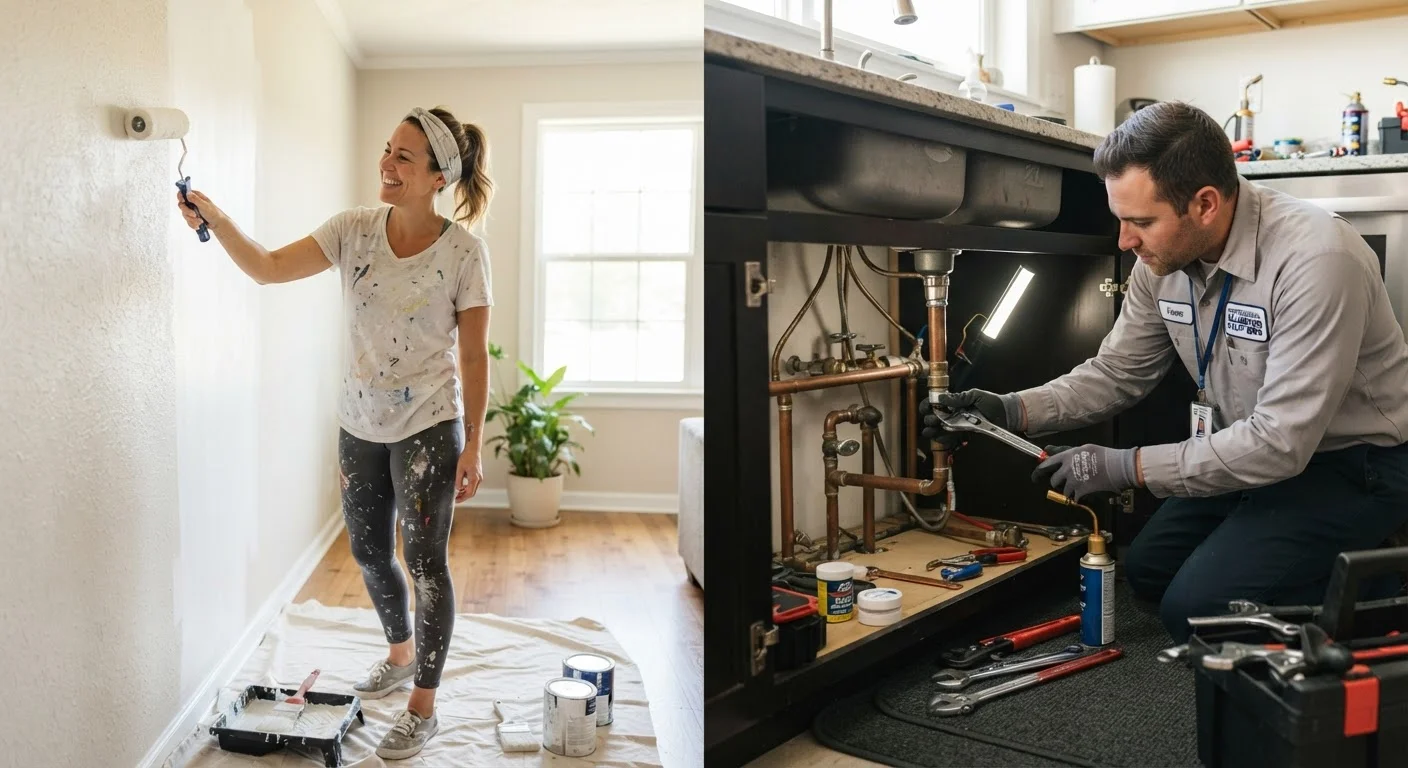
- Painting interior walls and trim - With proper surface prep, this is one of the highest-impact, lowest-risk DIY projects. See how to prep walls correctly before you pick up a roller.
- Patching drywall - Small to medium holes are a common and manageable DIY task. Our step-by-step drywall patching guide walks you through it.
- Fixing leaky faucets and running toilets - Most fixture-level plumbing repairs don't touch supply mains or drain stacks. Basic plumbing repairs like these are fair game for a prepared homeowner.
- Caulking and weatherstripping - Sealing gaps around windows, doors, and tubs requires inexpensive materials and no specialized knowledge.
- Replacing hardware and fixtures - Cabinet pulls, door handles, light switch covers, and similar swaps are beginner-friendly and require only basic hand tools.
| Repair Type | DIY | Hire a Pro | |
|---|---|---|---|
| Interior painting | Well-suited - low risk, high reward | Not necessary unless large-scale commercial | |
| Drywall patching | Ideal for small to medium holes | Consider for full panel replacement | |
| Faucet/toilet repairs | Fixture-level work is manageable | Needed for main line or sewage issues | |
| Electrical panel/circuits | Not recommended - safety and code risk | Required in most jurisdictions | |
| Gas line work | Never - serious safety hazard | Always required | |
| Structural/foundation | Not advised without engineering input | Licensed contractor essential | |
| HVAC repairs | Filter changes only | Certified tech for system-level work |
Having the right equipment matters. Refer to the core DIY tool kit to make sure you're set up before starting any project.
When to Call a Licensed Professional
Certain repairs sit in a different category entirely - not because they're intimidating, but because the risks of error are disproportionately high. In these cases, hiring a licensed professional isn't a sign of defeat; it's simply the right call.
- Electrical panel work and new circuit installation - Panel upgrades, new circuits, and service entrance work carry shock and fire risk, and are regulated by code in virtually every U.S. jurisdiction. Most localities require a licensed electrician and an inspection.
- Gas line connections and appliance hookups - Any repair or modification to a gas supply line requires a licensed professional. A leak is not a recoverable mistake.
- Structural repairs - Load-bearing walls, foundation cracks, and roof framing should be assessed and repaired by qualified contractors. Incorrect work can compromise your home's structural integrity.
- Major plumbing into mains - Tying into supply mains or sewer lines, or rerouting drain stacks, typically requires permits and a licensed plumber.
- HVAC system repairs - Refrigerant handling is federally regulated and requires EPA Section 608 certification. Furnace and heat pump repairs often carry safety and warranty implications best handled by a certified technician.
For a parallel perspective on this decision-making framework in a different context, DIY vs. professional car maintenance covers the same honest approach applied to vehicle repairs.
The Gray Zone: Projects That Depend on Your Experience
Not every repair falls neatly into DIY or hire. Some tasks are safe for an experienced homeowner but risky for a first-timer. Honest self-assessment matters here more than optimism.
Replacing a light fixture or outlet, for example, is manageable if you know how to shut off the correct circuit breaker, test for live current with a non-contact voltage tester, and follow wiring diagrams. If those steps sound uncertain, this is a job for a professional - or at minimum, a task to learn with hands-on guidance before attempting alone.
Similarly, tiling a bathroom floor is a realistic DIY project for someone who has done surface prep and layout work before, but a costly mistake for someone skipping the planning steps. The honest look at DIY advantages and drawbacks can help you weigh whether you're genuinely ready for a borderline project.
A useful rule of thumb: if you'd need to watch three or more instructional videos just to understand what tools are involved, consider whether one call to a professional might be faster and safer overall.
This article provides general home repair guidance for educational purposes. Always verify local permit requirements and consult a licensed contractor for work involving electrical, gas, structural, or other regulated systems.