

Key Takeaways
Start here
Why a Budget Is the Foundation of Financial Control
Next
Step 1: Calculate Your Real Monthly Income
Then
Step 2: Map Out Every Expense
Choose your approach
Step 3: Choose a Budgeting Method
Apply it
Step 4: Set Spending Limits and Build In a Buffer
Keep going
Keeping Your Budget Working Over Time
Why a Budget Is the Foundation of Financial Control
A budget is simply a written plan for your money - a document that tells your dollars where to go before the month begins rather than wondering where they went afterward. For many households, spending is largely automatic: the mortgage comes out, groceries get bought, subscriptions charge quietly in the background. Without a plan, it's easy to reach the end of the month with less than expected and no clear explanation why.
Budgeting doesn't restrict your life. Done well, it gives you permission to spend on what matters because you've already confirmed the essentials are covered. It also creates the awareness needed to tackle bigger goals - building an emergency fund, paying down debt, or saving for a major purchase. For a broader view of how budgeting fits into your overall financial life, see The Complete Guide to Household Budgeting.
This article provides general financial information for educational purposes and is not a substitute for personalized financial advice. Consider consulting a licensed financial professional for guidance specific to your circumstances.
Step 1: Calculate Your Real Monthly Income
The only income that matters for your budget is the money that actually lands in your account - your take-home pay after taxes, insurance premiums, and any retirement contributions are deducted. Using your gross salary inflates your available funds and leads to a budget that doesn't hold up in practice.
- Salaried workers: Divide your annual net pay by 12, or use a recent pay stub's net amount.
- Hourly workers: Multiply your typical hours per week by your hourly rate, then subtract estimated withholdings.
- Variable income: Use your lowest typical month as your baseline. When you earn more, treat the surplus as bonus funds for savings or debt - not as spending money.
Include all reliable income sources: a partner's earnings, consistent side work, or regular rental income. Leave out one-time windfalls to avoid building a budget that depends on them.
Use Net Pay, Not Gross, Every Time
It's a common beginner mistake to build a budget around your salary before deductions. Always use the amount deposited into your account - your net or take-home pay. If you're unsure, check your most recent pay stub for the 'net pay' line.
Step 2: Map Out Every Expense
Pull up three months of bank and credit card statements and list everything you spent money on. Group expenses into two categories:
- Fixed expenses
- Costs that are the same each month - rent or mortgage, loan payments, insurance premiums, and fixed subscriptions. These are non-negotiable in the short term.
- Variable expenses
- Costs that fluctuate - groceries, gas, dining out, clothing, entertainment. These are where most of your adjustable spending lives.
Don't forget irregular expenses: annual fees, car registration, holiday gifts, or medical copays that don't appear every month. Estimate your annual total for these and divide by 12 to create a monthly savings line item for them.
Once mapped, total your expenses and compare them to your income. If spending exceeds income, you've identified a gap. If income exceeds spending, you now know what's available for savings or debt reduction - and likely some categories where spending has gone unexamined.
Step 3: Choose a Budgeting Method
There is no single correct budgeting system. The right method is the one you'll use consistently. Here are three approaches that work well for beginners:
- 50/30/20: Allocate roughly 50% of take-home pay to needs (housing, utilities, groceries), 30% to wants (dining, entertainment, hobbies), and 20% to savings and debt repayment. It's flexible and requires minimal tracking.
- Zero-based budgeting: Assign every dollar of income a specific purpose so that income minus outgo equals zero. It demands more discipline but gives precise control. Learn more in our guide on zero-based budgeting.
- Pay-yourself-first: Move a set amount to savings immediately when you're paid, then spend what's left. This prioritizes savings automatically. See how it compares in pay-yourself-first vs. traditional budgeting.
Beginners often do well starting with 50/30/20 for its simplicity, then migrating to a more detailed method as confidence grows. For a thorough walkthrough grounded in real-life numbers, see building a monthly budget that reflects your real life.
Take-home pay
The amount of money you actually receive after taxes, insurance, and other deductions are removed from your paycheck. This is the number your budget should be built on.
Fixed expense
A recurring cost that stays the same amount each month, such as rent, a car payment, or a fixed-rate loan. These are generally non-negotiable in the short term.
Variable expense
A spending category where the amount changes from month to month, like groceries, gas, or dining out. This is where most budgeting adjustments happen.
Emergency fund
A dedicated pool of savings set aside to cover unexpected costs - like a medical bill or car repair - without disrupting your regular budget or adding debt.
50/30/20 rule
A simple budgeting framework that divides take-home pay into three buckets: roughly 50% for needs, 30% for wants, and 20% for savings and debt repayment.
Budget buffer
A small amount of money set aside within a budget for miscellaneous or unpredictable spending, helping prevent minor surprises from throwing off the entire plan.
Step 4: Set Spending Limits and Build In a Buffer
Using your expense map and chosen method, assign a dollar limit to each spending category. Work from your fixed expenses first - those are already set. Then distribute remaining income across variable categories based on your priorities.
Two rules help budgets survive contact with real life:
- Build a miscellaneous buffer. Allocate a small amount - even $50-$100 - to a catch-all category for spending that doesn't fit neatly elsewhere. This prevents minor surprises from breaking your plan.
- Create a starter emergency fund. Before aggressively tackling other goals, aim to set aside a small cushion - financial educators commonly suggest starting with $500 to $1,000 - to absorb unexpected costs without resorting to credit. Once you have a working budget, you can grow that fund further. The Saving & Investing hub covers strategies for building on that foundation.
If you find categories where spending consistently overshoots the limit, the limit may be unrealistic. Adjust it - a budget should reflect your actual life, not an idealized version of it.
Keeping Your Budget Working Over Time
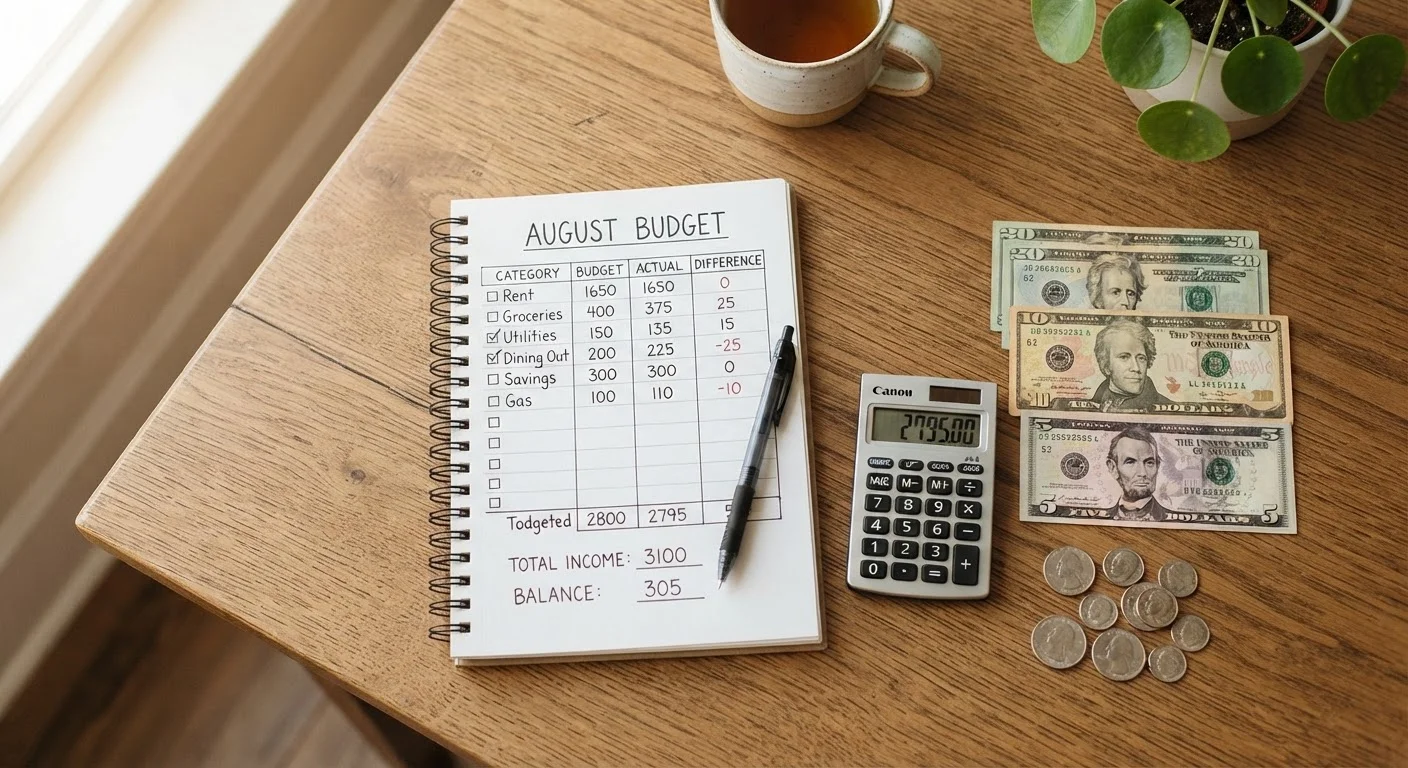
A budget is a living document, not a one-time exercise. Set aside time at the end of each month to compare what you planned against what you actually spent. Look for patterns: Which categories run over regularly? Which are you consistently underspending?
Life changes - income shifts, a new expense arrives, a goal changes priority - and your budget should change with it. For strategies on maintaining a budget through job changes, emergencies, and seasonal swings, see keeping a budget on track when life gets unpredictable.
As your budget stabilizes, it naturally surfaces opportunities to grow your savings or address debt more aggressively. Those are topics worth exploring in the Debt & Credit hub and through our guide on saving and investing from zero. Even small, consistent progress compounds over time - and it all begins with knowing where your money is going.