

| Typical stock allocation, early career | 80-90% equities (General financial planning heuristic; varies by individual) |
| Typical stock allocation, mid-career | 65-75% equities (General financial planning heuristic; varies by individual) |
| Typical stock allocation, near retirement | 40-60% equities (General financial planning heuristic; varies by individual) |
| Common rule-of-thumb formula | 110 minus your age = approximate % in stocks (Widely cited starting-point heuristic; not a personal recommendation) |
| Primary reason for reducing stocks over time | Shorter time horizon reduces ability to recover from market declines |
| Vehicle that automates allocation shifts | Target-date funds (Available through many employer retirement plans and brokerages) |
What Asset Allocation Means and Why It Changes Over Time
Asset allocation refers to how you divide your investment portfolio among different asset classes - most commonly stocks (equities) and bonds (fixed income), though it can also include cash equivalents and other investments. The mix you choose shapes both your potential returns and your exposure to risk.
Asset Allocation
The strategy of dividing a portfolio among different asset classes - such as stocks, bonds, and cash - based on an investor's goals, time horizon, and risk tolerance.
Equities (Stocks)
Ownership shares in a company. Stocks generally offer higher long-term growth potential but also greater short-term price volatility compared to bonds.
Fixed Income (Bonds)
Debt instruments issued by governments or corporations that typically pay regular interest. Bonds are generally considered lower-risk than stocks but usually offer lower long-term returns.
Rebalancing
The process of buying or selling investments to restore a portfolio to its target allocation after market movements have shifted the proportions.
Time Horizon
The length of time an investor expects to hold investments before needing to access the funds. Longer time horizons generally allow for greater short-term risk.
Sequence-of-Returns Risk
The risk that the timing of investment returns - particularly large losses early in retirement - can significantly reduce a portfolio's longevity, even if average long-term returns are positive.
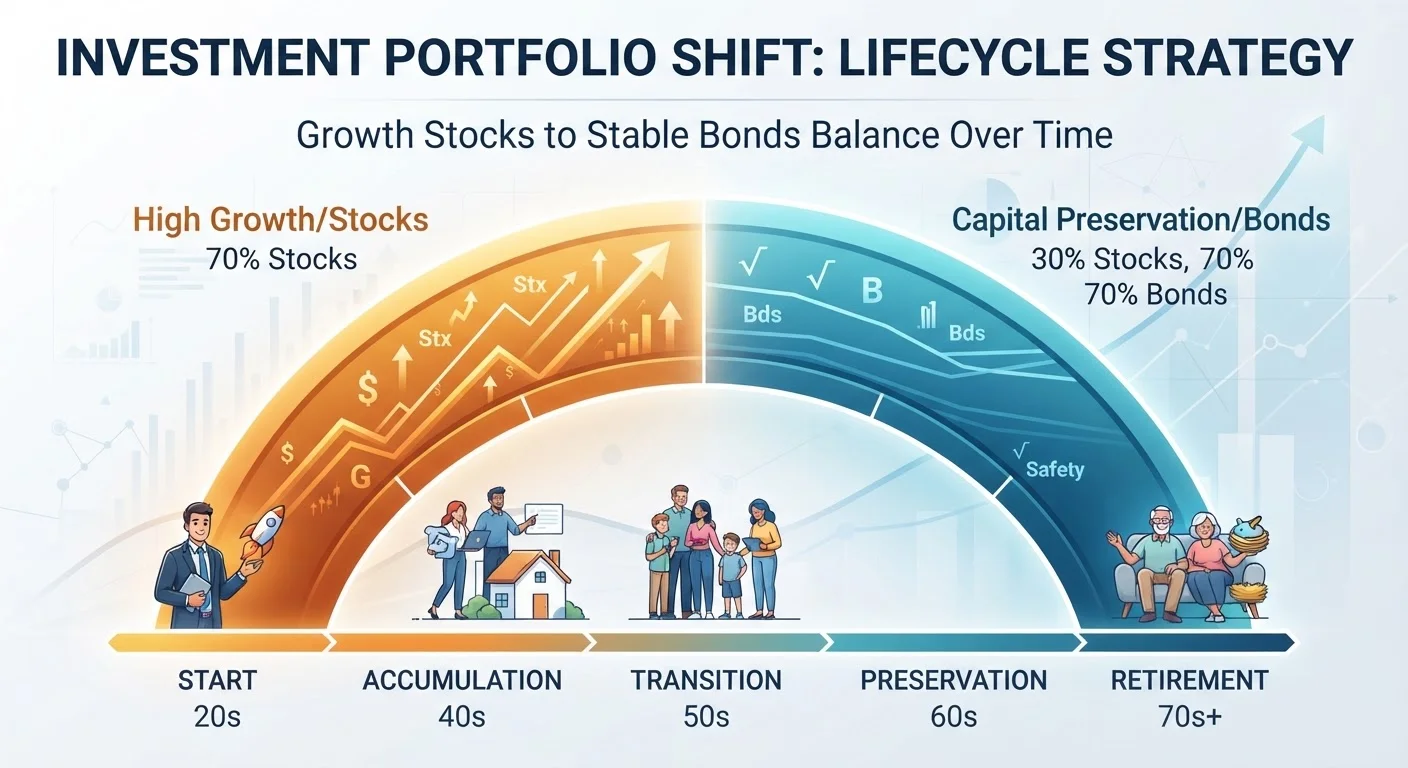
The core principle behind adjusting allocation over a lifetime is straightforward: time horizon and risk tolerance both change as you age. Early in your career, you have decades to recover from market downturns, which generally justifies a higher exposure to stocks. As retirement approaches, the priority often shifts toward preserving what you've accumulated, which typically means increasing the bond share of a portfolio.
This is general educational information, not personalized investment advice. A licensed financial professional can help you evaluate what allocation makes sense for your specific situation, goals, and risk tolerance.
Early Career: Emphasizing Growth
Investors in their 20s and early 30s commonly hold a stock-heavy portfolio - often in the range of 80-90% equities and 10-20% bonds, though this varies widely by individual circumstances. The reasoning is that a long time horizon gives investments more opportunity to recover from the inevitable ups and downs of stock markets.
| Typical stock allocation, early career | 80-90% equities (General financial planning heuristic; varies by individual) |
| Typical stock allocation, mid-career | 65-75% equities (General financial planning heuristic; varies by individual) |
| Typical stock allocation, near retirement | 40-60% equities (General financial planning heuristic; varies by individual) |
| Common rule-of-thumb formula | 110 minus your age = approximate % in stocks (Widely cited starting-point heuristic; not a personal recommendation) |
| Primary reason for reducing stocks over time | Shorter time horizon reduces ability to recover from market declines |
| Vehicle that automates allocation shifts | Target-date funds (Available through many employer retirement plans and brokerages) |
Stocks historically have delivered higher long-term average returns than bonds, along with significantly more short-term volatility. When you have 30 or more years before needing to draw on those funds, short-term price swings are easier to weather - though past market performance does not guarantee future results.
If you're building your foundational investing habits, common investing misconceptions are worth understanding early so they don't slow your progress. It's also worth reviewing habits that commonly derail wealth-building before they become entrenched patterns.
Mid-Career: Gradual Rebalancing
Through your 40s and into your 50s, many investors begin a slow, deliberate shift toward a more moderate allocation. A portfolio that was once 85% stocks might move toward something like 70% stocks and 30% bonds - though individual circumstances vary enormously based on income stability, other assets, risk tolerance, and retirement timeline.
A commonly referenced rule of thumb suggests subtracting your age from 110 (or 120, in some versions) to arrive at a rough stock percentage. For example, a 45-year-old might target roughly 65-75% in equities. These formulas are starting-point heuristics, not prescriptions - real planning requires a fuller picture of your financial life.
This period is also when irregular income, career transitions, or major expenses can complicate investing consistency. Practical strategies for maintaining your financial plan through unpredictable life events can help you stay on track even when cash flow is uneven.
Mid-career is also a good time to understand the vehicles you're investing through. How index funds compare to actively managed funds matters when rebalancing, since costs can meaningfully affect long-term outcomes.
Near and In Retirement: Shifting Toward Stability
As retirement approaches - typically within 10 years - many investors accelerate their shift toward bonds and other lower-volatility assets. The concern at this stage is sequence-of-returns risk: a major market decline in the years just before or after retirement can significantly impact a portfolio's ability to sustain withdrawals, even if markets eventually recover.
A common approach in early retirement is holding something like 40-60% in stocks and 40-60% in bonds, with some portion in cash or short-term instruments to cover near-term expenses. Some financial planners advocate keeping a modest stock allocation even in retirement to help the portfolio keep pace with inflation over a potentially long retirement horizon.
Target-date funds - mutual funds designed to automatically shift allocation as a target retirement year approaches - are one widely available vehicle that automates this gradual rebalancing. Understanding how consistent investing habits work over time can also be useful when planning drawdown strategies.
This article is for general informational and educational purposes only and does not constitute personalized financial, investment, or tax advice. Consult a qualified, licensed financial professional before making decisions about your own portfolio or retirement strategy.