

Key Takeaways
Dollar-Cost Averaging
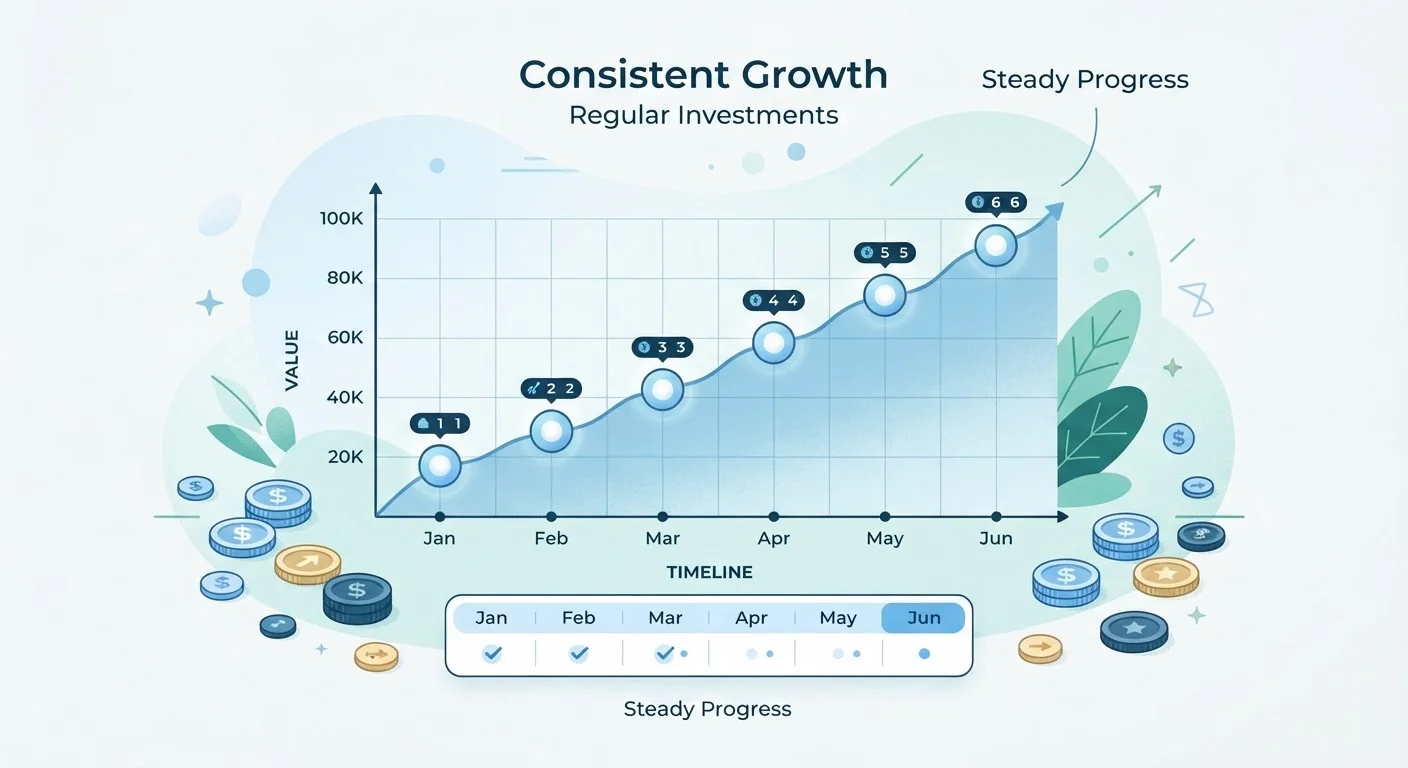
Dollar-cost averaging (DCA) is the practice of investing a fixed dollar amount into an asset - such as a stock or index fund - at regular intervals, regardless of the current price. Because you invest the same amount each time, you automatically buy more shares when prices are low and fewer when prices are high. Over time, this can lower the average cost per share compared to making one large lump-sum purchase at a single moment in time.
DCA does not guarantee a profit or protect against loss in declining markets. Its primary documented benefit is behavioral: it reduces the risk of investing a large sum right before a downturn and removes the pressure of market timing.
What Dollar-Cost Averaging Actually Looks Like in Practice
The concept sounds technical, but the mechanics are straightforward. Say you decide to invest $200 each month into a broad market index fund. Some months the share price is $50, so you purchase four shares. The next month the price drops to $40 - your $200 buys five shares. When prices rise to $80 a month later, your $200 buys only 2.5 shares.
Over those three months, you've invested $600 and acquired 11.5 shares. Your average cost per share works out to roughly $52 - lower than if you had waited and bought all 11.5 shares at the $80 price. That's the mechanical advantage: consistency in the amount, flexibility in the quantity.
This is essentially how a 401(k) plan works. Every pay period, a fixed contribution is deducted and invested - automatically, without the employee needing to decide whether it's a good week to invest. The habit is built into the system.
~10.7%
Average annual S&P 500 return (1957-2023, historical)
Historical data from S&P Dow Jones Indices shows long-term growth trends that give context to why consistent investing over time has been studied as a viable strategy - though past performance does not predict future results.
~50%
Reduction in annualized return from missing just 10 best trading days
According to J.P. Morgan Asset Management's annual Guide to the Markets, missing only the 10 best market days over a 20-year period can cut annualized returns roughly in half, illustrating the danger of market-timing attempts.
66%
Of 10-year rolling periods where lump sum beat DCA
Vanguard research analyzing historical U.S., U.K., and Australian markets found lump-sum investing outperformed DCA in approximately two-thirds of periods studied, reinforcing that DCA's value is primarily behavioral, not mechanically superior.
Why Emotion Is the Enemy of Good Investing
Most investors, even well-informed ones, struggle with market swings. When prices fall sharply, the instinct is to sell or pause contributions to avoid further losses. When prices rise quickly, the temptation is to pile in - often near a peak. Both behaviors tend to produce worse long-term outcomes than simply staying the course.
Behavioral finance research has documented this pattern extensively. Investors who try to time the market frequently miss the market's best days, which are often clustered close to its worst days. A 2023 J.P. Morgan Asset Management analysis found that missing just the 10 best days in the S&P 500 over a 20-year period roughly cut the annualized return in half.
DCA sidesteps this trap by making the decision automatic. You don't need to judge whether today is a good day to invest - the schedule does it for you. This is especially valuable for newer investors who may be more susceptible to reacting to financial news. If you're exploring other long-term strategies alongside DCA, our overview of index funds versus actively managed funds is a useful companion read.
Setting Up a Dollar-Cost Averaging Strategy
Getting started requires three decisions: what to invest in, how much to invest each period, and how frequently to invest.
- What to invest in: DCA is most straightforward with diversified, low-cost vehicles like broad market index funds or ETFs. These spread risk across many companies and tend to carry lower fees. See our piece on how investment fees erode returns for why costs matter enormously over decades.
- How much: Choose an amount that fits within your existing budget without straining it. Review your spending baseline first - our budgeting basics hub can help you identify how much you realistically have available.
- How often: Monthly contributions are the most common, but biweekly contributions aligned with a paycheck also work well. Consistency matters more than frequency.
Once those decisions are made, automate the transfer if your account allows it. Automation removes one more friction point that could cause you to skip a contribution during a stressful month.
Honest Limitations to Keep in Mind
Dollar-cost averaging is a useful strategy, but it's not a silver bullet. A few limitations deserve honest acknowledgment:
It doesn't guarantee profits. If you consistently invest in an asset that declines and doesn't recover, DCA will not save you. The strategy assumes reasonable long-term growth of the underlying asset.
Transaction costs can add up. If your brokerage charges a fee per trade, frequent small investments may generate more fees than a less frequent approach. Many modern platforms have eliminated per-trade commissions, but it's worth confirming.
Lump sums may outperform in rising markets. Because markets historically trend upward over long periods, delaying a large sum through scheduled installments means some of that money sits uninvested while prices rise. That said, for investors receiving income incrementally, this is largely a theoretical concern.
Understanding where your own strategy fits over time is important too. Our article on asset allocation across life stages explains how the mix of investments you hold should evolve as your goals and risk tolerance change.
This article is for general informational and educational purposes only and does not constitute personalized investment, financial, or tax advice. Past market performance does not guarantee future results. Consult a qualified, licensed financial professional before making decisions based on your individual circumstances.