

Key Takeaways
Option A
Clicker Training
The precision tool favored by professional trainers.
Best for: Owners who want a highly consistent, acoustically distinct marker - especially useful for teaching complex or multi-step behaviors.
Option B
Verbal Markers
The always-available, hands-free alternative.
Best for: Owners who value convenience and want a marker that works in any environment without carrying extra equipment.
If you want maximum consistency in early skill-building
Clicker Training
The clicker's neutral, identical sound every time reduces ambiguity for the pet, helping them associate the signal with the reward more quickly.
If you frequently train in public or hands-on settings
Verbal Markers
No equipment to juggle means your marker is always ready, even when you're holding a leash, a treat pouch, or managing another pet.
If your pet is noise-sensitive or easily startled
Verbal Markers
Some animals find the sharp click startling at first; a calm, consistent word is gentler and easier to introduce to anxious pets.
If you're training a hearing-impaired pet
Clicker Training
A tactile clicker placed against the pet's body can serve as a vibration-based marker, offering an adaptation that verbal cues cannot.
What Is a Marker, and Why Does It Matter?
In positive reinforcement training, a marker is a precise signal that tells your pet: "That behavior, right now, earns a reward." Think of it as a snapshot taken at the exact moment your dog sits, your cat touches a target, or your parrot steps onto your hand. Without a marker, your pet receives feedback too late - by the time the treat reaches them, they may be doing something entirely different.
Markers bridge the gap between behavior and reward. To understand why this matters in practice, see our article on what positive reinforcement actually means. The two most common marker types - clickers and verbal cues - both serve this function, but they do so in meaningfully different ways.
How Clicker Training Works
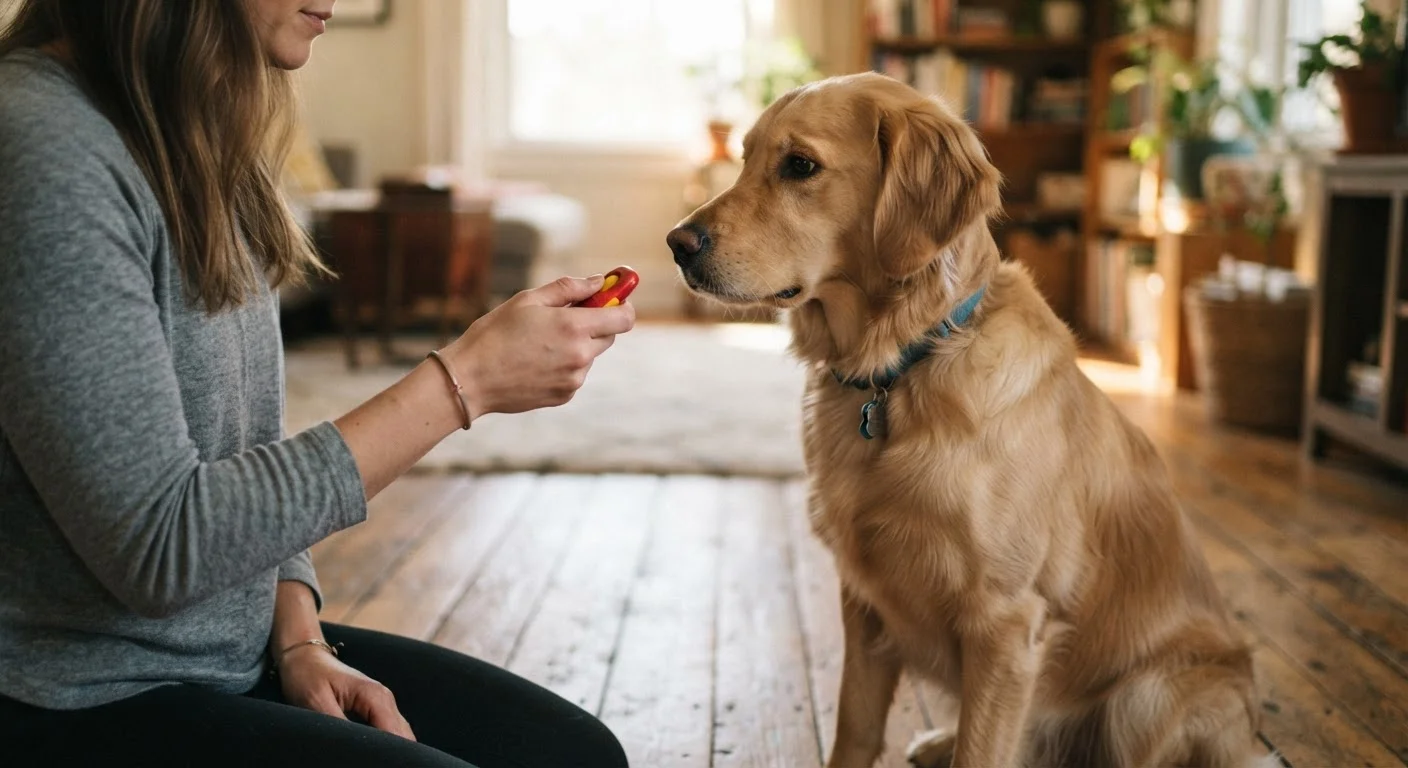
A clicker is a small handheld device that produces a short, sharp click sound when pressed. Before using it as a marker, trainers condition the clicker by pairing its sound with a treat several times - until the pet learns that click = good thing coming. This is called loading the clicker.
The primary advantage of a clicker is acoustic consistency. Every click sounds identical regardless of your mood, energy level, or how the day is going. Pets - especially dogs and birds - can detect subtle emotional cues in your voice, which means a verbal marker can inadvertently vary. The clicker removes that variable entirely.
Clickers are particularly effective when:
- Introducing a brand-new behavior that requires split-second precision
- Working with fast-moving animals where timing is critical
- Training multiple handlers want to use exactly the same marker
| Criterion | Clicker Training | Verbal Markers |
|---|---|---|
| Consistency | Identical sound every time | Can vary with tone and mood |
| Portability | Requires carrying a device | Always available - no equipment |
| Conditioning required | Yes - must load the clicker | Yes - must pair word with reward |
| Best learning phase | Ideal for new behavior acquisition | Effective across all phases |
| Noise-sensitive pets | May cause initial startle response | Gentler introduction for anxious animals |
| Hearing-impaired pets | Adaptable as tactile vibration marker | Not usable |
| Multi-handler households | Ensures identical signal across handlers | Requires voice matching agreement |
How Verbal Markers Work
A verbal marker is a short, distinct word - commonly "Yes!" or "Good" - used the same way a clicker is: delivered at the exact moment the desired behavior occurs, followed immediately by a reward. Like the clicker, a verbal marker must be conditioned first. Pair your chosen word with a treat repeatedly until it carries clear meaning for your pet.
The main strengths of a verbal marker are portability and emotional connection. You always have your voice with you. Some trainers also note that pets with strong social bonds to their owners respond warmly to vocal praise as part of the marker itself, though the treat should still follow promptly.
Verbal markers do require discipline. Your marker word should be short, punchy, and reserved exclusively for marking behavior - not mixed into everyday conversation. Saying "Yes!" casually throughout the day dilutes its training power. For more on how timing and technique interact, check out our guide on reward timing and common training mistakes.
Practical Considerations for Choosing Your Marker
Neither method is objectively superior - both produce measurable learning when used correctly. The right choice depends on your lifestyle, your pet's temperament, and the training context.
Consider a clicker if:
- You're training complex, precision behaviors (agility, trick sequences)
- You want a truly neutral marker unaffected by your emotional state
- You're new to training and want a tool that enforces good timing habits
Consider verbal markers if:
- You frequently train without your hands free
- Your pet is sound-sensitive or reactive to sharp noises
- You work in settings where carrying equipment is impractical
Whichever you choose, consistency and clear criteria matter far more than the marker type itself. Switching between a clicker and a verbal marker mid-session - or mid-week - can confuse your pet and slow progress. Commit to one approach for each training phase, and keep sessions short and focused. Our pre-session readiness checklist can help you set the right conditions before you begin.
~0.1 sec
Ideal marker delivery window after behavior
Applied behavior science research consistently identifies a very short window - often cited as within one to two seconds - as optimal for associating a marker with a specific behavior.
3-5 reps
Minimum pairings to begin loading a marker
Most certified trainers recommend at least three to five click-treat or word-treat pairings per session when first conditioning a new marker.