

Key Takeaways
Start here
Why the First Week Matters So Much
Next
Setting Up Your Home Before Your Dog Arrives
Then
Building a Daily Routine From Day One
Apply it
Introducing Positive Reinforcement Early
Watch for this
Common First-Week Mistakes to Avoid
Why the First Week Matters So Much
Dogs are highly sensitive to patterns. The behaviors they practice in the first days at home begin forming habits - some helpful, some not. A dog that jumps to greet people and is met with laughter quickly learns that jumping works. A dog given consistent boundaries from the start learns what is expected much faster.
This isn't about being strict - it's about being clear. Predictability reduces anxiety for dogs. When a new dog can anticipate what comes next (walk, meal, rest), their nervous system settles more quickly and they become more receptive to learning.
Plan to schedule a vet appointment within the first week as well. See our guide to your pet's first vet visit to know what to expect and how to prepare.
Setting Up Your Home Before Your Dog Arrives
A prepared space reduces chaos on day one. Before your dog comes home, designate specific zones: a sleeping area, feeding station, and a safe indoor space for downtime. Remove hazards at floor level - power cords, small objects, toxic plants, and unsecured trash cans.
Consider using a crate or exercise pen as your dog's "home base." Dogs are den animals by nature; a crate introduced as a calm, positive space (never as punishment) gives them somewhere to decompress. Keep it in a low-traffic area of the house.
Positive reinforcement
A training approach where desired behaviors are rewarded immediately, making those behaviors more likely to be repeated. No punishment is involved.
Crate training
Teaching a dog to view a crate as a safe, comfortable space. When introduced gradually and positively, crates help with housetraining and give dogs a place to rest undisturbed.
Decompression period
The adjustment time a newly adopted or rehomed dog needs to settle into a new environment. During this period, low stimulation and predictable routines are especially important.
Housetraining
Teaching your dog to eliminate (urinate and defecate) outdoors or in a designated area, rather than inside your home. Consistency and timely rewards are the foundation.
Cue
A signal - usually a word or gesture - that prompts a specific behavior from your dog, such as "sit" or "come." Cues are taught through repetition and reward.
If you're thinking about how home routines for your dog fit alongside your own household habits, our article on building lasting home habits offers a complementary perspective on structure and consistency.
Building a Daily Routine From Day One
Dogs thrive on schedule. A reliable daily routine tells your dog what to expect and reduces the stress of uncertainty. Aim for consistent times for feeding, bathroom breaks, walks, training, play, and sleep - even on weekends.
A simple structure for an adult dog might look like this:
- Morning: Outdoor bathroom break, then breakfast, then a short walk
- Midday: Another outdoor break and brief play or training session
- Evening: Dinner, a longer walk, calm wind-down time
- Bedtime: Final bathroom break, crate or sleep area
Puppies need bathroom breaks every one to two hours while awake. For guidance on feeding schedules and portions, particularly for puppies and senior dogs, a detailed nutrition guide can help you calibrate the right approach.
Introducing Positive Reinforcement Early
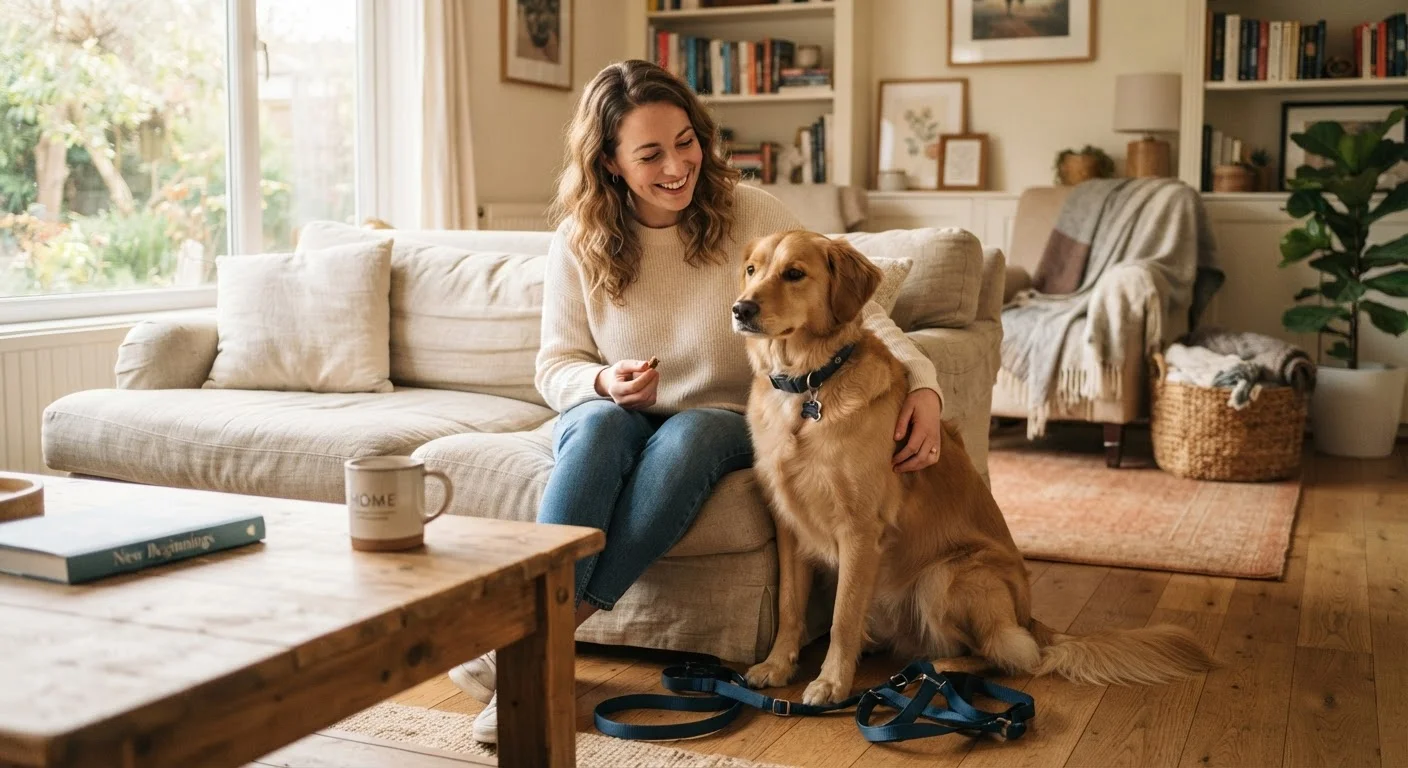
Positive reinforcement means rewarding the behavior you want to see more of - immediately after it happens. The reward can be a small treat, verbal praise, or brief play, depending on what motivates your dog. The key is timing: the reward must follow the behavior within one to two seconds for your dog to make the connection.
Start with simple cues: their name, "sit," and "come." Keep training sessions under five minutes. End before your dog loses focus so they associate training with success, not frustration.
Keep Early Training Sessions Short
Three to five minutes per session is plenty for a new dog, especially in week one. Multiple short sessions throughout the day are more effective than one long session. Always end on a success - ask for something your dog already knows so they finish on a positive note.
Avoid punishing mistakes, especially in week one. Punishment-based correction (yelling, leash jerks, or physical corrections) can damage trust before it's established. Redirect unwanted behavior toward an acceptable alternative instead.
Once your dog has a reliable foundation, you can build on it. Our article on teaching a solid stay cue walks through how to build one of the most practical and safety-critical behaviors step by step.
Common First-Week Mistakes to Avoid
Even well-intentioned owners make predictable missteps in week one. Awareness of these patterns helps you course-correct before habits set in.
- Overloading with visitors: Friends and family want to meet the new dog, but too much stimulation too soon is overwhelming. Hold off on visitors for the first few days.
- Inconsistent rules: If the dog is allowed on the couch sometimes but not others, they cannot learn the boundary. Every household member must follow the same rules.
- Skipping early vet care: Many new owners delay the first checkup. Visit our overview of common preventive care mistakes to understand what gets missed and why it compounds over time.
- Expecting too much too fast: A new dog needs time to decompress. If they seem shy or unsure, give space rather than forcing interaction.
This article is for general informational and educational purposes only and is not a substitute for professional veterinary advice. Always consult a licensed veterinarian regarding your individual dog's health, behavior, or care needs.