

Key Takeaways
Start here
How Dashboard Warning Lights Work
Critical knowledge
Red Lights: Stop and Act Now
Next
Amber and Yellow Lights: Schedule Service Soon
Good to know
Green and Blue Lights: Informational Only
Apply it
What to Do When a Light Comes On
How Dashboard Warning Lights Work
Modern vehicles use an OBD system - a network of sensors monitoring everything from engine temperature to brake fluid pressure. When a sensor detects a reading outside its acceptable range, it stores a fault code and signals the instrument cluster to illuminate the corresponding warning light.
The color of the light is your first cue to urgency. Automakers broadly follow a traffic-light convention: red signals an immediate safety risk, amber or yellow indicates a system that needs attention soon, and green or blue is purely informational. Not every manufacturer follows this perfectly, which is why your owner's manual - not general guides - is the final authority for your specific vehicle.
OBD-II
On-Board Diagnostics, second generation - a standardized system built into all vehicles sold in the U.S. since 1996 that monitors engine and emissions performance and stores diagnostic fault codes.
Fault Code
A numeric or alphanumeric code stored by your vehicle's computer when a sensor reading falls outside its expected range. Mechanics use these codes to identify which system triggered a warning light.
Catalytic Converter
An emissions control device in your exhaust system that converts harmful combustion gases into less harmful ones. Engine misfires can overheat and permanently damage it.
TPMS
Tire Pressure Monitoring System - sensors mounted inside the wheels that alert you when a tire's air pressure drops significantly below the recommended level.
Instrument Cluster
The panel behind the steering wheel that houses the speedometer, fuel gauge, and all warning lights and indicator icons.
For a deeper look at how these maintenance intervals and systems connect, see our car maintenance schedule guide.
Red Lights: Stop and Act Now
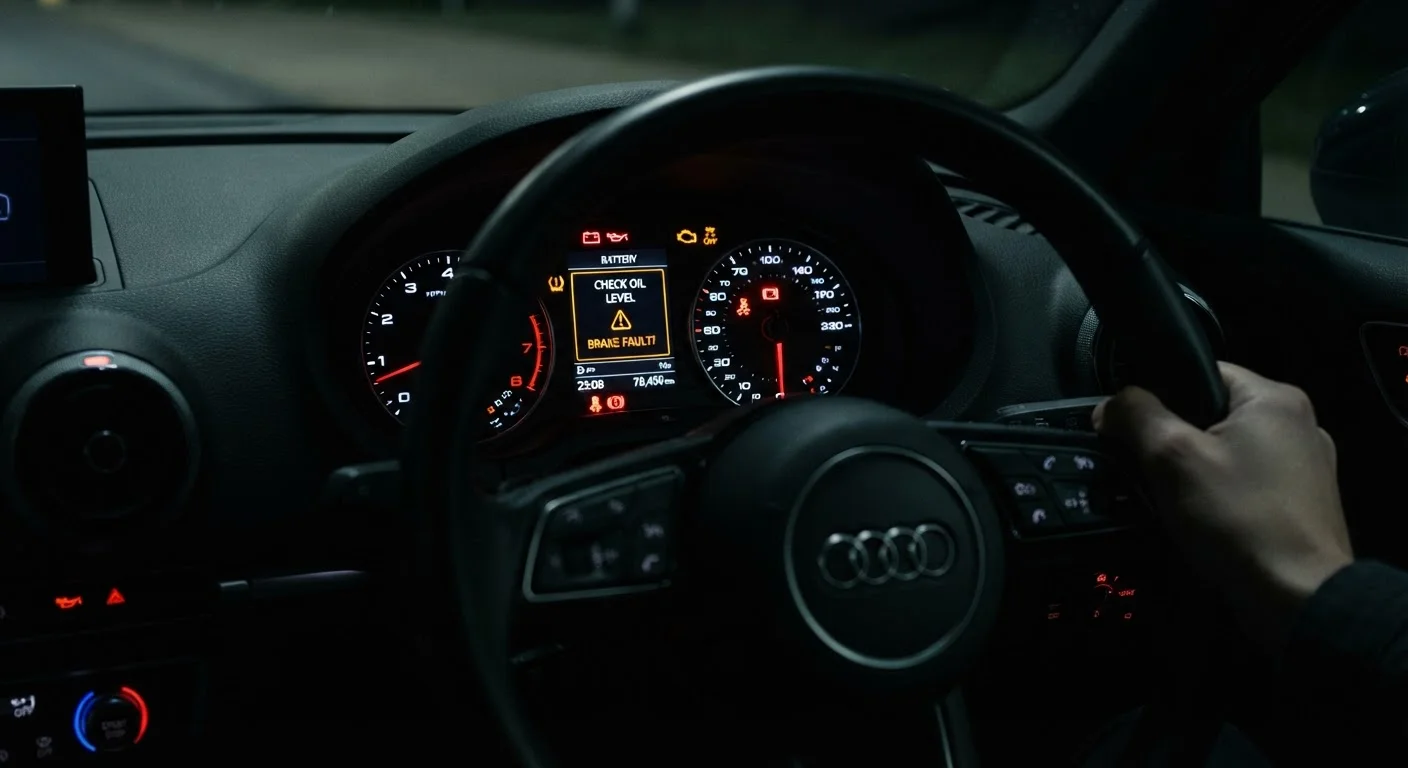
Red warning lights represent active threats to vehicle safety or engine survival. The most critical ones include:
- Oil Pressure (oil can icon): Pull over immediately and shut off the engine. Low oil pressure means metal components may be grinding without lubrication. Check the oil level; if it's adequate and the light persists, do not restart the vehicle without professional guidance.
- Engine Temperature (thermometer icon): Your coolant is overheating. Pull over safely, turn off the engine, and wait for it to cool before checking the coolant reservoir. Never open a hot radiator cap.
- Battery / Charging System: The charging system has failed. Your car is running on battery reserve only - electrical systems will begin shutting down. Drive directly to a service facility if possible, or call for assistance.
- Brake System Warning: If the parking brake is released and this light is on, brake fluid may be low or there's a hydraulic fault. Have the brakes inspected before driving further.
Continuing to drive through a red warning light can turn a manageable repair into a catastrophic one. Learn more about brake-specific symptoms in our guide on what your brakes are telling you.
Amber and Yellow Lights: Schedule Service Soon
Amber lights mean a system needs attention, but typically not right this moment. Ignoring them long enough, however, turns an inexpensive service into a costly repair - a reality explored in detail in the real cost of skipping routine maintenance.
Take a photo when the light appears
If a warning light comes on and then goes off before you reach a mechanic, a photo with a timestamp gives your technician important diagnostic context. Some fault codes are stored even after the light clears, but a photo confirms exactly which symbol appeared. This small habit can save diagnostic time and money.
- Check Engine (engine outline icon): Steady means schedule a diagnostic scan soon. Flashing means reduce speed and seek service today - an active misfire is occurring.
- TPMS (tire cross-section with exclamation mark): One or more tires are low on pressure. Check all four tires at your earliest opportunity. Driving on underinflated tires affects fuel economy, handling, and tire life.
- Low Fuel: You have limited range remaining. Fuel pump longevity is linked to adequate fuel levels, so don't make a habit of running near empty.
- Service Due / Maintenance Required: Your vehicle has reached a mileage or time threshold for scheduled maintenance. This is a reminder, not a malfunction - but it shouldn't be dismissed indefinitely.
- Traction Control / Stability Control (car with wavy lines): If this stays on, the system may be disabled or faulty. Have it inspected, especially before winter driving.
Green and Blue Lights: Informational Only
Green and blue lights confirm that a system is active - not that something is wrong. Common examples include:
- High Beams (blue): Your high beams are on. A reminder to switch back to low beams when oncoming traffic approaches - a basic safe driving habit.
- Turn Signal (green): Left or right indicator is active.
- Cruise Control (green): Cruise control is engaged.
- Eco Mode / EV Mode (green): Your vehicle is operating in a fuel-efficient or all-electric drive mode.
If a green or blue light appears unexpectedly and you didn't activate the corresponding function, consult your owner's manual to confirm whether it indicates a feature that's been automatically engaged or a fault in that system.
What to Do When a Light Comes On
The moment a warning light illuminates, take these steps in order:
- Note the color and icon. Red demands immediate action; amber means plan a service visit within days, not weeks.
- Check for additional symptoms. Unusual sounds, smells, vibrations, or changes in handling give a mechanic crucial diagnostic context.
- Consult your owner's manual. Every vehicle's warning system has model-specific nuances. The manual describes exactly what each symbol means and the recommended response.
- Get an OBD-II code read. For check engine and similar amber lights, an OBD-II scanner retrieves the specific fault code. Many auto parts retailers offer this at no charge, giving you a starting point before you speak with a mechanic.
- Don't delay on red lights. If you're uncertain whether a red light is serious, treat it as serious until a professional tells you otherwise.
Understanding when to handle something yourself versus when to call a professional is a skill in itself. Our guide on DIY car maintenance - what's safe and what isn't can help you make that call confidently. For tire-related warnings specifically, understanding what the numbers on your tires mean provides useful context.