

| Load index 98 equals | 1,653 lbs maximum per tire (Tire and Rim Association standard load table) |
| Speed rating "H" maximum | 130 mph sustained (Industry-standard speed rating classification) |
| Recommended inspection age | 6 years from manufacture date (Many vehicle and tire manufacturer guidelines) |
| Maximum tire service life | 10 years from manufacture date (Commonly cited industry guideline; check owner's manual) |
| Tire type prefix for passenger cars | "P" (metric passenger) |
| DOT date code location | Last 4 digits of DOT sequence on sidewall |
Decoding the Sidewall: What That String of Letters and Numbers Means
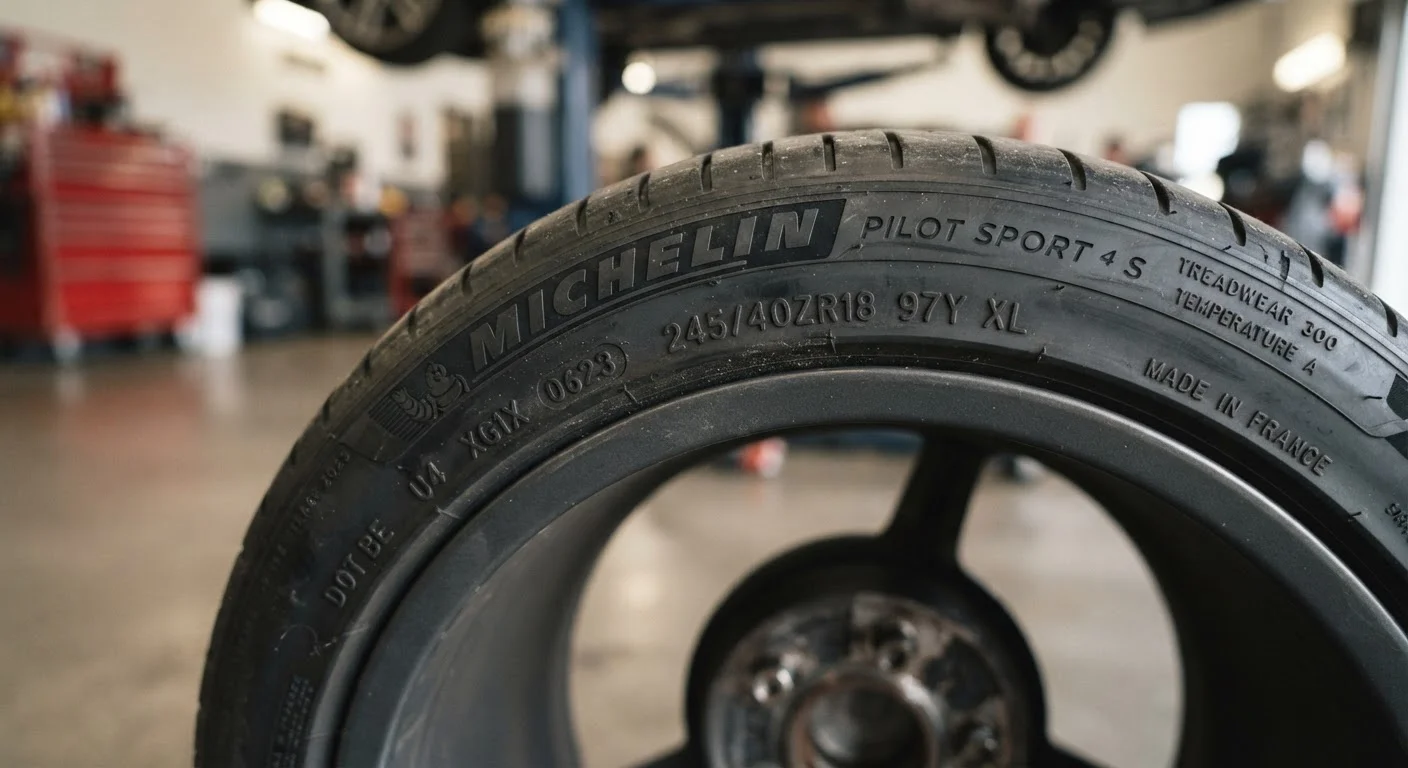
Look at your tire's sidewall and you'll see something like P215/65R17 98H. It looks like a serial number, but each segment carries specific meaning that directly affects your vehicle's safety and performance.
Section Width
The measurement in millimeters across the widest point of a tire's tread from sidewall to sidewall, measured when the tire is mounted and properly inflated.
Aspect Ratio
The ratio of a tire's sidewall height to its section width, expressed as a percentage. A lower aspect ratio means a shorter sidewall and typically a firmer ride.
Load Index
A standardized numerical code indicating the maximum weight a tire can safely support when properly inflated. It corresponds to a specific weight value on an industry-standard table.
Speed Rating
A letter code indicating the maximum sustained speed a tire is engineered to handle safely under its rated load. Exceeding this rating can cause structural failure.
DOT Date Code
A four-digit number at the end of the DOT sequence on the tire sidewall indicating the week and year the tire was manufactured. Used to assess tire age and degradation risk.
Radial Construction
The standard tire construction type (designated "R") where internal cords run perpendicular to the direction of travel, offering better fuel efficiency and ride comfort than older bias-ply designs.
Here's how to break it down from left to right:
- P - The tire type prefix. "P" stands for passenger vehicle. "LT" indicates light truck. Some tires have no prefix, meaning they follow a metric standard used in Europe and some performance applications.
- 215 - Section width in millimeters. This is the width of the tire from sidewall to sidewall when properly mounted and inflated.
- 65 - Aspect ratio. This is the tire's sidewall height expressed as a percentage of its section width. A "65" means the sidewall height is 65% of 215 mm. Lower numbers (like 45 or 50) indicate a shorter, sportier sidewall.
- R - Construction type. "R" means radial, which is the dominant construction standard for passenger tires in the United States today.
- 17 - Wheel diameter in inches. This must match your rim exactly.
- 98 - Load index. This number corresponds to the maximum weight the tire can safely carry when properly inflated. A load index of 98 equals 1,653 lbs per tire.
- H - Speed rating. This letter indicates the maximum sustained speed the tire is designed to handle safely under load.
For the full picture on keeping those tires in good working order, see our guide to tire pressure, tread depth, and rotation.
Load Index and Speed Rating: Why These Two Numbers Are Safety-Critical
| Load index 98 equals | 1,653 lbs maximum per tire (Tire and Rim Association standard load table) |
| Speed rating "H" maximum | 130 mph sustained (Industry-standard speed rating classification) |
| Recommended inspection age | 6 years from manufacture date (Many vehicle and tire manufacturer guidelines) |
| Maximum tire service life | 10 years from manufacture date (Commonly cited industry guideline; check owner's manual) |
| Tire type prefix for passenger cars | "P" (metric passenger) |
| DOT date code location | Last 4 digits of DOT sequence on sidewall |
The load index is one of the most misunderstood figures on a tire. It's a standardized numerical code - not the actual weight in pounds - that maps to a specific load capacity on a published industry table. Using a tire with a load index lower than your vehicle's requirement can lead to tire failure, especially when carrying passengers, cargo, or towing a trailer.
Your vehicle's required minimum load index is listed in the owner's manual and on the door placard (usually found on the driver's side door jamb). Never substitute a tire with a lower load index than specified, even temporarily.
The speed rating works similarly. It's not a recommendation for how fast to drive - it's the ceiling under which the tire maintains its structural integrity and handling characteristics. Common speed ratings and their limits:
- S - Up to 112 mph
- T - Up to 118 mph
- H - Up to 130 mph
- V - Up to 149 mph
- W - Up to 168 mph
- Y - Up to 186 mph
Sustained driving near or above a tire's speed rating - even on a closed course - can cause heat buildup that degrades the tire internally. For guidance on how speed interacts with stopping distances, see our reference on speed limits, following distance, and reaction time.
DOT Code and Tire Age: The Number Most Drivers Miss
Beyond the size and rating string, look for the DOT code - a longer sequence starting with "DOT" and ending with a four-digit number that is arguably the most safety-relevant figure on the entire sidewall.
That four-digit number is the manufacturing date code. The first two digits represent the week, and the last two represent the year. A code reading 2319 means the tire was made in the 23rd week of 2019.
Why does this matter? Rubber compounds degrade over time due to oxidation and UV exposure, even when a tire appears visually fine and has adequate tread depth. Many vehicle manufacturers and tire industry organizations recommend inspecting tires that are six years old and considering replacement at or before ten years from the manufacture date, regardless of tread wear - though you should consult your vehicle's owner's manual and a qualified tire professional for guidance specific to your situation.
A tire can sit in a warehouse for two years before being sold, meaning a "new" tire could already be two years old when you buy it. Checking the DOT date at purchase is a straightforward habit that many drivers overlook.
Tire condition ties directly into your vehicle's broader maintenance rhythm. Our car maintenance schedule guide explains how to integrate tire checks into your regular service intervals. And if your dashboard tire pressure warning light comes on, our dashboard warning lights reference can help you interpret what to do next.
This article is for general informational purposes. Always refer to your vehicle owner's manual and consult a qualified tire professional for decisions specific to your vehicle and driving conditions.