

Why Tires Deserve Regular Attention
Your tires are the only part of your vehicle that actually contacts the road - four small patches of rubber, each roughly the size of a hand, bearing the full weight and momentum of the car. Getting the basics right on tire pressure, tread depth, and rotation isn't just a matter of saving money on replacements; it directly affects braking distance, cornering stability, and your risk of a blowout. Part of responsible safe driving practice is understanding what your tires are telling you before they fail.
For a full pre-trip inspection framework, see our long road trip safety walkthrough, which puts tire checks into broader vehicle-readiness context.
Tire Pressure: What to Check and When
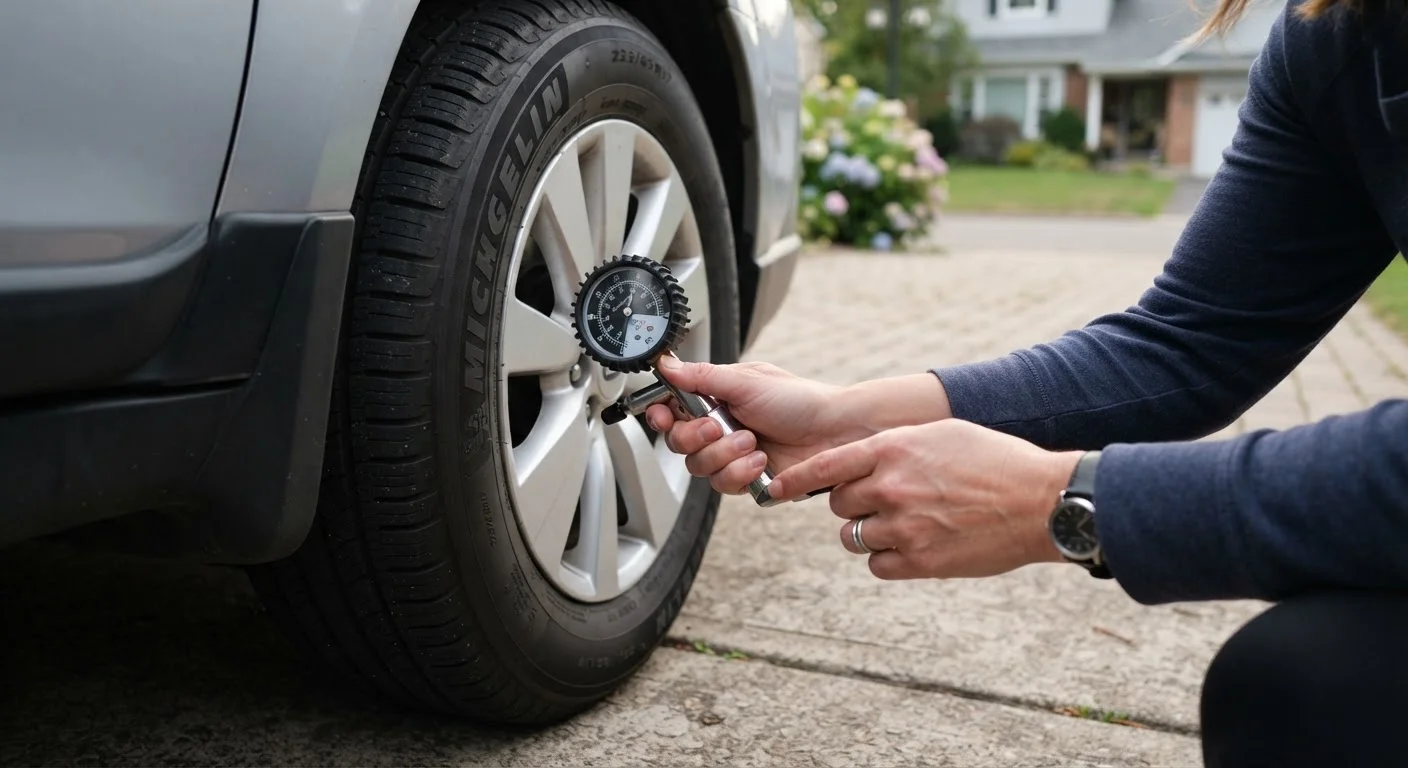
Tire pressure is measured in PSI. The correct PSI for your vehicle is listed on a sticker inside the driver's door jamb or in the owner's manual - not on the tire sidewall, which shows the maximum allowable pressure, not the recommended operating pressure.
Check pressure when tires are cold - meaning the vehicle has been parked for at least three hours or driven fewer than one mile. Driving heats the air inside tires and raises readings by 4-8 PSI, which can mask underinflation. A quality digital or analog gauge is more reliable than relying solely on the low-pressure dashboard warning light, which only activates when pressure is already significantly low.
Temperature matters: tire pressure drops roughly 1 PSI for every 10°F decrease in ambient temperature. Seasonal maintenance checks are particularly important for this reason - a tire correctly inflated in September may be meaningfully underinflated by December. Aim to check pressure at least once a month and before any long drive.
Tread Depth: Measuring Wear and Knowing When to Replace
Tire tread channels water away from the contact patch so rubber can grip the road. As tread wears down, wet-weather grip decreases significantly - stopping distances can increase substantially on rain-soaked roads. This is directly relevant to how your vehicle handles in adverse weather; wet and low-visibility driving becomes genuinely more dangerous on worn tires.
Tread depth is measured in 32nds of an inch. New passenger tires typically start at 10/32" to 11/32". The legal minimum in most U.S. states is 2/32", but most safety organizations recommend replacing tires at 4/32" - sooner in climates with significant rain or snow.
The simplest field check is the penny test: insert a penny into a tread groove with Lincoln's head pointing down. If you can see the top of Lincoln's head, the tread is at or below 2/32" and replacement is overdue. For a more useful safety margin, use a quarter: if the top of Washington's head is visible, you're at approximately 4/32" and approaching the replacement threshold.
Worn tires also often show uneven wear patterns - more on the edges or center of the tread - which can indicate chronic over- or underinflation, or alignment problems. Understanding what the markings on your tires mean can also help you interpret age and rating information alongside wear.
Rotation: Why It Matters and How Often to Do It
Tires wear at different rates depending on their position. Front tires on front-wheel-drive vehicles carry the load of steering and primary acceleration, causing them to wear faster - often significantly. Rotation moves tires between positions systematically so wear evens out across all four, extending the usable life of the full set.
Most manufacturers recommend rotation every 5,000 to 7,500 miles, though your owner's manual is the authoritative source for your specific vehicle. A common practice is rotating at every oil change if your oil change interval falls in that range.
Common rotation patterns include front-to-rear same-side swaps for directional tires, and cross-rotation (front-left to rear-right, front-right to rear-left) for non-directional tires. Some patterns also involve including the spare - consult a qualified mechanic if you're unsure what pattern applies to your vehicle and tire type. For vehicles with different-sized front and rear tires, rotation may not be possible without remounting, which is a job for a professional.
Neglecting rotation doesn't just cost money - unevenly worn tires can contribute to handling imbalance and make emergency maneuvers less predictable. Keeping a log of rotation dates and mileage is a straightforward habit that pays dividends across the life of your tires.