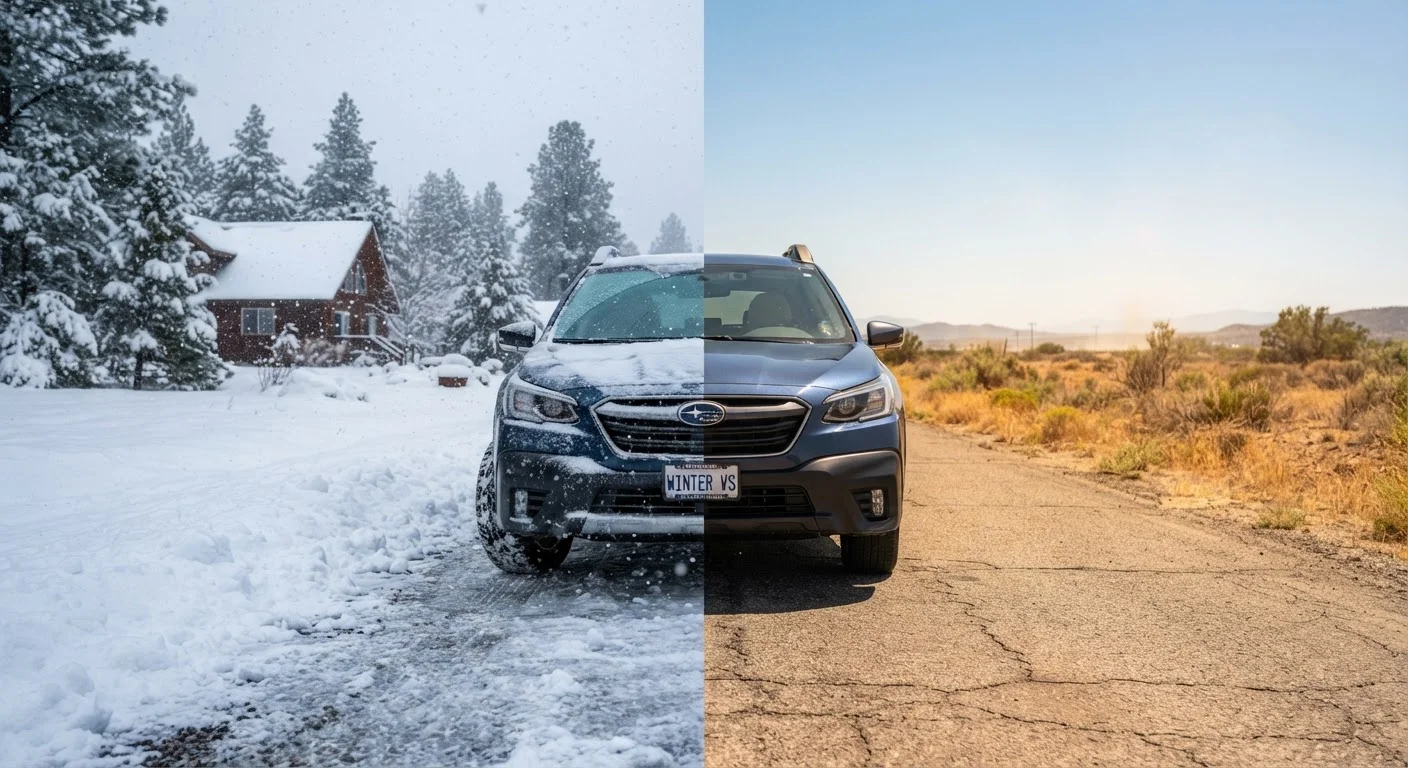
Cold weather thickens fluids, strains batteries, and reduces tire pressure - all requiring specific pre-winter checks.
Summer heat accelerates coolant breakdown, tire wear, and cabin air filter degradation more than most drivers expect.
Many seasonal checks are straightforward driveway tasks any driver can perform safely with basic tools.
Your owner's manual provides the most reliable guidance for your specific vehicle's service intervals.
Catching small issues before a season change consistently costs less than reactive repairs after a breakdown.
45–90 min
Summary
22 items · 45-90 minutes per seasonal transition
Why Seasons Stress Your Vehicle Differently
Most mechanical failures don't happen randomly - they happen when a vehicle is pushed into conditions it wasn't adequately prepared for. Winter and summer represent the two most demanding extremes your car faces each year, and they stress completely different systems in completely different ways.
Cold temperatures thicken engine oil, reduce battery cranking power, lower tire pressure, and make rubber components brittle. Summer heat does the opposite - it pushes coolant systems to their limits, accelerates fluid evaporation, and can cause overinflated tires to blow out under load. Understanding why each season is demanding helps you prioritise the right checks at the right time.
This checklist covers both seasonal transitions. Work through the relevant section as temperatures begin to shift - ideally a few weeks before the hardest weather arrives. For a broader view of how your vehicle's service needs fit together, see your car's full maintenance schedule explained.
Pre-Winter Checks
Test your battery's cold cranking amps (CCA) - cold weather reduces battery capacity significantly, and a marginal battery that starts fine in October may fail in January. Most auto parts stores offer free battery testing.Must
Check tire pressure and adjust to the vehicle manufacturer's recommended PSI - for every 10°F drop in temperature, tire pressure falls roughly 1 PSI. Refer to tire pressure fundamentals for the full procedure.Must
Inspect tire tread depth - winter driving demands more grip than dry summer roads. The penny test is a common starting point, but a tread depth gauge gives a more precise reading.Must
Verify your coolant (antifreeze) mixture is correct for your climate - a 50/50 mix of coolant and distilled water protects to around -34°F in most formulations, but verify your specific product's rating.Must
Switch to or confirm you're using the correct winter-grade engine oil - some climates and older engines benefit from a lower-viscosity oil that flows more readily in cold starts. Check your owner's manual for the recommended grade.Should
Inspect wiper blades and replace if streaking or skipping - consider winter-specific blades designed to shed ice and snow more effectively.Must
Top up windshield washer fluid with a winter-rated formula that won't freeze in the reservoir or on your windshield.Must
Check all exterior lights - shorter daylight hours and overcast skies make fully functioning headlights, tail lights, and turn signals especially critical in winter.Must
Inspect brake performance and listen for any unusual sounds - common brake symptoms are worth reviewing before conditions deteriorate.Must
Assemble or restock a winter emergency kit - include an ice scraper, jumper cables or jump starter, a blanket, sand or kitty litter for traction, and a flashlight with fresh batteries.Should
Pre-Summer Checks
Inspect the cooling system - check coolant level and condition, look for hose cracks or soft spots, and confirm the radiator cap seals properly. Overheating is the leading cause of summer breakdowns.Must
Check tire pressure again - heat causes air to expand, and overinflated tires have less contact with the road and are more prone to blowouts. Verify pressure when tires are cold (driven less than a mile).Must
Examine tire tread and sidewalls for cracking or bulging - rubber degrades in UV exposure over time, and summer heat accelerates wear. A tire showing sidewall bulges should be inspected by a professional immediately.Must
Check and top up all fluids - engine oil, brake fluid, power steering fluid, and transmission fluid all deserve attention before sustained summer heat. See how to check car fluids in your driveway for step-by-step guidance.Must
Inspect and replace the cabin air filter if needed - a clogged filter restricts airflow to your AC system and reduces cooling effectiveness during peak summer heat.Should
Test the air conditioning system - run it at full blast and confirm it cools down within a minute or two. Weak or warm airflow may indicate low refrigerant or a compressor issue that a mechanic should diagnose.Must
Check the engine air filter - summer driving often means more dust and debris, which accelerates filter clogging and reduces fuel efficiency. understand when filters wear out to know if yours is due.Should
Inspect belts and hoses for cracking, glazing, or fraying - heat is the primary aging mechanism for rubber components, and a snapped belt in summer traffic is a serious inconvenience and safety concern.Should
Check battery health - while cold kills batteries most dramatically, summer heat actually accelerates internal battery degradation. See battery health basics for what to watch for.Should
Replace worn wiper blades - winter blades (if you used them) should be swapped back to standard blades, which handle summer rain and UV exposure better.Nice to have
Check sunshade and window tinting condition - these reduce interior heat buildup that can damage dashboards, electronics, and increase AC workload.Nice to have
Review your roadside emergency kit for season-appropriate contents - swap the heavy blanket for water bottles and sun protection, and confirm jumper cables or a jump starter are still in good condition.Nice to have
Tools and Resources You'll Need
Most of these checks require only basic equipment and can be completed in your driveway. For tasks that require lifting the vehicle or draining fluids, a qualified mechanic is the appropriate choice - particularly if you're not experienced with those procedures. See which maintenance tasks are safe to DIY and which aren't for a realistic breakdown.
Required
Tire pressure gauge
Accurately measure tire inflation before adjusting to manufacturer-recommended PSI for the season.
Required
Tread depth gauge
Measure remaining tread depth across multiple points on each tire for a reliable wear assessment.
Required
Battery tester or multimeter
Check battery voltage and cold cranking amps - especially important before winter when battery demand spikes.
Required
Flashlight or work light
Illuminate engine compartment, undercarriage hoses, and tire sidewalls during inspection.
Required
Coolant test strips or refractometer
Verify your antifreeze mixture provides adequate freeze protection for your local winter temperatures.
Required
Owner's manual
Confirm the correct fluid types, oil viscosity grades, and service intervals specific to your vehicle.
Optional
Jumper cables or portable jump starter
Emergency battery starting aid - an essential part of both winter and summer roadside kits.
Required
Mechanic or dealership service centre
Handle fluid flushes, AC refrigerant recharges, brake inspections, and any task requiring a lift or specialised tools.
Staying Safe Once the Season Arrives
Completing these checks before the season turns is only half the equation. Once conditions change, your driving habits need to adapt as well. Icy roads multiply stopping distances dramatically - our guide on what ice and snow do to stopping distance explains the physics in plain terms. For a broader look at adjusting your technique in challenging weather, driving in rain, snow, and fog covers what actually changes behind the wheel.
If you're heading into a long drive at any time of year, run through the pre-trip safety walkthrough before you leave the driveway.
Don't Ignore Dashboard Warning Lights
If a check engine, battery, temperature, or oil pressure warning light is illuminated, address it before relying on your vehicle through a seasonal extreme. Warning lights often signal a condition that worsens significantly under the stress of heat or cold. A qualified mechanic can retrieve diagnostic codes and advise on urgency - don't assume the light will resolve on its own.
AC Refrigerant Requires Professional Handling
Automotive refrigerant (commonly R-134a or the newer R-1234yf) is regulated and requires certified equipment to handle safely and legally. Do not attempt to recharge your AC system without the proper tools and training. If your air conditioning is underperforming, have a licensed technician diagnose and service the system.
This article provides general vehicle maintenance information for educational purposes. Always consult your vehicle's owner's manual and a licensed mechanic for guidance specific to your make, model, and driving conditions.
Cars & Driving Editorial Team is the collective byline for our editorial team and contributor network. Articles published under this byline or an editorial pen name are researched, written, and reviewed according to our editorial standards for clarity, consistency, and independence before publication.
Disclaimer: The content provided on our blog site traverses numerous categories, offering readers valuable and practical information. Readers can use the editorial team’s research and data to gain more insights into their topics of interest. However, they are requested not to treat the articles as conclusive. The website team cannot be held responsible for differences in data or inaccuracies found across other platforms. Please also note that the site might also miss out on various schemes and offers available that the readers may find more beneficial than the ones we cover.