

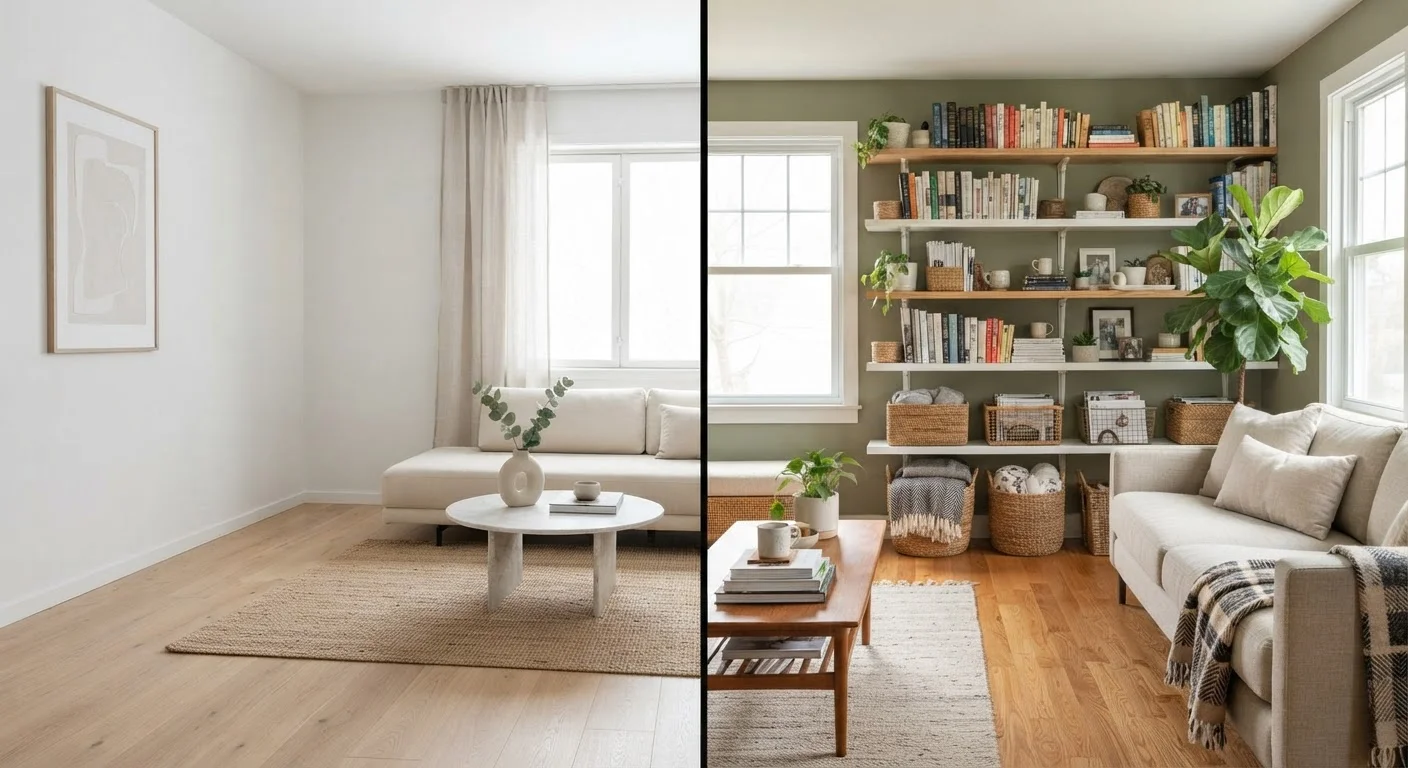
Key Takeaways
Our Verdict
Minimalist organizing and traditional storage solve the same problem - a home that feels chaotic - but from opposite directions. Minimalism reduces what you own so less storage is needed; traditional storage systems make room for everything you own. For most households, the answer lies somewhere in between: pare down deliberately, then store what remains thoughtfully.
| Best for | Recommended |
|---|---|
| Small-space dwellers or those who prefer low-maintenance upkeep | Minimalist Organizing |
| Families with children, hobbyists, or those with varied functional needs | Traditional Storage Solutions |
| Homeowners wanting lasting results without an all-or-nothing overhaul | Hybrid Approach |
What Each Philosophy Actually Means
Minimalist organizing starts with a simple premise: the fewer items you own, the less there is to manage. Rather than investing in bins, shelves, and systems, the minimalist approach asks you to evaluate each possession and keep only what genuinely serves your life. The result is a home where surfaces stay clear not because everything is hidden away, but because there simply isn't excess to hide.
Traditional storage, by contrast, accepts the full breadth of what a household accumulates - seasonal gear, hobby supplies, sentimental items, backup pantry stock - and focuses on assigning every item a logical home. This philosophy leans on labeled containers, dedicated zones, and layered storage solutions to keep things accessible without creating visual chaos.
Understanding this core difference matters before you make any changes. If you try to apply traditional storage systems to an overstuffed home without first reducing volume, you're likely to end up reorganizing clutter rather than eliminating it. Our guide on why sequence matters in decluttering explains why this order is so critical.
Comparing the Two Approaches
The table below breaks down how minimalist organizing and traditional storage compare across the dimensions that matter most to homeowners.
| Minimalist Organizing | Traditional Storage Solutions | |
|---|---|---|
| Core philosophy | Own less to manage less | Store more with better systems |
| Upfront effort | High - requires deep decision-making | Moderate - focuses on system setup |
| Ongoing maintenance | Low once habits are established | Moderate - systems require upkeep |
| Best household size | Individuals or couples | Families or multi-person households |
| Flexibility for life changes | Requires re-evaluation of possessions | Easier to adapt by adding systems |
| Risk factor | Too restrictive for some lifestyles | Accumulation creep over time |
| Upfront cost | Low - fewer products needed | Moderate - storage products required |
One important nuance: the upfront effort column cuts both ways. Minimalism demands significant decision-making energy early - every item requires deliberate evaluation. Traditional storage demands ongoing purchasing and maintenance of systems. Neither approach is effort-free; the effort simply falls at different points and in different forms.
When Minimalist Organizing Works Well
Minimalism tends to thrive in specific conditions. Small apartments and studios benefit enormously - less furniture and fewer possessions make compact spaces feel open and livable. Households with one or two adults who have stable, predictable needs often find the minimal ownership model sustainable over time.
It also works well for people who find visual clutter mentally draining. Research into how disordered environments affect focus and mood suggests that reducing the number of objects in a space can lower background stress - though results vary by individual. You can explore this further in our overview of the psychology behind clutter.
The challenge arrives when life circumstances shift - a new baby, an aging parent moving in, a serious hobby that requires equipment. Minimalism demands ongoing commitment to re-evaluate possessions as life changes, which not everyone finds practical or appealing.
When Traditional Storage Solutions Shine
Traditional storage is often the more realistic approach for families, multi-person households, and anyone with significant functional demands on their space. A home with three children, athletic gear, seasonal decorations, and a kitchen used for daily cooking simply generates more stuff - and a good storage system makes that stuff manageable rather than burdensome.
The strength of traditional storage is its flexibility. You can add a shelving unit to a garage, introduce drawer dividers to a kitchen, or use labeled bins in a linen closet without requiring any philosophical shift in what you own. For a room-by-room breakdown of where storage systems pay off most, see our complete room-by-room organization walkthrough.
The risk with traditional storage is accumulation creep. When every item has a dedicated spot, it becomes easy to justify keeping things you rarely use. Over time, storage systems can fill beyond capacity - and you find yourself needing more storage rather than less stuff. Common organizing myths often fuel this cycle without homeowners realizing it.
Building a Practical Hybrid Strategy
For most American households, neither extreme is the right answer. A hybrid approach applies minimalist thinking where it counts most - reducing duplicates, eliminating unused items, and questioning new purchases - while still using targeted storage systems for what genuinely needs to be kept.
Start by decluttering each room before introducing any storage products. This prevents the common mistake of buying organizers for items you'd be better off donating. Once volume is reduced to a realistic level, invest in storage solutions suited to what actually remains. If you're new to this process, our beginner's walkthrough to getting organized is a useful starting point.
Principles like the one-in-one-out rule - where a new item enters the home only when an equivalent leaves - help sustain a hybrid system without requiring ongoing purges. For a broader overview of such organizing principles, see our reference guide to key organizing concepts.
The goal isn't a picture-perfect home from a design magazine. It's a home that functions well for the people who actually live in it - with enough room to breathe and enough systems to stay manageable over time.