

Key Takeaways
Why Watering Frequency Shapes Root Depth
Most homeowners water their lawns the way they water houseplants - a little every day or two, just enough to wet the surface. It feels attentive, even caring. But for turfgrass, this approach creates a hidden problem: roots follow the moisture. When the top inch of soil is consistently damp, grass has no biological reason to send roots deeper. Over time, you end up with a shallow root system that struggles the moment temperatures spike or rain skips a week.
Deep watering works on a straightforward principle: wet the soil to a depth of 6 to 8 inches, then let it dry out partially before watering again. That drying period is actually productive - roots extend downward in search of retained moisture, gradually building a deeper anchor. A lawn with deep roots can draw on moisture reserves that shallow-rooted grass simply cannot reach. The result is turf that stays greener longer under stress and recovers more quickly after dry spells.
This approach is a cornerstone of responsible year-round lawn care. For a broader view of how watering fits into seasonal routines, see our year-round lawn maintenance guide.
How to Measure and Apply the Right Amount
The general target for most cool-season and warm-season grasses is roughly 1 inch of water per session, applied once or twice per week depending on temperature and rainfall. But knowing that number and actually delivering it are two different things. Sprinkler output varies enormously by head type, water pressure, and coverage pattern.
A simple way to calibrate: place several empty tuna cans or straight-sided containers around your lawn, run your sprinkler for 30 minutes, then measure the water collected. Average the readings across the cans. That tells you your sprinkler's output per half hour, so you can calculate exactly how long to run it to hit your 1-inch target.
Clay soils absorb water slowly - running a sprinkler too fast on clay causes runoff before water penetrates. If you see puddling or water sheeting off, use a cycle-and-soak method: run sprinklers for 10 to 15 minutes, pause for 30 to 45 minutes to let water absorb, then repeat. Sandy soils drain quickly and may need a slightly longer run time but will absorb without puddling. For more on how soil composition affects your lawn's behavior, our article on soil health and plant struggles covers the foundational science.
Best Practices for Deep, Efficient Watering
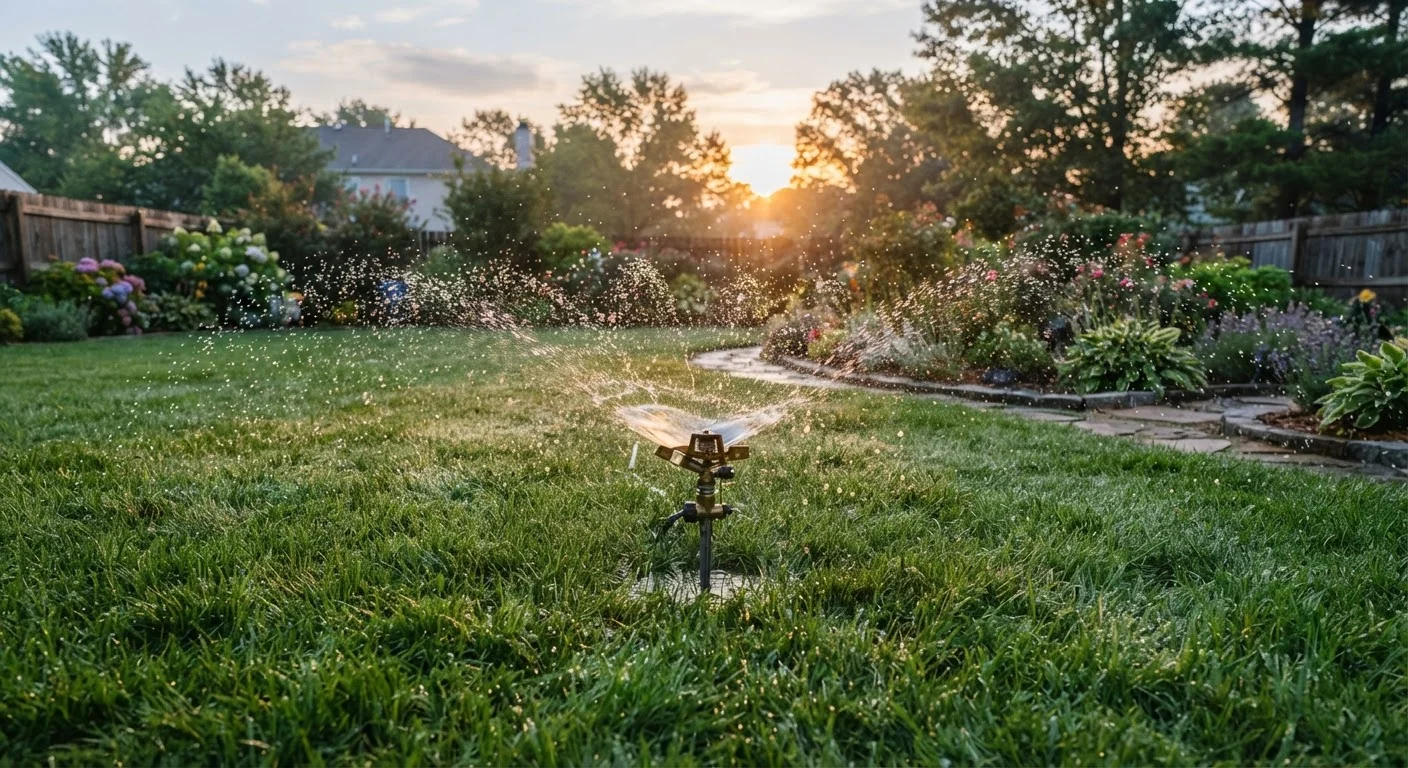
Applying water at the right time matters just as much as applying the right amount. Early morning - between 5 and 10 a.m. - is widely considered the most effective window. Evaporation rates are lower than midday, and the grass blades have time to dry before nightfall, which reduces the risk of fungal disease. Avoid evening watering if you can; wet turf sitting through a warm night is an invitation for lawn disease to take hold. For more on separating common watering myths from evidence-based practice, our piece on garden myths experienced gardeners have stopped believing is a useful companion read.
Water to a depth of 6 to 8 inches, not just the surface
Shallow soil moisture keeps roots anchored near the top, where they're most exposed to heat and dry air. Reaching deeper soil layers gives roots a reason to grow downward, building drought resilience. This depth also stabilizes soil temperature around the root zone.
Allow the soil to partially dry between watering sessions
The drying interval is when root extension happens. Roots actively search for moisture as the upper soil dries, which is the mechanism behind deeper root development. Constant moisture removes this biological incentive.
Use cycle-and-soak watering on clay or compacted soils
Dense soils absorb water more slowly than the sprinkler delivers it, causing runoff before water penetrates. Breaking the session into shorter intervals with absorption pauses ensures water actually reaches the root zone.
Always water in the early morning rather than at night
Morning watering allows grass blades to dry during the day, limiting the prolonged leaf wetness that encourages fungal diseases like brown patch and dollar spot. Evaporation is also lower in the morning than at midday.
Calibrate your sprinkler output before relying on a fixed schedule
Sprinkler systems vary widely in flow rate, and running for a set number of minutes doesn't guarantee the right amount of water is being applied. Measuring actual output prevents both under- and over-watering.
One often-overlooked factor is the condition of the soil itself. Compacted soil resists deep water penetration regardless of how long you run the sprinkler. If water pools on the surface even with a slow application rate, compaction may be the culprit. Core aeration - typically done in fall for cool-season grasses and late spring for warm-season varieties - opens channels for water, air, and nutrients to reach the root zone more effectively.
For homeowners interested in reducing overall irrigation demands, combining deep-watering habits with thoughtful plant selection is a powerful strategy. Our guide to low-maintenance landscaping approaches explores how grouping plants by water need and incorporating drought-tolerant species can meaningfully cut outdoor water use over time.
Recognizing Signs Your Lawn Needs Adjustment
Your lawn communicates its needs visibly. Grass that turns a blue-gray tint, curls at the blade tips, or holds footprints rather than springing back is showing early drought stress - a sign it needs water soon. On the other end, consistently spongy or muddy turf, or grass that develops a thatch layer and looks perpetually saturated, often signals overwatering or poor drainage rather than a need for more irrigation.
If bare spots are developing alongside watering issues, the problem may be multifactorial. Compaction, shade, or disease can combine with poor watering habits to create patches that won't recover on their own. Our article on diagnosing and fixing lawn bare spots walks through how to identify what's actually causing the problem before spending time and money on a fix that won't hold.
Adjusting your watering schedule seasonally is also important. Cool spring and fall temperatures mean less evaporation and slower grass growth - most lawns need significantly less water during these periods than in midsummer heat. Letting the forecast guide you, rather than running a fixed schedule year-round, saves water and keeps the lawn healthier overall.